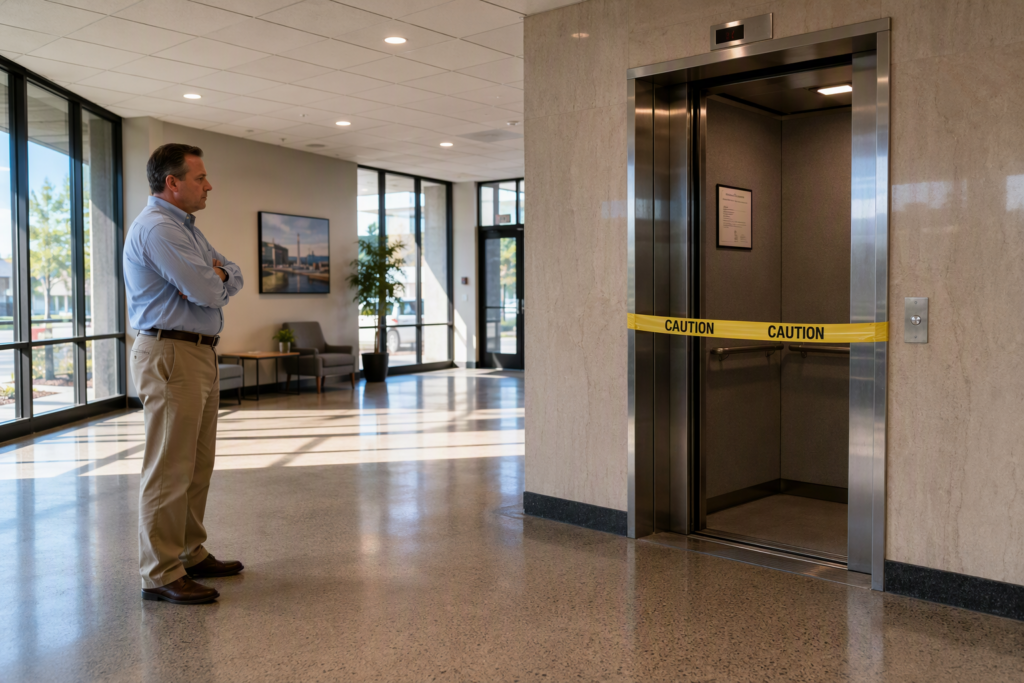
Quick Answer: Before signing an elevator maintenance contract, verify that it clearly defines scope of work, parts coverage, response time commitments, compliance with ASME A17.1 Safety Code for Elevators and Escalators and California inspection requirements, termination rights, and technician qualifications — any contract missing these terms creates legal and safety exposure for your property.

For California property managers, an elevator maintenance contract is one of the most consequential service agreements on the books. A poorly written contract can leave a building exposed to compliance violations, unexpected repair costs, elevator downtime, and liability claims. This guide breaks down every clause that matters, the red flags that signal a problematic vendor, and how to compare competing proposals before committing to a multi-year agreement.
—
What Are the Non-Negotiable Terms Every Elevator Maintenance Contract Must Include?
A compliant, protective elevator maintenance contract must contain the following core elements. If any of these are absent, request an amendment before signing.
- Defined scope of work: A line-by-line list of which components are included in routine maintenance (e.g., machine room equipment, door operators, control systems, safety devices) versus excluded.
- Parts and labor coverage: Explicit language stating which parts are covered under the base contract, which require additional purchase orders, and how labor billing works for repair calls outside routine visits.
- Inspection and compliance obligations: The contractor should commit to maintaining the elevator in conformance with ASME A17.1 Safety Code for Elevators and Escalators (new installations) and ASME A17.3 Safety Code for Existing Elevators and Escalators (existing equipment).
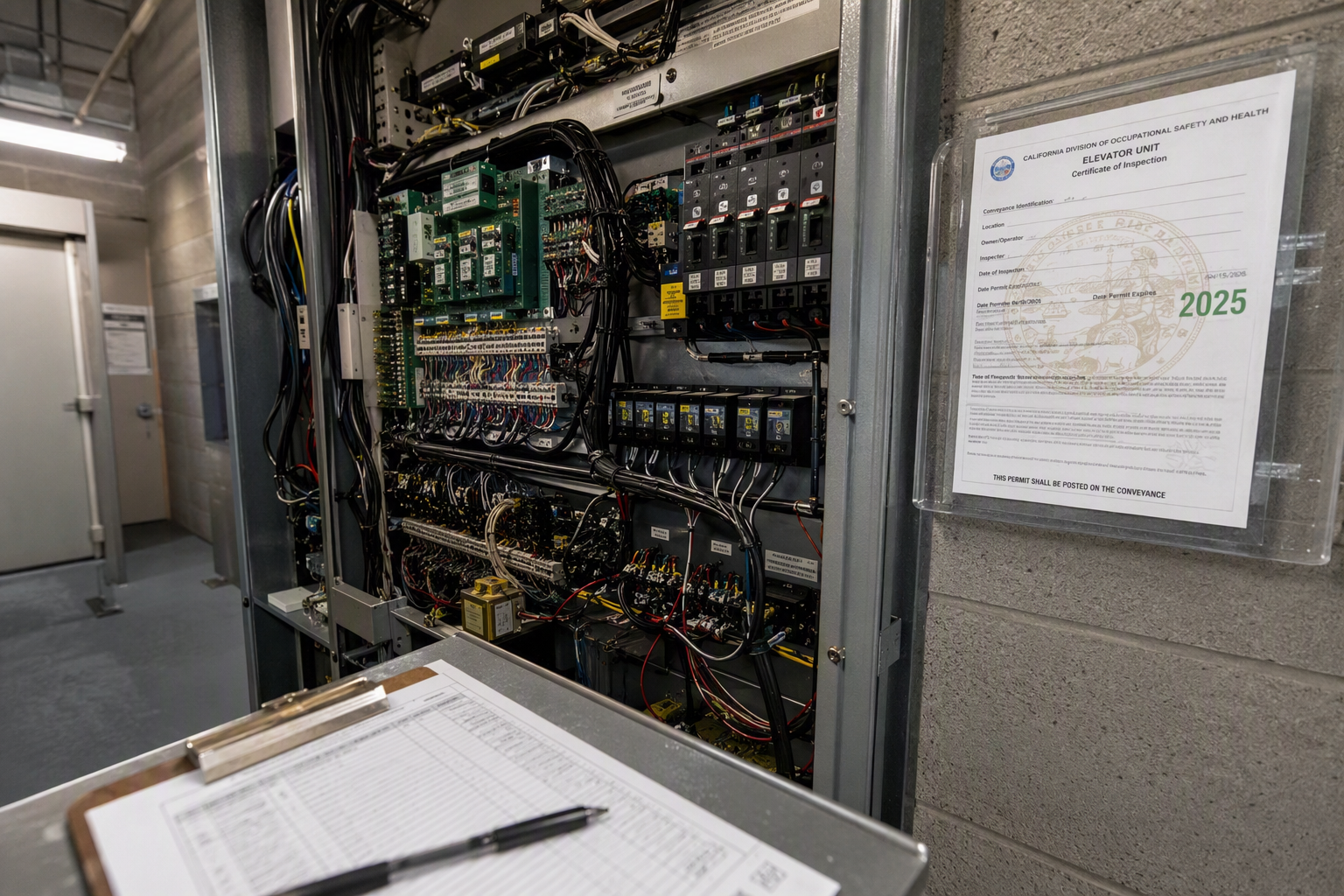
- Recordkeeping and reporting: Maintenance logs, inspection certificates, and violation correction records must be provided to the building owner upon request and retained on-site as required by California’s Division of Occupational Safety and Health (Cal/OSHA).
- Response time commitments: Written guarantees for emergency response, callback, and entrapment situations — not verbal promises.
- ADA compliance language: The contract should reference the vendor’s obligation to flag any accessibility concerns covered under the Americans with Disabilities Act.
- Insurance and indemnification: Proof of general liability and workers’ compensation insurance, plus indemnification clauses protecting the property owner from contractor negligence.
- Escalation and dispute resolution: A defined process for handling disputes, billing disagreements, or service failures.
- Termination for cause: Clear terms allowing the building owner to exit the contract without penalty if the vendor fails to perform.
—
What Are the Biggest Red Flags in an Elevator Maintenance Contract?
Certain contract provisions — or conspicuous omissions — signal that a vendor may not serve the property owner’s best interests. Property managers should treat the following as serious warning signs.
| Red Flag | Why It’s a Problem | What to Ask For Instead |
|---|---|---|
| Vague scope language (“all standard maintenance”) | Allows vendor to exclude major components at their discretion | Component-by-component inclusion/exclusion list |
| Proprietary parts clauses | Locks building into one vendor for all parts, often at inflated prices | Open-market parts access or itemized parts pricing schedule |
| Auto-renewal without written notice window | Contract renews indefinitely without owner awareness | 30–90 day written cancellation window before renewal date |
| No response time guarantees in writing | Verbal promises are unenforceable; entrapments have no guaranteed resolution window | Written emergency response commitments for entrapment and critical failures |
| Unlimited price escalation clauses | Annual cost increases with no cap expose the property to runaway expenses | Capped annual increase tied to a published index (e.g., CPI) |
| No exit clause for non-performance | Building is trapped in a contract even if the vendor fails to meet basic obligations | Termination for cause provision with a cure period |
| Exclusion of safety device testing | Safety devices (governors, buffers, safeties) are omitted from routine scope, creating compliance gaps | Explicit inclusion of all safety devices required by ASME A17.1/A17.3 |
| No mention of California inspection compliance | Vendor may not be coordinating with the local Authority Having Jurisdiction (AHJ) | Written commitment to coordinate mandatory periodic inspections with the AHJ |
—
How Do Full-Coverage, Partial-Coverage, and Examination-Only Contracts Compare?
Elevator maintenance contracts typically fall into three tiers. Understanding the trade-offs helps property managers select the right level of protection for their equipment age, budget, and risk tolerance.
| Contract Type | What’s Typically Covered | Common Exclusions | Best Suited For | Key Risk |
|---|---|---|---|---|
| Full-Coverage (Comprehensive) | Routine maintenance, labor, most parts, callbacks, minor adjustments | Vandalism, misuse, major modernization, cab interiors | Older equipment, high-traffic buildings, budget predictability | Contract may define “covered parts” narrowly — verify in writing |
| Partial-Coverage (Oil and Grease / Lubrication) | Routine lubrication, adjustments, safety tests | Most parts and labor for repairs | Newer equipment under manufacturer warranty, lower budgets | Repair costs are fully at-risk; can be expensive after year three |
| Examination-Only | Periodic inspection visits and written report | All maintenance, parts, labor | Buildings with in-house maintenance staff who handle minor work | Compliance gaps if in-house staff lack elevator-specific qualifications |
For most California commercial and multi-family residential properties, a full-coverage or partial-coverage contract with a qualified independent provider offers the most balanced risk profile.
—
What California-Specific Compliance Terms Should the Contract Address?
California elevator law is administered through Cal/OSHA’s Elevator Unit, which enforces inspection and permit requirements for most elevators in the state. A well-structured maintenance contract should address:
- Annual permit coordination: The vendor should assist the building owner in maintaining a current, valid operating permit by ensuring the elevator passes required periodic inspections.
- ASME A17.1 and A17.3 alignment: Both ASME A17.1 (new equipment) and ASME A17.3 (existing equipment) govern the safety standards that California-permitted elevators must meet. The contract should specify that maintenance is performed to these standards.
- Violation correction timelines: When an inspection results in a correction notice, the contract should define how quickly the vendor will remedy cited deficiencies and who bears the cost.
- ADA accessibility maintenance: Features required under the ADA — such as door timing, floor leveling accuracy, and audible signals — should be explicitly included in the maintenance scope.
- OSHA machine room safety: Vendor technicians working in machine rooms must comply with applicable OSHA safety standards; the contract should confirm the vendor’s responsibility for their workers’ compliance.
—
How Should Property Managers Compare Competing Vendor Proposals?
When evaluating multiple bids, a side-by-side comparison on standardized criteria prevents “apples to oranges” mistakes. Use this framework:
| Evaluation Criterion | What to Look For | Questions to Ask the Vendor |
|---|---|---|
| Scope clarity | Named components, not catch-all language | “Can you provide a component-level inclusion/exclusion list?” |
| Parts sourcing | Open-market access or transparent markup | “Are you a proprietary service provider for this equipment brand?” |
| Technician qualifications | Verifiable industry credentials; California licensing compliance | “Are your technicians licensed by Cal/OSHA’s Elevator Unit?” |
| Response commitments | Written, not verbal, emergency response terms | “Show me the response time language in the contract itself.” |
| Contract flexibility | Reasonable term length, clear exit provisions | “What happens if I need to exit the contract due to non-performance?” |
| Compliance support | Active coordination with California AHJ for inspections | “Who schedules and prepares for our annual state inspection?” |
| Pricing transparency | Fixed base fee with defined escalation cap | “What is the maximum annual price increase, and what index governs it?” |
| Insurance verification | Certificates of insurance on request, adequate limits | “Can you provide a certificate of insurance naming our property as additional insured?” |
—
What Steps Should a Property Manager Follow Before Signing an Elevator Maintenance Contract?
- Audit your existing equipment: Document the make, model, age, and current condition of every elevator on the property. This baseline protects you in disputes about pre-existing deficiencies.
- Pull the current inspection records: Request copies of the most recent California inspection certificate and any outstanding violation notices before the new vendor begins work.
- Request itemized proposals from at least two vendors: Standardized comparison prevents one vendor’s lower headline price from concealing narrower coverage.
- Have legal counsel review indemnification and insurance clauses: These provisions carry significant liability implications for the property owner.
- Verify technician licensing: Confirm that the vendor’s technicians hold current California credentials as required by the state’s elevator safety program.
- Confirm ASME code alignment in writing: Ask for a written statement that maintenance will be performed in accordance with ASME A17.1 and A17.3.
- Negotiate the termination clause before signing: Insist on a “termination for cause” provision with a defined cure period (typically 30 days) before penalties apply.
- Establish a maintenance log handover process: Require that all maintenance records are provided to the building owner in a portable format, not retained exclusively by the vendor’s internal system.
—
Why Does Proprietary Parts Language Matter So Much?
Some original equipment manufacturers (OEMs) and their affiliated service divisions use proprietary software or parts clauses to restrict building owners from switching service providers. Once locked into a proprietary contract, the property may face significant switching costs — including firmware access fees or voided warranties — if they attempt to hire an independent contractor.
An independent elevator service provider such as Liftech Elevator operates without OEM restrictions, meaning parts can be sourced competitively and the building owner retains full flexibility to change service providers at contract end without hardware or software penalties.
Before signing any contract, property managers should ask directly: “Does this contract restrict my ability to hire a different service provider at renewal, and does it include any proprietary software or parts exclusivity clauses?”
—
How Long Should an Elevator Maintenance Contract Term Be?
Contract term length is a negotiation point, not a fixed industry standard. Consider the following trade-offs:
| Term Length | Pros | Cons | Best For |
|---|---|---|---|
| 1 Year | Maximum flexibility; easy to switch vendors | May limit vendor investment in relationship; fewer pricing incentives | New vendor relationships; buildings evaluating service quality |
| 2–3 Years | Pricing stability; vendor more invested in long-term performance | Longer commitment; requires strong exit clauses | Established properties with predictable maintenance needs |
| 5+ Years | Potential for locked-in pricing; long-term relationship | Significant risk if vendor performance declines; hard to exit | Only appropriate with strong performance benchmarks and exit provisions written in |
Regardless of term length, every elevator maintenance contract should include a termination for cause clause, allowing the building owner to exit without penalty if the vendor fails to correct deficiencies within a defined cure period.
—
What Records Should a Vendor Provide Under a Maintenance Contract?
Recordkeeping is not optional in California — it is a compliance obligation. A properly structured contract should require the vendor to provide:
- A maintenance log for each elevator, updated after every visit
- Copies of all California inspection certificates and tags
- Written reports of any deficiencies found during routine visits
- Documentation of all parts replaced, including part descriptions and dates
- Correction records for any citations issued by the California AHJ
- Incident reports for any entrapment, injury, or equipment failure
Records should remain accessible to the building owner at all times — not held exclusively in the vendor’s portal or system. This is particularly important if the vendor relationship ends, as successor contractors will need historical maintenance data to service the equipment effectively.
—
Why Should California Property Managers Choose an Independent Elevator Service Provider?
Large OEM-affiliated service companies often prioritize proprietary equipment upgrades and long-term lock-in over the building owner’s flexibility and cost efficiency. An independent certified elevator service provider such as Liftech Elevator offers California property managers several structural advantages:
- No proprietary restrictions: Parts are sourced on the open market, keeping repair costs competitive and vendor switching straightforward.
- Accountability to the building owner: Independent providers depend on contract renewal through performance — not software lock-in — creating stronger incentives for quality service.
- California-specific expertise: Liftech Elevator operates exclusively in California, with direct familiarity with Cal/OSHA’s Elevator Unit requirements, local AHJ expectations, and ASME code compliance obligations specific to the state.
- Transparent contract terms: Independent providers are more likely to negotiate scope, parts coverage, and exit provisions — terms that OEM affiliates often treat as non-negotiable.
—
What Should Be Done If a Vendor Refuses to Modify Red-Flag Contract Language?
A vendor’s unwillingness to address legitimate contract concerns is itself a meaningful data point. If a vendor declines to:
- Provide a component-level scope list
- Add a termination for cause clause
- Cap annual price escalation
- Provide written response time commitments
- Confirm ASME code compliance in writing
…the property manager should treat that refusal as a signal to seek an alternative provider. Contract negotiations are standard practice in the elevator service industry. A vendor who treats basic protections as non-negotiable may be revealing how they approach service disputes as well.
Liftech Elevator encourages California property managers to bring any existing contract for review before renewal — understanding what is and is not covered is the first step toward protecting the property and its occupants.
—
Ready to Review Your Elevator Maintenance Contract?
Before you sign — or renew — your next elevator maintenance agreement, have a qualified independent provider review your current terms, equipment condition, and compliance status. Liftech Elevator serves California property managers with transparent, compliance-focused elevator service backed by a commitment to ASME code standards and California regulatory requirements.
Contact Liftech Elevator for a free elevator assessment: 562-609-3478
Need elevator service you can rely on? Liftech Elevator is ready to help.