How to Evaluate Whether Your Elevator Service Company Is Actually Performing the Maintenance They Are Billing You For
Property managers, building owners, and facilities directors across Signal Hill, Long Beach, Los Angeles, and Orange County invest significantly in elevator maintenance contracts — yet verifying that contracted work is actually being performed is one of the most overlooked responsibilities in building operations. This hub page answers the 20 most critical questions on the subject, with technical depth, applicable codes, and practical audit frameworks.
What Documentation Should an Elevator Service Company Provide After Every Maintenance Visit?
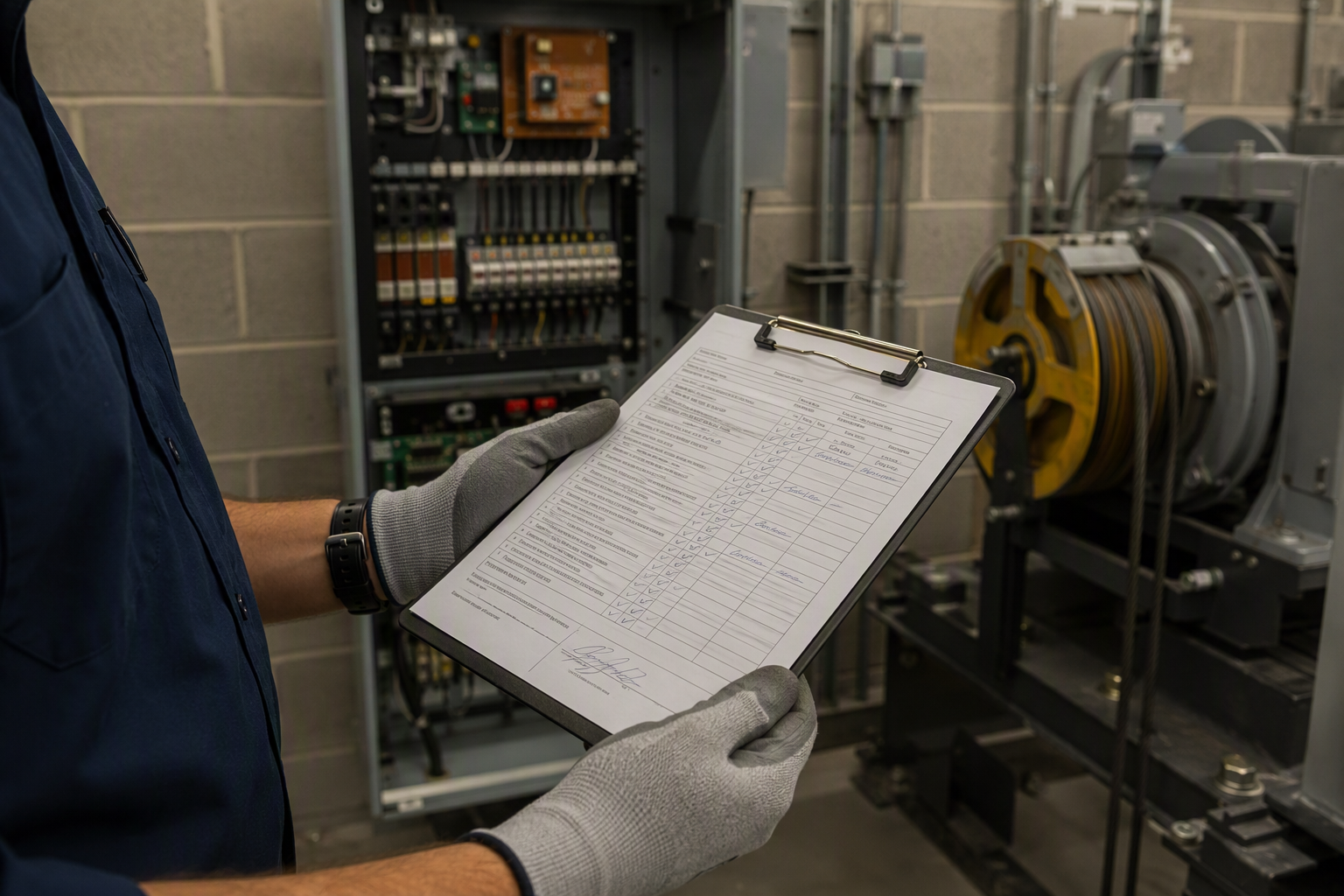
A legitimate elevator service company must provide a completed maintenance log or service report after every visit, signed by the technician, listing each task performed, parts inspected or replaced, and the equipment condition observed.
At minimum, a credible post-visit service report should include the date and time of arrival and departure, the unit number and location, a task-by-task checklist tied to the maintenance contract scope, notation of any deficiencies found, parts used or ordered, and the technician’s name and signature. If your current provider delivers only a generic one-line invoice, that is a significant red flag. California elevator maintenance standards, aligned with ASME A17.1 Safety Code for Elevators and Escalators, expect maintenance records to be detailed and retained. Ask to see your complete service history — a reputable company will provide it without hesitation.
What Does California Law Require Elevator Service Companies to Document?
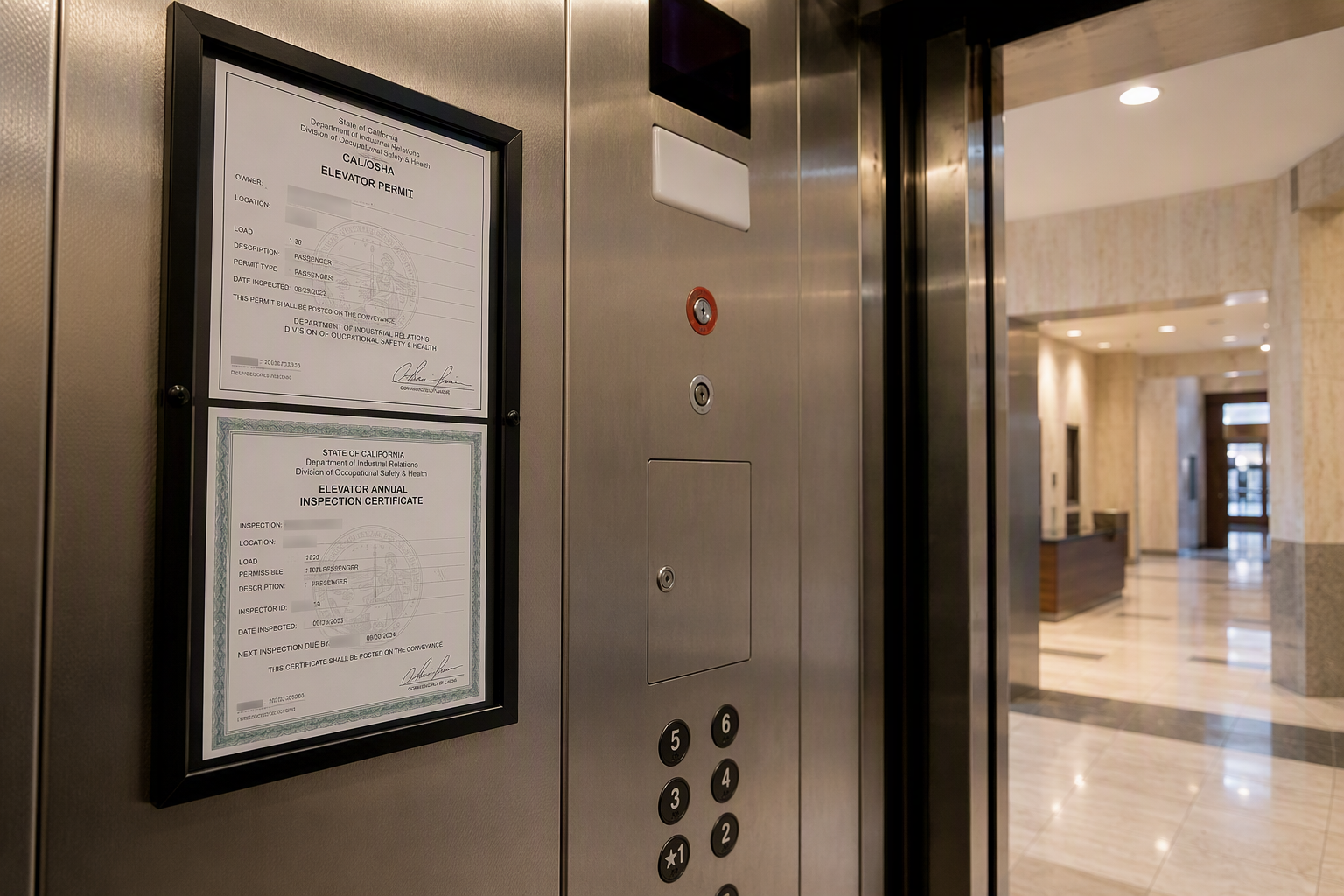
California requires that elevator maintenance and inspection records be maintained and available to the Authority Having Jurisdiction (AHJ), which in most California jurisdictions is the Division of Occupational Safety and Health (DOSH), commonly known as Cal/OSHA’s Elevator Unit.
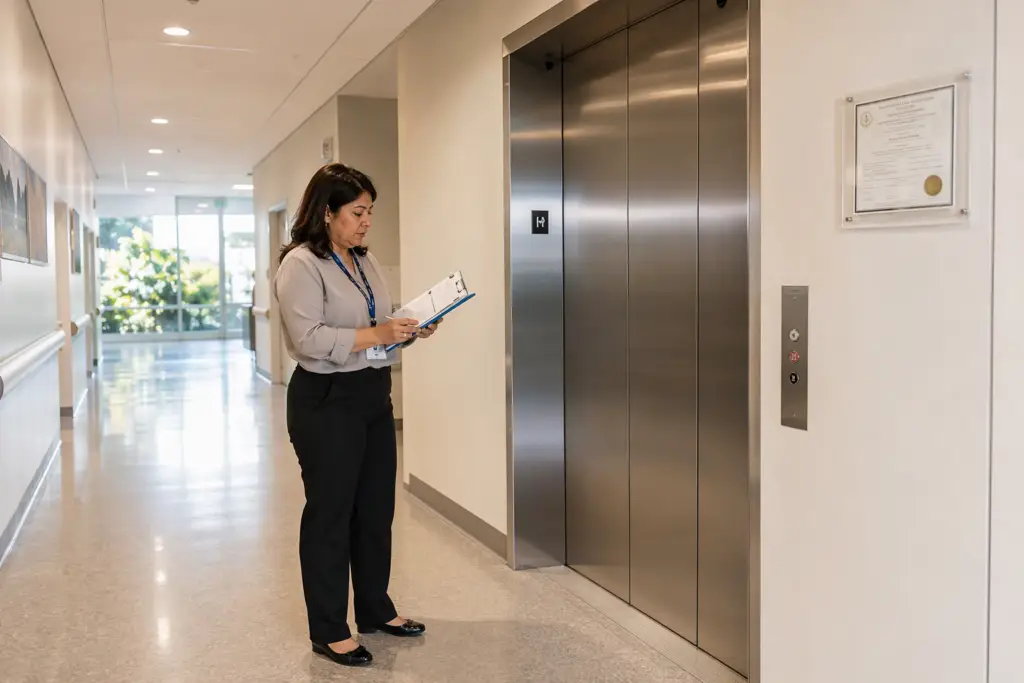
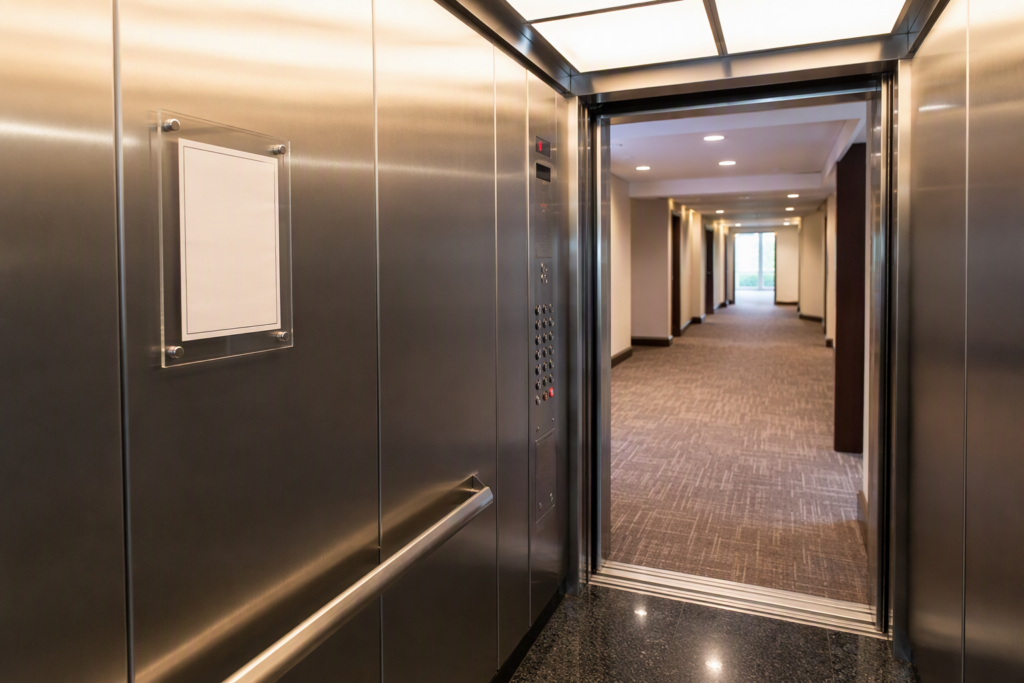
California elevator safety is governed through the California Department of Industrial Relations, Elevator Safety Unit, which enforces compliance with the state’s elevator safety orders. These safety orders incorporate ASME A17.1 Safety Code for Elevators and Escalators and ASME A17.3 Safety Code for Existing Elevators and Escalators as the baseline technical standards. Permits and inspection certificates must be posted inside the elevator cab and are renewed annually. If the certificate posted in your cab is expired or missing, your service company may be failing a fundamental obligation.
How Often Should Routine Elevator Maintenance Be Performed?
The frequency of routine maintenance depends on the elevator type, usage volume, and contract tier, but most commercial elevators under a full-service contract receive monthly maintenance visits as a baseline standard.
High-traffic elevators in commercial towers, hospitals, or busy residential buildings in Los Angeles or Orange County may require more frequent attention. Low-usage units in smaller buildings may operate on quarterly schedules for some components. Regardless of frequency, each visit should be documented. Cross-referencing your billing cycle against actual visit records is a primary method for detecting billing fraud or service neglect. If you are billed for twelve monthly visits annually but can only verify eight service logs, you have a documented discrepancy that warrants immediate escalation.
What Is a Maintenance Control Program and Why Does It Matter for Verification?
A Maintenance Control Program (MCP), required under ASME A17.1, is a written document that defines exactly which maintenance tasks must be performed, at what intervals, and how they must be recorded — making it the foundational tool for auditing whether your service company is meeting its obligations.
The MCP is not a marketing document — it is a technical compliance requirement. Your service company should provide you with the MCP specific to your elevator model and usage. This document will list every lubrication point, adjustment, test, and inspection interval required. When you receive a service report, compare the tasks listed against the MCP. If the MCP calls for monthly pit inspections and your logs show they were skipped, you have verifiable proof of a service gap. Liftech Elevator provides clients with clear MCP documentation so building owners always know what work is scheduled and can verify completion.
What Are the Warning Signs That Maintenance Is Not Being Performed as Billed?
Common warning signs include recurring equipment malfunctions, vague or templated service reports, technician visits shorter than the work scope requires, missing or expired inspection certificates, and an inability by the service company to produce a complete maintenance history.
Additional red flags include:
- Lubricant reservoirs that are dry or visibly depleted despite recent service billing
- Accumulated dust, debris, or rust in the pit, machine room, or on components that should be cleaned regularly
- Safety devices showing no evidence of recent testing
- Callback rates (repeat service calls for the same issue) that are disproportionately high
- Technicians who cannot answer basic questions about the elevator’s maintenance history when on-site
- Invoices that list labor time inconsistent with the complexity of the work claimed
Any combination of these signals warrants a formal audit or a consultation with an independent elevator consulting firm or a reputable local provider such as Liftech Elevator, which serves building owners across Long Beach, Signal Hill, Los Angeles, and Orange County.
How Can a Building Owner Conduct an Independent Audit of Elevator Maintenance Records?
An independent audit involves systematically comparing your contractual scope of work, the service company’s reported maintenance logs, California inspection records, and a physical inspection of the equipment to identify gaps between what was billed and what was actually performed.
Follow this step-by-step audit process:
- Gather your complete maintenance contract, including the scope of work and MCP appendix.
- Request a full chronological service log from your current provider covering the past 12 to 24 months.
- Cross-reference each log entry against your invoices to confirm visits billed match visits documented.
- Contact the California Department of Industrial Relations, Elevator Safety Unit, to verify that your elevator’s permit and most recent state inspection are current.
- Physically inspect the elevator cab for a current, posted inspection certificate.
- Arrange a walkthrough with an independent elevator technician or a competing provider to assess the physical condition of the pit, machine room, and car components against what a properly maintained unit should look like.
- Document all findings in writing and present discrepancies to your current service company for explanation, with a deadline for response.
- If discrepancies are unresolved, file a complaint with the California Department of Industrial Relations and consult legal counsel regarding contract remedies.
What Physical Conditions Indicate a Specific Maintenance Task Was or Was Not Completed?
Specific equipment conditions serve as physical evidence of whether maintenance tasks were actually performed — dry guide rail lubricators, contaminated hydraulic fluid, corroded pit components, and unlubricated rope sheaves are all indicators of neglected service.
| Component | Expected Condition After Proper Maintenance | Indicator of Neglect | Relevant Standard |
|---|---|---|---|
| Guide Rails | Lightly coated with appropriate lubricant, no scoring | Dry, scored, or corroded rail surfaces | ASME A17.1 |
| Elevator Pit | Clean, dry, lit, with functional sump pit if required | Standing water, debris accumulation, burned-out lighting | ASME A17.1 |
| Hydraulic Fluid | Clean, at correct level, no contamination | Dark, foamy, or low fluid; oil leaks on cylinder or unit | ASME A17.1 |
| Hoist Ropes | Proper tension, no broken wires, correctly lubricated | Visible broken strands, dry ropes, uneven tension | ASME A17.1 |
| Door Operator | Smooth operation, proper force adjustment, clean tracks | Jerky movement, excessive noise, misaligned panels | ASME A17.1 |
| Safety Devices (Governor, Safeties) | Evidence of periodic test notation in logs | No test record, corroded components, missing seals | ASME A17.1 |
| Machine Room | Clean, temperature-controlled, organized, secure | Excessive heat, clutter, oil stains, unsecured access | ASME A17.1 |
| Cab Interior / ADA Features | Functioning Braille, lighting, emergency phone, handrails | Non-functional emergency phone, missing Braille, burned-out lighting | ADA |
How Do Full-Service Contracts Differ From Oil-and-Grease Contracts, and Why Does It Matter for Verification?
A full-service contract covers parts, labor, and repairs as part of the monthly fee, while an oil-and-grease (or lubrication-only) contract covers basic lubrication and adjustment only — understanding the difference is essential to knowing what you should actually be verifying during each visit.
Many billing disputes arise because building owners assume they have full coverage when they have a limited contract, or vice versa. Review your contract type carefully. Under a full-service agreement, you should never receive additional invoices for routine wear items such as door contacts, rollers, or buffers. Under an oil-and-grease agreement, those items are billed separately. If your contract specifies tasks that are not appearing in service reports, the omission is a billable discrepancy regardless of contract tier.
What Role Do California State Inspections Play in Verifying Elevator Maintenance Quality?
California state elevator inspections conducted by the Department of Industrial Relations serve as an independent, government-level verification of elevator safety and compliance — and inspection reports are an invaluable tool for identifying maintenance failures your service company may not have disclosed.
California elevators are subject to periodic inspections by state-certified inspectors. The resulting inspection report will note any violations, deficiencies, or orders to correct. If a state inspection finds issues that your service company’s own reports claimed had been addressed, you have documented evidence of falsified or incomplete maintenance reporting. Request copies of all state inspection reports for your unit’s history. These are public records tied to your elevator’s permit number and can be requested through the California Department of Industrial Relations.
What Questions Should You Ask a Prospective Elevator Service Company Before Signing a Contract?
Before signing any elevator maintenance contract, building owners should ask specific questions about documentation practices, MCP availability, technician accountability, and the process for handling discovered deficiencies — the answers reveal whether the company prioritizes transparency.
Key questions to ask include:
- Will you provide a written Maintenance Control Program specific to my equipment?
- What documentation will I receive after every maintenance visit?
- How do you handle deficiencies found during maintenance — are they reported immediately and in writing?
- Can I access my complete maintenance history at any time?
- Are your technicians licensed by the State of California?
- How do you document safety device testing and what records are retained?
- What is your escalation process if I believe maintenance is not being performed as contracted?
A company that provides clear, confident answers to all of these questions — and is willing to put accountability provisions in the contract — is operating with a level of transparency that protects both parties.
How Does Elevator Callback Rate Indicate Maintenance Quality?
Callback rate — the frequency with which a service company is called back to address recurring malfunctions between scheduled visits — is a measurable performance indicator directly tied to the thoroughness of preventive maintenance being performed.
A high callback rate on a well-maintained elevator is statistically improbable. If your elevator is generating frequent service calls for the same recurring issues — nuisance door faults, leveling problems, or controller errors — despite regular billing for preventive maintenance, it suggests that the root cause is not being addressed during scheduled visits. Track every callback by date, issue reported, and resolution provided. Compile this data over a rolling 12-month period and compare it to your maintenance log. Persistent callbacks combined with clean maintenance reports is a contradiction that warrants direct investigation.
What Should Be Included in a Credible Elevator Maintenance Contract to Protect Building Owners?
A credible elevator maintenance contract should include a detailed scope-of-work schedule, a Maintenance Control Program reference, documentation delivery obligations, deficiency reporting requirements, performance benchmarks, and clear remedies for non-performance.
Protective contract provisions to look for or negotiate include:
- A clause requiring written service reports within a defined period after each visit
- An explicit list of covered components and tasks
- A requirement that deficiencies be reported in writing to the building owner on the day of discovery
- Provisions for independent audits at the building owner’s request
- Liquidated damages or service credits for missed scheduled visits
- Clear termination clauses if documented performance failures occur
Are Elevator Technicians in California Required to Be Licensed?
Yes — elevator mechanics and constructors in California are required to hold valid state certification, and verifying that the technician servicing your equipment holds a current California-issued license is a fundamental step in vetting your service company.
California elevator technician licensing is administered through the Department of Industrial Relations. Only certified individuals are legally authorized to perform elevator maintenance, repair, and construction work on California elevators. Building owners can request proof of licensing from their service provider and may verify certification status through the California Department of Industrial Relations. If a company cannot provide license verification for the technicians it assigns to your property, this represents a serious compliance and liability risk, and warrants immediate reconsideration of the service relationship.
How Should Building Owners Handle a Situation Where They Suspect Billing Fraud?
When billing fraud is suspected, building owners should immediately secure all documentation, cease verbal-only communications with the service company, issue a formal written inquiry, and simultaneously consult with an independent elevator professional and legal counsel.
Follow these steps in sequence:
- Preserve all invoices, service reports, contracts, and correspondence — do not discard any documents.
- Send a formal written request to the service company demanding a complete, chronological maintenance log.
- Commission an independent physical inspection of the elevator by a qualified, unaffiliated party.
- Compare the independent inspection findings against the service company’s reported maintenance records.
- If fraud is substantiated, file a complaint with the California Department of Industrial Relations and the California Contractors State License Board as applicable.
- Consult with an attorney experienced in commercial contracts to evaluate breach of contract, fraud, and potential recovery options.
- Issue a notice of termination in accordance with the contract’s termination provisions and engage a replacement service provider.
What ADA Compliance Obligations Does Elevator Maintenance Affect?
Elevator maintenance directly affects ADA compliance, because the Americans with Disabilities Act requires that accessible elevators remain operational and that accessibility features — including Braille controls, audio announcements, and cab dimensions — are maintained in working condition.
Under the ADA, buildings that are required to provide accessible elevator service must maintain that service in operable condition. Excessive elevator downtime or failure to maintain accessibility features such as visible and audible door signals, Braille and raised characters on controls, and functional emergency communication systems can expose building owners to ADA complaints and legal liability. A maintenance company that does not specifically address ADA feature functionality in its service reports may be leaving building owners exposed. Verify that ADA-related features are explicitly covered in your maintenance contract and appear on service checklists.
How Can Technology Help Building Owners Verify Elevator Maintenance in Real Time?
Modern elevator systems and remote monitoring platforms can provide building owners with real-time data on equipment status, fault codes, and service activity — offering a technology-based layer of verification that complements traditional documentation review.
Many contemporary elevator controllers generate digital fault logs that record error codes, door cycle counts, and operational anomalies with timestamps. Some service platforms provide building owners with online portals where maintenance activity and equipment status are logged in real time. If your elevator system is capable of remote monitoring and your service company does not offer or discuss this capability, it is worth inquiring about. Independent third-party monitoring solutions are also available and can provide an unbiased data record of equipment behavior between maintenance visits — a record your service company cannot alter.
What Is the Difference Between Preventive Maintenance and Corrective Maintenance, and How Does Each Appear on an Invoice?
Preventive maintenance refers to scheduled, proactive service designed to prevent failures, while corrective maintenance addresses specific defects or failures that have already occurred — and distinguishing between the two on invoices is essential for verifying that you are receiving the service you contracted for.
Under a full-service contract, corrective maintenance for covered components should be included at no additional charge. Under limited contracts, corrective work generates separate billable events. If invoices are blending these categories — billing you separately for work that should fall within the preventive maintenance scope — you may be overpaying. Request that all invoices categorize work explicitly as preventive or corrective, identify the specific component addressed, and reference the contract clause under which the work was performed or billed separately.
How Does an Elevator Assessment by an Independent Provider Differ From a Regular Maintenance Visit?
An independent elevator assessment is a comprehensive, unbiased evaluation of the equipment’s condition, maintenance history, and compliance status conducted by a provider with no financial stake in the current maintenance contract — making it fundamentally more objective than a visit by the incumbent service company.
Independent assessments typically include a full machine room, pit, and cab inspection; a review of available maintenance records; identification of deferred maintenance or code deficiencies; and a written report with findings and recommendations. This type of assessment is particularly valuable when a building owner is evaluating a new property acquisition, considering a service provider change, or has specific concerns about whether current maintenance obligations are being met. Liftech Elevator offers free elevator assessments to building owners in Signal Hill, Long Beach, Los Angeles, and Orange County, providing an objective baseline evaluation with no obligation.
How Should Building Owners Transition Elevator Service Providers When Dissatisfied?
Transitioning elevator service providers requires careful contract review for termination clauses, a physical condition assessment of the equipment, and a structured handoff of maintenance records — all of which protect the building owner and the incoming service company from inherited liability.
Follow this transition process:
- Review your existing contract for termination notice requirements and any proprietary parts clauses that may affect the incoming provider’s ability to service the equipment.
- Issue a formal written notice of termination in compliance with the contract terms.
- Request the return of all maintenance records, MCP documentation, and any equipment-specific materials held by the outgoing provider.
- Schedule an independent assessment with the prospective new provider before the transition date to document existing equipment condition.
- Ensure the incoming provider reviews all available maintenance history before the first service visit.
- Confirm that the new provider will establish a fresh, properly documented MCP for your equipment.
- Notify the California Department of Industrial Relations of the service provider change as required for permit and certification continuity.
What Ongoing Best Practices Should Building Owners Follow to Continuously Verify Elevator Maintenance Quality?
Ongoing verification of elevator maintenance quality requires systematic record-keeping, periodic independent audits, active engagement with state inspection outcomes, and a standing expectation of written documentation from the service provider after every visit.
Building owners who maintain the highest standard of oversight typically implement the following practices on a continuous basis:
- Maintain a dedicated elevator maintenance file with all service reports, invoices, and inspection records organized chronologically
- Review each service report against the MCP within a week of receipt and flag any uncompleted items in writing
- Track callback frequency monthly and compare against historical baselines
- Verify that the cab certificate of inspection is current every time they or their staff use the elevator
- Commission an independent assessment at least annually, particularly for high-usage units
- Establish a direct communication channel with the assigned service technician and their supervisor for immediate escalation of concerns
- Include elevator maintenance performance as a standing agenda item in property management reviews
Building owners throughout Los Angeles and Orange County who work with Liftech Elevator receive detailed, itemized service documentation after every visit, making these verification practices straightforward to implement and sustain.
Get an Independent Elevator Assessment From Liftech Elevator
If you have questions about whether your current elevator service company is delivering the maintenance you are paying for, do not wait for a state inspection or a mechanical failure to find out. Liftech Elevator provides free elevator assessments for building owners and property managers in Signal Hill, Long Beach, Los Angeles, and Orange County — with transparent, documented evaluations of your equipment’s condition and maintenance compliance status.
Our team works with all major elevator makes and models, operates in full compliance with ASME A17.1 Safety Code for Elevators and Escalators and California state elevator safety requirements, and provides every client with clear Maintenance Control Program documentation and detailed post-visit service reports.
Contact Liftech Elevator for a free elevator assessment: 562-609-3478
Need elevator service you can rely on? Liftech Elevator is ready to help.