What Questions Should I Ask Elevator Companies Before Hiring One for Maintenance or Modernization?
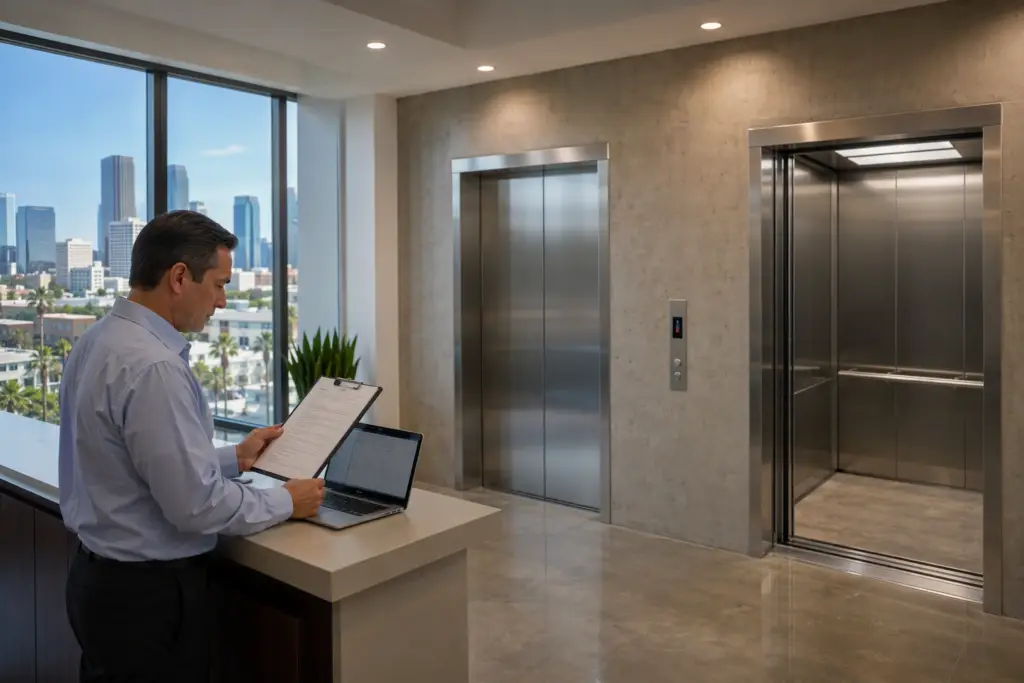
Building owners and facilities managers in Signal Hill, Long Beach, Los Angeles, and Orange County face a critical decision when selecting an elevator service company. The wrong choice can mean failed inspections, costly downtime, liability exposure, and safety risks for passengers. The right set of questions asked upfront protects the building, its occupants, and the owner’s investment. This hub page covers every question worth asking — organized by topic — so that any property manager can evaluate elevator contractors with confidence.
Is the elevator company licensed to work in California?
In California, elevator contractors must hold the appropriate license issued through the California Contractors State License Board (CSLB), and all elevator mechanics must be certified under California law — an unlicensed contractor exposes the building owner to liability and voids insurance coverage.
California requires elevator mechanics to be certified, and elevator contractors must carry a valid CSLB license. Before signing any agreement, ask for the contractor’s CSLB license number and verify it directly at the CSLB website. Also confirm that the company’s mechanics hold current California Elevator Mechanic Certification. Working with an unlicensed or uncertified company can result in failed inspections, unenforceable warranties, and significant legal exposure for the building owner. This is a non-negotiable first question for any property in Los Angeles, Long Beach, Signal Hill, or Orange County.
Which safety codes does the company work to, and how current is their knowledge?
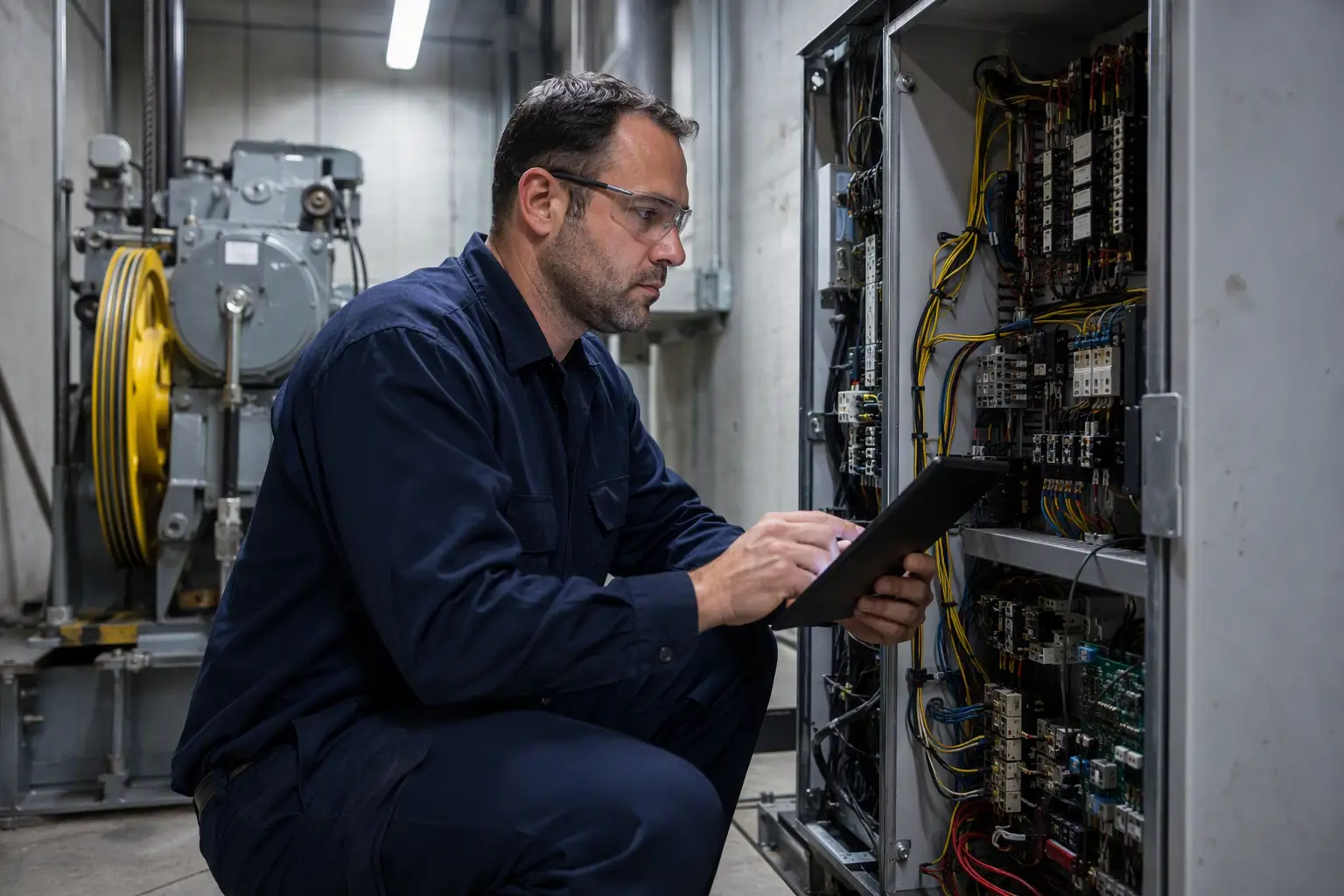
Elevator companies in California must work in compliance with the ASME A17.1 Safety Code for Elevators and Escalators for new installations and modernizations, and the ASME A17.3 Safety Code for Existing Elevators and Escalators for existing equipment — companies unfamiliar with the current editions of these standards should not be hired.
The ASME A17.1 and A17.3 codes are the foundational safety standards governing elevator design, installation, inspection, testing, and alteration throughout California. A qualified contractor should be able to discuss these codes by name, explain how they apply to a specific building’s equipment, and demonstrate awareness of the most recently adopted edition. Ask the company explicitly: “Which edition of ASME A17.1 and A17.3 are you currently working to, and has the local Authority Having Jurisdiction (AHJ) adopted that edition?” In California, the AHJ is typically the Division of Occupational Safety and Health (Cal/OSHA) Elevator Unit. A contractor who cannot answer this question clearly lacks the technical depth necessary for compliant work.
Does the company have experience with ADA compliance retrofits?
Any elevator company working on existing equipment should understand how ADA (Americans with Disabilities Act) requirements apply to elevator controls, cab dimensions, door timing, and audio/visual signals — gaps in ADA compliance can expose building owners to federal complaints and costly retroactive modifications.
The ADA establishes minimum accessibility standards for elevators in public accommodations and commercial facilities. When modernizing or modifying an elevator, the project may trigger ADA requirements around control panel height, Braille markings, audible indicators, door reopening devices, and cab leveling accuracy. Ask the contractor whether they will assess the existing installation for ADA compliance as part of any modernization scope, and whether they have completed similar ADA retrofit projects on comparable buildings. Liftech Elevator incorporates ADA compliance review into its modernization assessments for clients across Los Angeles, Long Beach, Signal Hill, and Orange County.
What does the maintenance contract actually include?
Maintenance contracts vary enormously between companies — a thorough contract should specify inspection frequency, lubrication schedules, parts coverage, exclusions, callback procedures, and documentation requirements, not merely promise “full maintenance.”
The phrase “full maintenance” or “comprehensive maintenance” is not standardized in the elevator industry. One contractor’s full maintenance may exclude major components such as controllers, motors, or hydraulic cylinders, while another’s includes them. Before signing, request a written list of every included task, every excluded component, and the precise intervals at which each service is performed. Ask specifically: “Does this contract cover parts and labor for all mechanical and electrical components? What is excluded?” Also ask whether the contract includes mandatory periodic inspections and the filing of inspection certificates with the AHJ — this is a compliance requirement, not optional.
How does the company handle state-mandated inspections and permits?
California requires periodic safety inspections of elevators by a licensed inspector, and the elevator service company should manage the permit application and inspection scheduling process on the building owner’s behalf — failure to maintain a current inspection certificate can result in an order to cease operation.
In California, the elevator owner is legally responsible for ensuring the unit is inspected and that a valid Certificate of Compliance is posted in the car. A reputable elevator company will proactively schedule inspections, coordinate with the AHJ or a Qualified Elevator Inspector (QEI), and notify the building owner of any deficiencies identified during inspection. Ask the company: “Do you manage the inspection scheduling process? Will you notify us of upcoming inspection deadlines? If a deficiency is found, how quickly can you correct it?” A company that places the entire administrative burden on the building owner is a red flag.
What is the company’s approach to modernization — and how do they assess the scope?
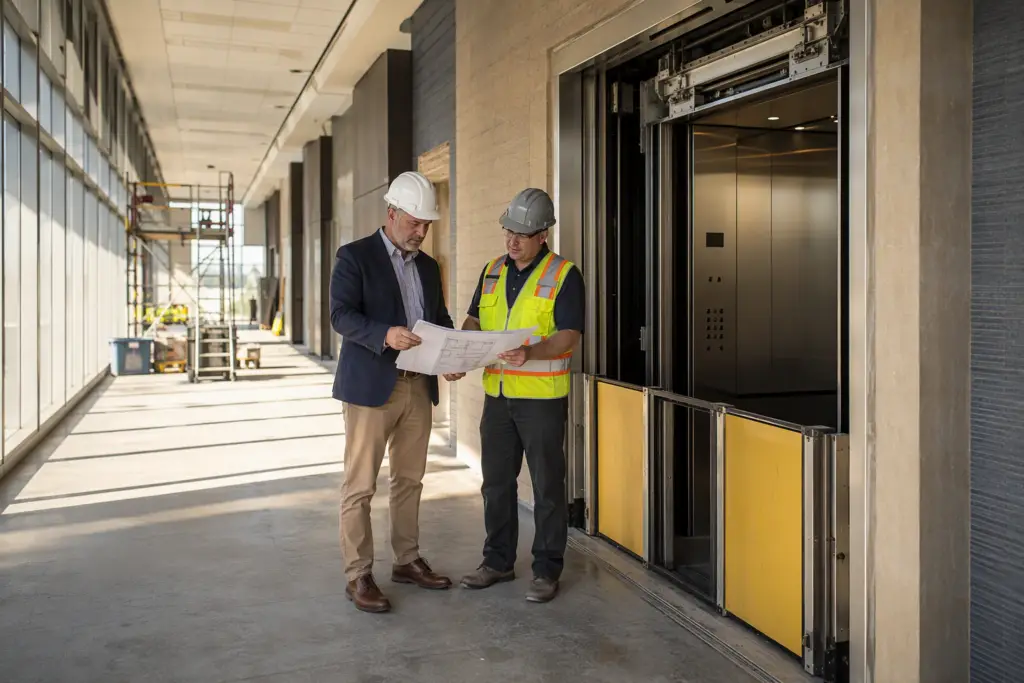
A qualified elevator company will conduct a formal condition assessment of the existing equipment before recommending any modernization scope, rather than proposing a standard package without evaluating the specific installation.
Elevator modernization is not one-size-fits-all. The appropriate scope depends on the age and condition of the controller, drive system, motor, cab interior, door operator, safety devices, and fixtures. A thorough modernization assessment should examine each subsystem and produce a written report ranking components by urgency. Ask the company: “Will you provide a written condition assessment before proposing a modernization scope? Can you explain why each recommended component is included?” Modernization projects that comply with ASME A17.1 must also address any safety code upgrades triggered by the alteration. Liftech Elevator provides written modernization assessments for properties throughout Los Angeles County and Orange County before any scope of work is finalized.
How are replacement parts sourced, and what is the expected lead time?
Parts sourcing strategy directly affects repair turnaround time — ask whether the company stocks common parts locally, maintains relationships with OEM suppliers, and what their typical lead time is for hard-to-source components on older equipment.
Older elevator equipment — particularly units installed before the 1990s — may rely on obsolete or proprietary components that are no longer manufactured by the original OEM. A company with strong sourcing relationships and local parts inventory can dramatically reduce downtime compared to a contractor who orders every part on demand. Ask specifically: “Do you carry a local parts inventory? How do you source components for equipment of this age and manufacturer?” Also ask about their protocol when a part is on back-order — do they have a plan to keep the elevator operational or provide a temporary solution while waiting?
What is the company’s emergency callback process?
When an elevator fails or a passenger becomes trapped, the company’s emergency response protocol matters as much as their routine maintenance quality — ask for a clear explanation of their callback procedure, including how calls are received and dispatched after business hours.
Elevator entrapments and unexpected failures do not occur on a schedule. A reputable elevator company should have a documented emergency callback process that includes a dedicated service line, qualified dispatching, and a clear escalation path when the first available technician cannot resolve the issue. Ask the company to walk through exactly what happens from the moment an emergency call is placed: Who answers? How is a technician dispatched? What information does the technician receive before arriving? Building owners in Signal Hill and Long Beach should also confirm that the company’s technicians are familiar with local buildings and can navigate to the site efficiently.
Can the company provide verifiable references from comparable properties?
References from property managers or building owners who operate similar equipment — in terms of building type, elevator age, and use — are the most reliable external validation of a contractor’s capability and service quality.
Generic references are of limited value. Ask for references specifically from buildings with similar characteristics: a commercial office tower, a mid-rise residential building, a healthcare facility, or whatever matches the property in question. Request the name, title, and contact information of the facilities manager or property manager — not just a company name. When speaking with references, ask: “How responsive is the company when issues arise between scheduled maintenance visits? Have they ever missed a state inspection deadline? How did they handle a situation where a repair took longer than expected?” Verifiable references are a strong signal of a company’s actual track record.
What documentation does the company provide after each service visit?
Professional elevator companies provide written service reports after every maintenance visit, documenting what was inspected, what was lubricated or adjusted, what was found, and any recommended repairs — this documentation is essential for regulatory compliance and liability protection.
Service documentation serves multiple functions: it demonstrates due diligence to inspectors and insurers, creates an audit trail for warranty claims, and helps building management track recurring issues. Ask to see a sample service report before signing a contract. The report should include the date, technician’s name and certification number, a checklist of tasks performed, any abnormal findings, and a clear notation of recommended follow-up work. Ask the company: “How is service documentation delivered to us? Is it available digitally? How long do you retain records?” A company that cannot produce organized service records is a compliance risk.
How does the company price modernization projects — and what does the proposal include?
A credible modernization proposal should be itemized by scope element, specify the equipment brands and models being installed, include a project timeline with milestones, and clearly state what is and is not included in the contract price.
Comparing elevator modernization quotes is difficult when proposals are presented at different levels of detail. A lump-sum proposal with no line-item breakdown makes it impossible to evaluate whether the price reflects the work required. Ask the company to break out the cost by major scope elements — controller replacement, drive system, cab renovation, door operators, and so on. Ask which brands and models of components are being specified, and whether alternatives are available at different price points. Also clarify: “Is permit and inspection fees included? Is the cost of temporary loss-of-service included in your timeline estimate?” These details prevent costly surprises mid-project.
What is the expected timeline for a modernization project, and how is building disruption managed?
Modernization timelines vary significantly based on scope, parts lead times, and permit processing — a qualified contractor will provide a realistic project schedule and a clear plan for minimizing disruption to building occupants during the work.
In a multi-story building, elevator downtime during modernization directly affects occupants, particularly in residential buildings, healthcare facilities, and commercial towers. Ask the company to provide a detailed project schedule showing the sequence of work, expected permit processing time with the AHJ, and any milestones that could shift the timeline. Ask how they communicate with building management when delays occur. For buildings with a single elevator, ask whether temporary vertical access solutions are available or recommended during the outage period. A contractor who cannot answer these questions with specifics is likely underestimating the project complexity.
Does the company carry adequate insurance coverage?
Any elevator company working on a building should carry general liability insurance, workers’ compensation insurance, and — depending on the scope — professional liability coverage, with the building owner named as an additional insured on the general liability policy.
Insurance requirements for elevator contractors are not optional — they protect building owners from liability if a technician is injured on site or if a maintenance error causes property damage or passenger injury. Ask the company for a current certificate of insurance and verify that coverage limits are appropriate for the scope of work. For modernization projects, limits should be substantially higher than for routine maintenance visits. Also ask: “Will you name our ownership entity as additional insured on your general liability policy?” A contractor who resists this standard request should be disqualified from consideration.
What elevator brands and systems does the company service?
Elevator companies may have strong expertise with certain manufacturers and limited experience with others — building owners should confirm that the contractor has documented experience servicing the specific brand, model, and generation of equipment installed in their building.
The elevator industry includes a wide range of equipment manufacturers, including both major OEMs and independent brands. Some service companies are factory-authorized by specific manufacturers; others are independent contractors. Both models can produce excellent outcomes, but the company must be able to demonstrate actual experience with the equipment in question — not just claim general capability. Ask: “How many units of this brand and model generation are currently in your service portfolio? Have your technicians received manufacturer training on this equipment?” For older proprietary systems, this question is especially important.
How does the company stay current on code changes and safety bulletins?
Elevator safety codes and manufacturer safety bulletins are updated periodically, and a responsible contractor should have a defined process for tracking changes to ASME A17.1 and A17.3 and ensuring that their technicians are trained on current requirements.
Code compliance is not static. New editions of ASME A17.1 and A17.3 are issued periodically, and California’s AHJ adopts updated editions on its own schedule. Manufacturers also issue safety bulletins that may require field modifications on specific equipment. Ask the company: “How do your technicians stay current on code changes? Is there a formal training program? When did your team last complete code-related training?” A company that relies solely on technicians’ existing knowledge without ongoing education is a compliance risk, particularly for properties that undergo modernization — which triggers a comprehensive code compliance review under ASME A17.1.
What is the process for handling a failed inspection?
When an elevator fails a state inspection, the building owner faces an order to cease operation — a qualified service company should have a clear, documented protocol for addressing deficiencies quickly and returning the unit to service with full documentation.
Inspection failures are not uncommon, particularly on aging equipment. The critical factor is how the service company responds. Ask the company to walk through their process: “If our elevator fails inspection, what happens next? Who contacts us, and how quickly? How do you prioritize the corrective work? How do you coordinate the re-inspection with the AHJ?” A company with a defined, practiced protocol for this scenario demonstrates operational maturity. Ask also whether corrective work following an inspection failure is covered under the maintenance contract or billed separately — this affects the total cost of ownership significantly.
Does the company subcontract any work, and how is subcontractor quality managed?
Some elevator companies subcontract portions of their work — particularly cab renovation, electrical work, or modernization labor — and building owners should understand which portions will be self-performed versus subcontracted, and how subcontractor qualifications are verified.
Subcontracting is not inherently problematic, but it introduces a layer of quality and accountability risk. A primary contractor who subcontracts core elevator work without adequate oversight may not be able to guarantee the quality of that work or take full responsibility when problems arise. Ask: “Will all mechanical and electrical elevator work be performed by your own certified mechanics? If any work is subcontracted, how do you verify the subcontractor’s California licensing and insurance?” Also clarify who is the responsible party for warranty claims on subcontracted work. This question is particularly relevant for full modernization projects where multiple trades may be involved.
How does the company communicate with building management on an ongoing basis?
Clear, consistent communication between the elevator service company and building management is essential for coordinating scheduled maintenance, tracking outstanding repairs, and ensuring that decision-makers are informed before problems escalate.
Poor communication is one of the most common complaints building owners have about elevator service companies — not technical failures, but administrative ones: missed appointments with no notice, repair recommendations that never made it to the person with budget authority, or inspection deadlines that passed unacknowledged. Ask the company: “Who is our primary point of contact? How do we reach them? How will you notify us when scheduled maintenance is coming? How do you communicate repair recommendations — verbally, in writing, or through a digital platform?” Liftech Elevator serves property managers across Long Beach, Los Angeles, Signal Hill, and Orange County who expect consistent, professional communication as part of the service relationship.
What should I expect during the initial assessment visit?
A professional elevator company should conduct an initial site assessment that includes a physical inspection of the machine room, pit, hoistway, cab, and all accessible components before providing any proposal — a company that quotes without a site visit cannot provide an accurate proposal.
The initial assessment visit is an opportunity to evaluate the contractor as much as to gather information about the equipment. A thorough assessor will examine the following in a structured order:
- Review the existing inspection certificate and any outstanding violations or conditions noted by the AHJ.
- Inspect the machine room for cleanliness, equipment condition, oil leaks, controller condition, and code compliance.
- Examine the pit for water intrusion, pit lighting, stop switch functionality, and cleanliness per code requirements.
- Evaluate hoistway components including ropes or hydraulic cylinders, guide rails, and safety devices.
- Assess the cab interior, including fixtures, floor leveling accuracy, door operation, and ADA compliance of controls.
- Operate the elevator through its full range of travel, noting ride quality, leveling, door timing, and any anomalies.
- Produce a written summary of findings and a prioritized recommendation list before leaving the site.
A contractor who conducts a brief walk-through and provides a quote on the spot, without a written findings report, has not completed a genuine assessment. Ask what written deliverable you will receive from the initial visit before agreeing to it.
How do elevator service companies compare on key evaluation criteria?
The following table provides a benchmark framework for comparing elevator service companies across the criteria most relevant to building owners in California — use it as a scoring guide when evaluating multiple contractors.
| Evaluation Criteria | Minimum Acceptable Standard | Best-Practice Standard | Red Flag |
|---|---|---|---|
| California Contractor Licensing | Valid CSLB license, verifiable online | Current license with no disciplinary history | Cannot provide license number |
| Mechanic Certification | California-certified mechanics | Ongoing manufacturer and code training documented | Unable to confirm certification status |
| Code Knowledge | Familiarity with ASME A17.1 and A17.3 | Ability to cite current edition and local AHJ adoption status | Unfamiliar with applicable codes |
| ADA Compliance | Aware of ADA elevator requirements | Includes ADA review in all modernization proposals | No mention of ADA during assessment |
| Insurance Coverage | GL and workers’ comp, current certificates | Additional insured endorsement provided upon request | Cannot produce certificate of insurance |
| Inspection Management | Coordinates inspections with AHJ | Proactive deadline tracking and owner notification | Leaves inspection scheduling entirely to owner |
| Service Documentation | Written report provided after each visit | Digital records with owner portal access | Verbal-only reporting, no written records |
| Modernization Assessment | Site visit before any proposal | Written condition assessment with prioritized recommendations | Quote provided without site visit |
| Parts Sourcing | Established supplier relationships | Local parts inventory for common components | No inventory; all parts ordered on demand |
| References | At least 3 verifiable references | References from comparable property types in the same market | Unable or unwilling to provide references |
Building owners can use this framework to score each contractor under consideration across the same criteria, enabling a like-for-like comparison that goes beyond price alone. Liftech Elevator welcomes evaluation against every criterion in this table for properties throughout Signal Hill, Long Beach, Los Angeles, and Orange County.
Are there any questions specific to hydraulic versus traction elevator systems?
Yes — hydraulic and traction elevator systems have distinct maintenance requirements, failure modes, and modernization considerations, and a qualified contractor should be able to address system-specific questions for whichever type is installed in the building.
Hydraulic elevators require questions around fluid type, cylinder condition, leak detection, and oil containment compliance. Traction elevators require questions around rope inspection intervals, sheave condition, counterweight clearances, and governor and safety device testing. For hydraulic systems, ask: “Are you familiar with single-bottom cylinder assessment and the options for in-ground cylinder rehabilitation versus replacement?” For traction systems, ask: “How do you assess rope wear and when do you recommend replacement versus continued service?” These system-specific questions reveal whether the contractor’s technicians have genuine hands-on experience with the equipment or are applying generic knowledge.
Get Your Free Elevator Assessment from Liftech Elevator
Property managers and building owners in Signal Hill, Long Beach, Los Angeles, and Orange County deserve a service partner who can answer every question on this page with clarity and specificity. Liftech Elevator provides comprehensive elevator maintenance, modernization, and compliance services — and offers a free initial elevator assessment so building owners can make informed decisions without obligation.
Contact Liftech Elevator for a free elevator assessment: 562-609-3478
Need elevator service you can rely on? Liftech Elevator is ready to help.