Commercial Elevator Repair Cost in Los Angeles & Orange County: 2026 Data & Pricing Guide
Understanding what drives commercial elevator repair costs in the Los Angeles and Orange County markets is critical for property managers, building owners, and facility directors. California’s regulatory environment, labor market, and seismic considerations create cost dynamics that differ meaningfully from other regions. This guide breaks down every major pricing factor using attributable data and qualitative analysis so decision-makers can budget accurately and avoid surprises.
—
What Is the Typical Cost Range for Commercial Elevator Repairs in Los Angeles and Orange County?
Commercial elevator repair costs span an extremely wide range because “repair” covers everything from replacing a worn door sensor to overhauling a machine room. Rather than citing fabricated averages, it is more useful to understand cost by repair category:
- Minor repairs (door hardware, buttons, lighting, sensors): Generally the least expensive category. Labor, parts, and any required permit fees combine at the lower end of the cost spectrum.
- Intermediate repairs (motor controller issues, cable adjustments, hydraulic fluid leaks): Mid-range costs that increase significantly when proprietary parts for older equipment must be sourced.
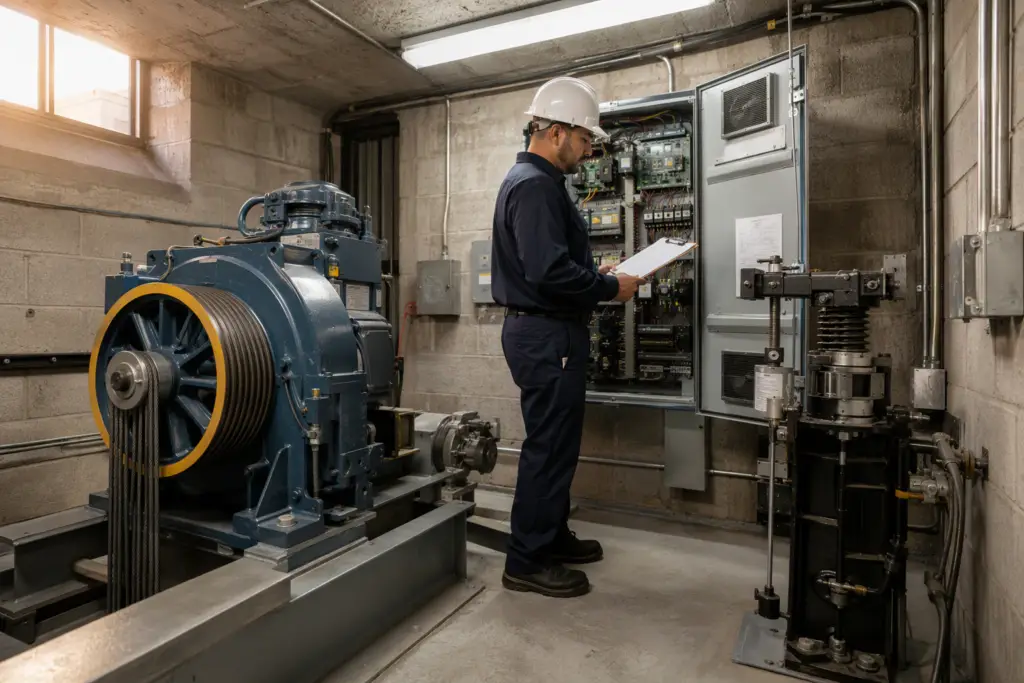
- Major repairs and component replacement (hoist machine, controller replacement, hydraulic cylinder): High-cost work that often triggers California Department of Industrial Relations (DIR) permit requirements and mandatory inspections before the elevator returns to service.
- Modernization and full system upgrades: The most expensive category, often required when an older elevator can no longer be brought into compliance through isolated repairs. Costs scale with cab size, travel height, and the scope of components replaced.
Liftech Elevator provides detailed, itemized assessments for each property so building owners in Los Angeles and Orange County receive accurate cost projections rather than generic estimates.
—
What Factors Most Affect the Price of Commercial Elevator Repairs?
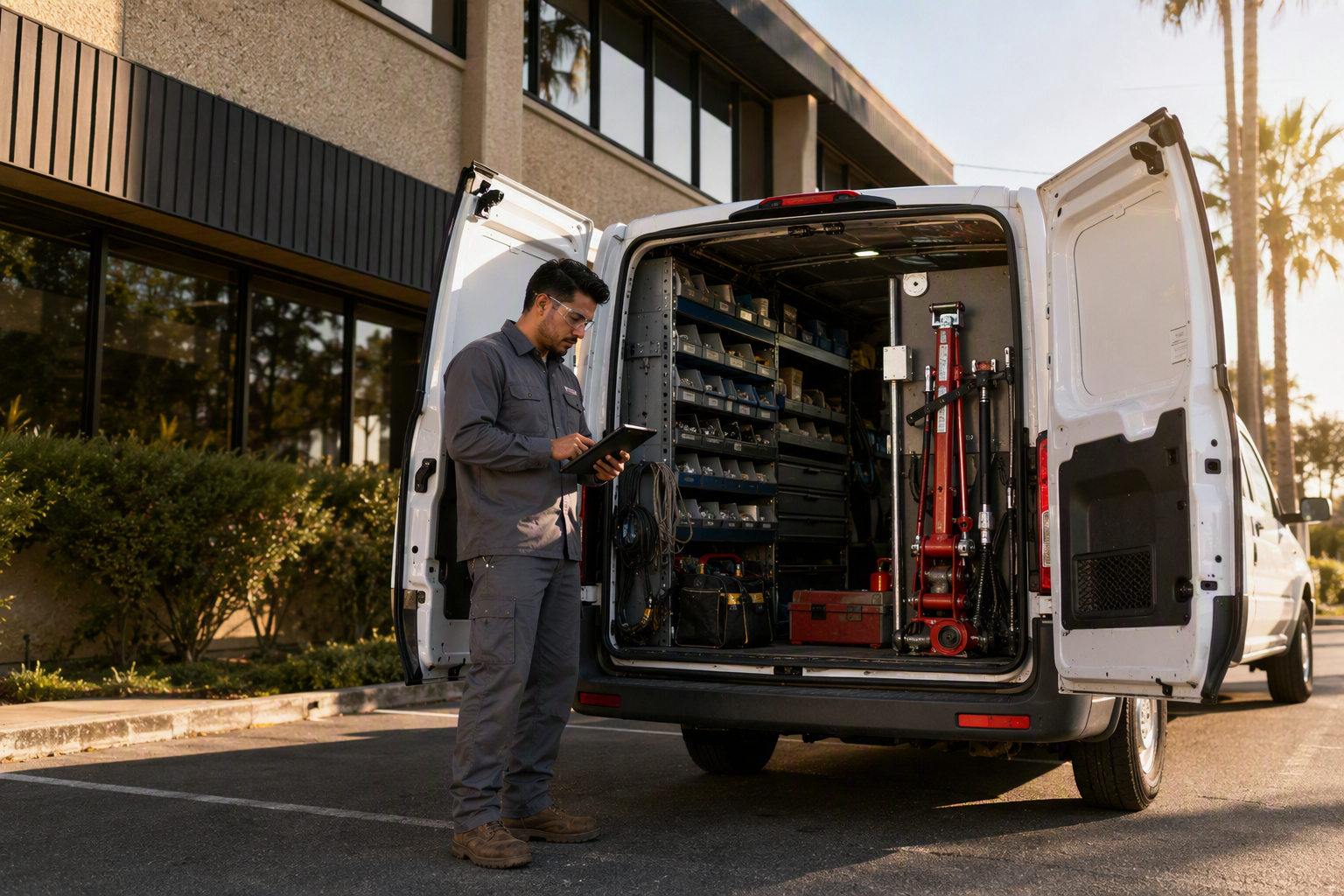
Several distinct variables combine to determine the final repair invoice for a commercial elevator in Southern California:
1. Type and Severity of the Failure
A door misalignment caused by worn gibs is a straightforward repair. A failed hydraulic cylinder on a below-ground piston unit, by contrast, may require excavation, environmental remediation for fluid spills, and replacement of a long-lead-time part. The nature of the failure is the single largest cost driver.
2. Elevator Age and Parts Availability
Elevators manufactured before the 1990s frequently use components that are no longer in production. Sourcing obsolete parts from specialty suppliers or fabricating replacements adds both cost and lead time. In many cases, the cost of sourcing discontinued parts for an aging unit approaches or exceeds the cost of full modernization, which is a calculation property owners in the Los Angeles and Orange County markets frequently face.
3. California Regulatory and Permit Requirements
California’s elevator safety program is administered through the California Department of Industrial Relations, Division of Occupational Safety and Health (Cal/OSHA), Elevator Unit. Any repair that qualifies as “alteration” under applicable safety codes requires a permit before work begins and a passing inspection before the elevator is returned to service. Permit and inspection fees are set by the state and add a predictable but unavoidable cost layer to repair projects. Failing an inspection requires re-inspection, which adds additional fees.
4. ASME Code Compliance Obligations
California adopts and enforces the ASME A17.1 Safety Code for Elevators and Escalators and ASME A17.3 Safety Code for Existing Elevators and Escalators. When a repair triggers code review, the Authority Having Jurisdiction (AHJ) may require that adjacent non-compliant conditions be corrected as part of approving the work. This “triggered compliance” scenario is a common source of cost overruns for owners who budget only for the presenting repair.
5. ADA Compliance Requirements
Repair projects that constitute alterations to a commercial facility may trigger obligations under the Americans with Disabilities Act (ADA). Control heights, door timing, tactile markings, and auditory signals must meet ADA Standards for Accessible Design when alterations are made to the “path of travel.” This can expand the scope—and cost—of what initially appears to be a simple repair.
6. Labor Market Conditions in Southern California
Los Angeles and Orange County operate in one of the highest-cost skilled-labor markets in the United States. Elevator mechanics in California are licensed through the California Department of Industrial Relations, and licensed labor commands market rates that reflect both the regulatory requirements and the cost of living in the region. After-hours, emergency, and holiday call-out labor carries premium rates above standard billing.
7. Seismic Compliance
California’s seismic environment creates an additional compliance dimension absent in most other states. When modernization or significant alteration work is performed, California may require seismic upgrades—including counterweight guarding and hydraulic shutoff valves—to bring older equipment into conformance with current safety requirements. These are real costs unique to California properties.
8. Building Access and Site Conditions
High-rise buildings in downtown Los Angeles present access challenges including freight elevator scheduling, parking costs for service vehicles, and building security protocols that add hours to every job. Conversely, some Orange County low-rise commercial properties present machine room access issues or limited parts staging areas. Site conditions directly affect billable labor hours.
9. Emergency vs. Scheduled Repairs
Planned, scheduled repairs executed during normal business hours are consistently less expensive than emergency call-outs. Emergency repairs involve after-hours labor premiums, expedited parts sourcing, and in some cases emergency permit processing.
—
What Does a California Elevator Permit and Inspection Cost?
Permit and inspection fees for commercial elevator repairs in California are established by the California Department of Industrial Relations and vary based on the type of work, the complexity of the equipment, and whether the work is classified as maintenance, repair, or alteration. Because these fees are set administratively and subject to periodic adjustment, the most accurate current figures are obtained directly from the DIR Elevator Unit or through a licensed elevator contractor familiar with the current fee schedule. Attempting to budget for permits without consulting the current schedule risks underestimating project costs.
—
How Does Elevator Type Affect Repair Cost?
Commercial elevators in Los Angeles and Orange County fall into several categories, each with distinct repair cost profiles:
- Hydraulic elevators: Common in low-rise commercial buildings (typically up to five or six floors). Repairs often involve hydraulic power units, cylinders, and fluid systems. Older single-bottom hydraulic units with in-ground cylinders present elevated repair costs due to the risk of cylinder corrosion and the potential for soil contamination from hydraulic fluid, which implicates environmental remediation requirements.
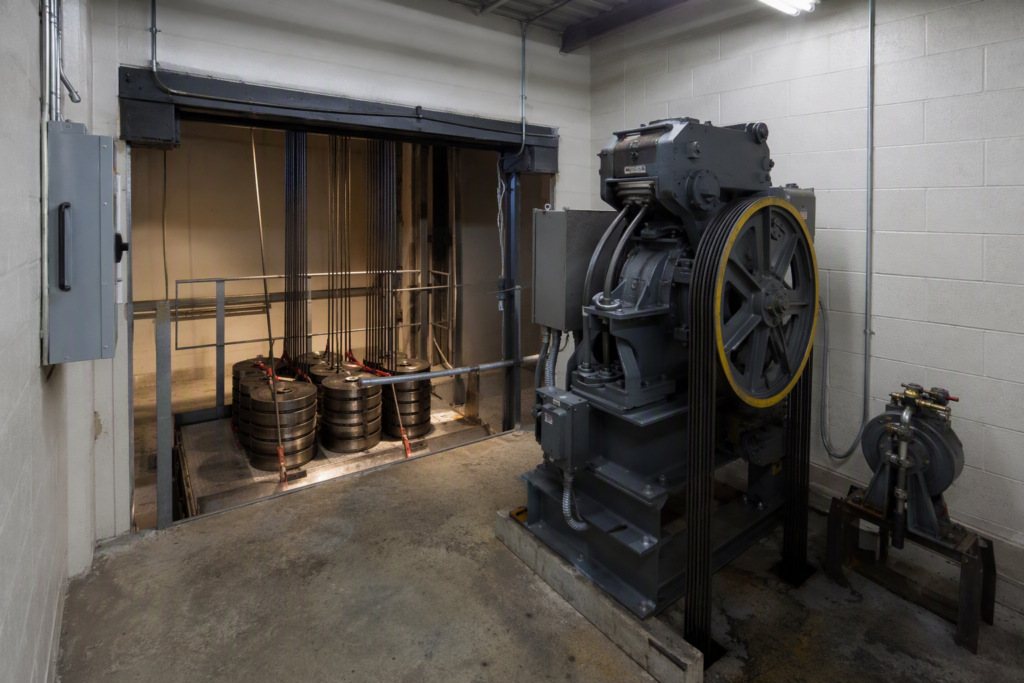
- Traction elevators (geared and gearless): Standard in mid- and high-rise commercial properties. Machine repair costs depend heavily on whether the unit uses a geared or gearless machine and whether the controller uses relay logic (older) or microprocessor-based (modern) technology. Relay logic controllers are increasingly difficult to repair or source parts for.
- Machine-room-less (MRL) traction elevators: A newer configuration that places drive components in the hoistway. Repairs often require more specialized access techniques, which can affect labor time.
- Freight elevators: Heavy-duty equipment subject to accelerated wear. Repair costs reflect both higher-capacity components and, in some cases, more demanding OSHA compliance considerations for workplace safety in industrial and warehouse settings.
—
What Are the Most Common Commercial Elevator Repairs and Their Cost Drivers?
The following repair categories recur most frequently in commercial properties across Los Angeles and Orange County:
- Door operator and door hardware repairs: Door systems are the highest-frequency failure point in commercial elevators. Door operators, cams, gibs, rollers, and clutch mechanisms are subject to constant wear. Cost is driven by parts availability and whether the existing operator is still manufactured.
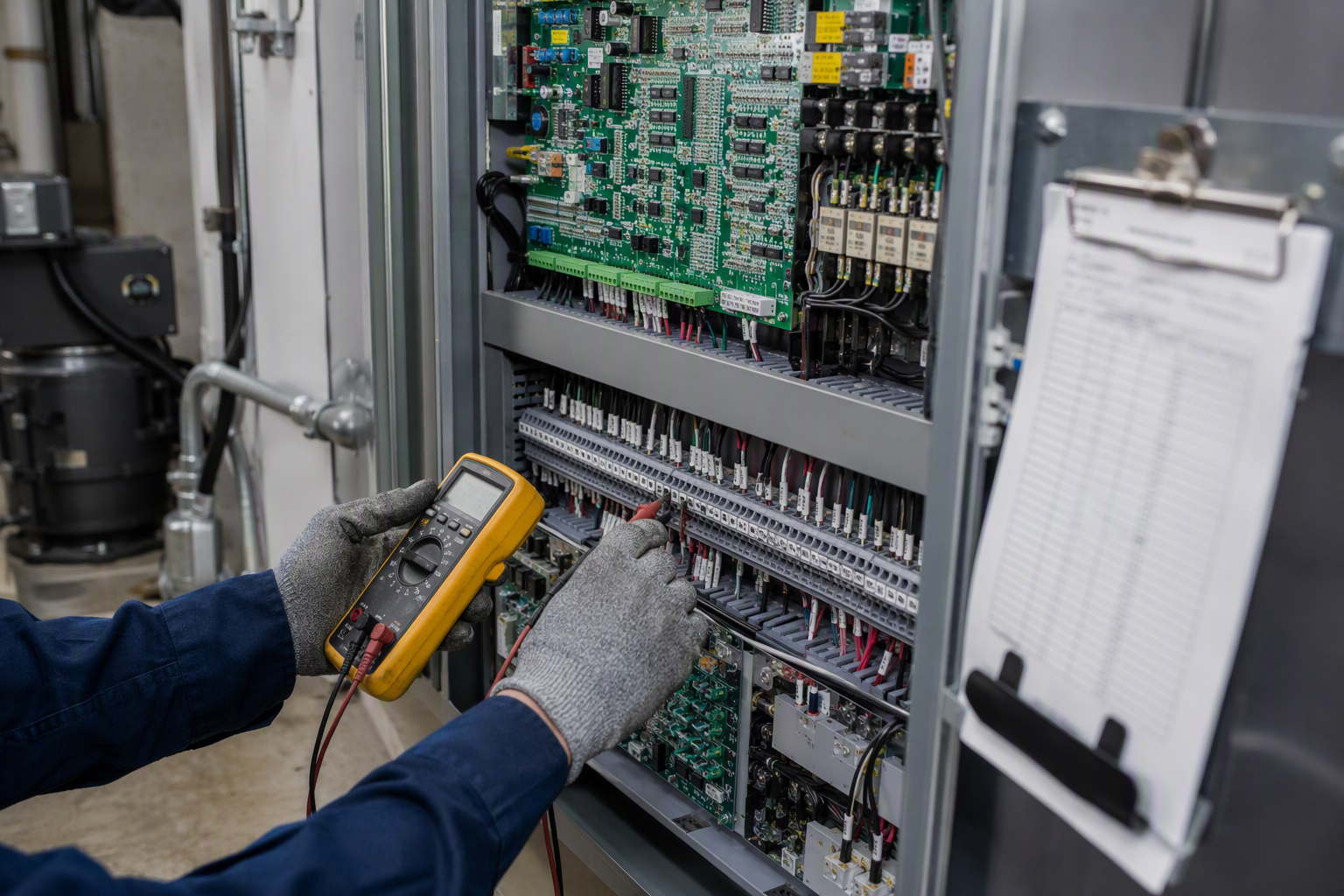
- Controller and circuit board repairs: Modern microprocessor controllers can sometimes be reprogrammed or have boards repaired. Older relay-based controllers may require complete replacement if a failed relay is no longer available.
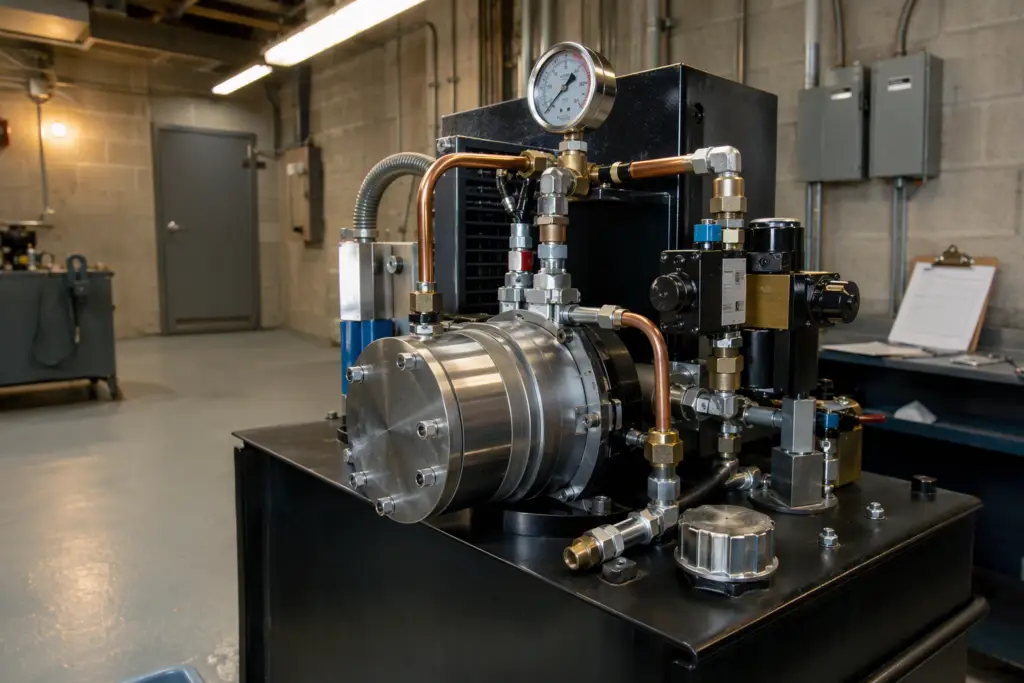
- Hydraulic power unit service: Includes pump motor replacement, valve repairs, and fluid changes. Environmental disposal of old hydraulic fluid is a regulated cost in California.
- Hoist rope and cable replacement: Required when ropes reach discard criteria defined under ASME A17.1. Cost scales with the number of ropes, rope length, and whether counterweight rope replacement is also needed.
- Brake adjustment and replacement: Safety-critical work that requires post-repair testing and, in some cases, witnessing by the AHJ before the unit is cleared for passenger use.
- Roller guide and slide guide replacement: Affects ride quality and safety. Labor intensity depends on the number of guide rails and the cab travel distance.
- Pit and machine room deficiency corrections: California inspectors cite pit lighting, sump pump, stop switch, and clearance deficiencies routinely. Correcting cited deficiencies before or after an annual inspection adds to total ownership cost.
—
What Steps Should a Building Owner Take When a Commercial Elevator Needs Repair?
- Shut down and secure the elevator safely. If the elevator has failed mid-operation or is exhibiting unsafe behavior, contact a licensed elevator mechanic immediately. Do not attempt to reset or bypass safety circuits.
- Notify building occupants and post an out-of-service notice. ADA obligations may require that an accessible alternative is made available or that occupants with disabilities receive direct notification.
- Contact a California-licensed elevator contractor. California law requires that elevator repair and maintenance work be performed by or under the direct supervision of a licensed elevator mechanic (Certified Competent Conveyance Mechanic, CCCM) as defined by the California Department of Industrial Relations.
- Obtain a written, itemized scope of work and estimate. Request that the contractor identify whether the proposed work requires a permit and inspection under California regulations.
- Verify permit requirements before work begins. Alteration work performed without the required permit is a violation of California elevator safety law and can result in mandatory shutdown orders and fines.
- Schedule required inspections. Coordinate with the contractor to ensure the California DIR Elevator Unit inspection is scheduled promptly after work is completed to minimize downtime.
- Review the inspection report and close any open items. Address any additional deficiencies cited during the acceptance inspection before returning the elevator to full service.
—
How Do Annual Maintenance Contracts Affect Repair Costs?
Commercial elevator maintenance contracts in Los Angeles and Orange County typically define which repair categories are covered under the contract and which are billed separately. Common contract structures include:
- Oil-and-grease (lubrication only): The most limited coverage, covering only routine lubrication and minor adjustments. Most repairs are billed separately at time-and-materials rates.
- Comprehensive (full-coverage): Covers most parts and labor for repairs within normal wear parameters. Parts with long replacement cycles (hoist ropes, door operators) and damage from misuse are frequently excluded.
- Partial or mid-tier: Covers labor but caps parts costs or excludes specific high-cost components.
Property owners should read maintenance contracts carefully to understand exclusions. In the Los Angeles and Orange County markets, an elevator under a comprehensive contract that requires a major repair may still generate significant out-of-pocket cost if the failed component is listed as excluded. Liftech Elevator helps building owners evaluate what their current contract covers and where gaps in coverage may expose them to unexpected costs.
—
How Does Elevator Age Influence Whether to Repair or Modernize?
The repair-versus-modernize decision is one of the most consequential financial choices for commercial building owners. Several qualitative signals indicate that modernization may be more cost-effective than continued repair investment:
- Repair frequency has increased significantly over the prior 12–24 months.
- The elevator controller uses relay logic or other obsolete technology for which replacement parts are scarce.
- The elevator has accumulated a pattern of inspection deficiencies that require ongoing correction.
- The estimated cost of the presenting repair, added to recent repair history, approaches a meaningful percentage of modernization cost.
- Seismic, ADA, or current-edition ASME A17.3 compliance would require significant investment regardless of the presenting repair.
Modernization typically results in lower ongoing maintenance costs, better energy efficiency, improved reliability, and a longer service life—factors that should be weighed against the higher upfront investment.
—
What Role Do California Inspections Play in Elevator Repair Costs?
California requires periodic inspections of all commercial elevators as a condition of legal operation. The ASME A17.1 Safety Code for Elevators and Escalators establishes the testing and inspection framework that California’s regulatory program is built upon. Annual routine inspections, periodic five-year safety tests, and acceptance inspections following alteration work are all part of the California elevator compliance lifecycle.
Failed inspections create repair obligations that can be time-sensitive if the elevator is placed out of service pending correction. The cost of emergency or expedited repair to clear an inspection deficiency is consistently higher than the cost of addressing the same deficiency proactively during scheduled maintenance.
—
How Do 2025–2026 Industry Trends Affect Elevator Repair Costs in Southern California?
Several trends are shaping the commercial elevator service market in Los Angeles and Orange County heading into 2026:
- Supply chain normalization with residual volatility: The supply chain disruptions of earlier years have eased for many standard elevator components, but specialty parts for older equipment and microprocessor components continue to experience longer-than-historical lead times in some categories.
- Accelerating obsolescence of legacy controllers: The population of commercial elevators in Southern California still operating on relay-based or early-generation microprocessor controllers is aging further each year, increasing both repair difficulty and modernization urgency for that segment.
- Growing enforcement focus on pit and machine room compliance: California inspection authorities have maintained consistent enforcement attention on pit conditions, machine room access, and seismic compliance items—meaning building owners who have deferred these corrections are increasingly likely to face mandatory repair orders.
- Energy efficiency and sustainability drivers: Los Angeles-area commercial real estate tenants and ESG-focused ownership groups are increasingly factoring elevator energy consumption into building performance assessments, creating demand for modernization projects that improve energy efficiency alongside safety and reliability.
- Remote monitoring adoption: Predictive maintenance technology that identifies developing failures before they cause outages is being adopted more broadly in the commercial sector, with the potential to reduce emergency repair frequency and associated premium costs over time.
—
How Should Building Owners Compare Elevator Repair Vendors in Los Angeles and Orange County?
Selecting an elevator repair contractor on price alone exposes building owners to significant risk. A more complete vendor evaluation considers:
- California licensing: Confirm the contractor employs mechanics holding the Certified Competent Conveyance Mechanic (CCCM) certification as required by the California Department of Industrial Relations.
- Permit management experience: Verify the contractor routinely manages California DIR permit applications and inspection coordination for the type of work proposed.
- Parts sourcing transparency: Ask how the contractor sources parts for the specific equipment type and age, and request disclosure of any markup on parts relative to the labor rate.
- Scope specificity: A detailed, itemized written proposal is a strong indicator of contractor competence. Vague proposals carry hidden cost escalation risk.
- References from comparable properties: Relevant experience with comparable elevator types and building categories in the Los Angeles or Orange County market is more predictive than general claims of capability.
Liftech Elevator operates as a data-driven service provider, equipping building owners and property managers across Los Angeles and Orange County with detailed, itemized repair assessments grounded in California code requirements and current market conditions—not ballpark figures.
—
What Is the Consequence of Deferring Commercial Elevator Repairs in California?
Deferred maintenance and repair on commercial elevators in California creates compounding risk across several dimensions:
- Safety liability: Elevator failures that result in passenger injury expose building owners to significant liability. California’s regulatory framework places affirmative obligations on elevator owners to maintain equipment in safe operating condition under ASME A17.1 and state law.
- Regulatory shutdown: The California DIR Elevator Unit has authority to order an elevator removed from service for unsafe conditions. A mandatory shutdown in a multi-story commercial building creates immediate operational and ADA accessibility consequences.
- Accelerating repair costs: Deferred maintenance allows minor deficiencies to develop into major failures. A worn door cam left unaddressed, for example, can ultimately damage door operator components at significantly higher replacement cost.
- Inspection citation accumulation: Elevators with growing deficiency lists are more likely to require comprehensive corrective work under inspection timelines set by the AHJ, reducing the owner’s ability to phase and control costs.
—
Frequently Asked Questions
Does commercial elevator repair require a permit in California?
Work classified as an “alteration” under California’s elevator safety regulations requires a permit from the California Department of Industrial Relations Elevator Unit before work begins, and a passing acceptance inspection before the elevator is returned to service. Routine maintenance and minor adjustments may not trigger permit requirements, but the line between maintenance and alteration must be evaluated by a licensed elevator contractor familiar with current California requirements.
Who is legally authorized to repair commercial elevators in Los Angeles and Orange County?
California law requires that elevator repair, maintenance, and alteration work be performed by or under the direct supervision of a mechanic holding the Certified Competent Conveyance Mechanic (CCCM) certification issued by the California Department of Industrial Relations. Building maintenance staff without this certification may not legally perform substantive elevator repair work.
How often must commercial elevators be inspected in California?
California administers an inspection program aligned with the periodic testing and inspection requirements established under the ASME A17.1 Safety Code for Elevators and Escalators. Commercial elevators are subject to routine annual inspections and periodic five-year safety tests (Category 1 and Category 5 tests for hydraulic units; periodic tests for traction units). The specific intervals and test types applicable to a given elevator depend on its type and configuration.
Can a building owner operate a commercial elevator without a current California certificate of compliance?
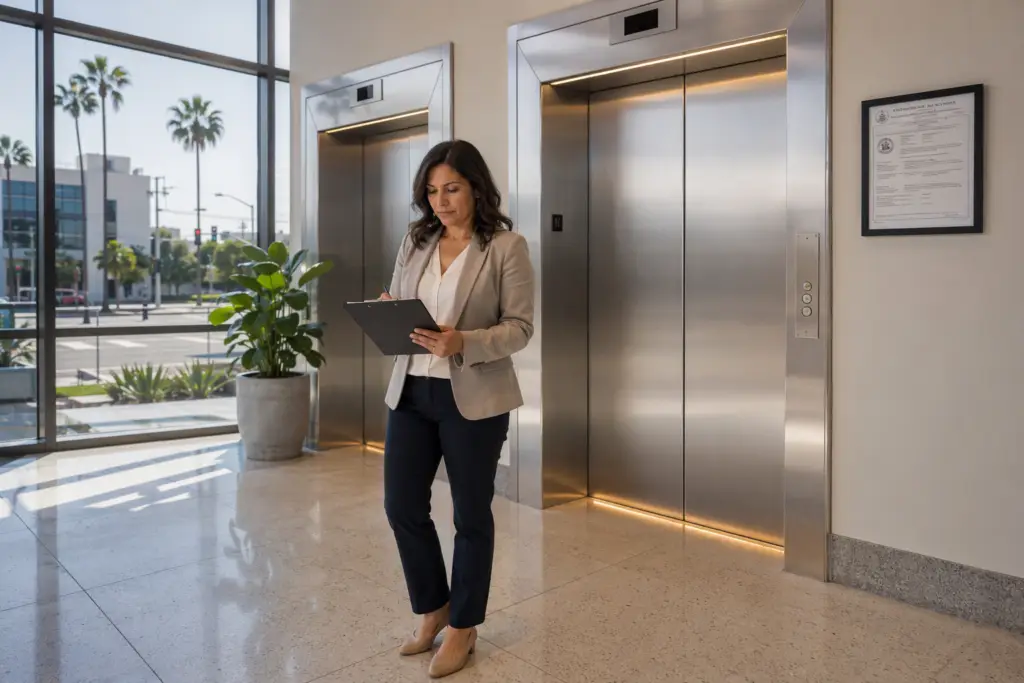
Operating a commercial elevator in California without a current, valid certificate of inspection is a violation of state law and exposes the building owner to regulatory penalties and liability. The certificate must be posted in or near the elevator cab and renewed upon passing each required inspection cycle.
Do ADA requirements apply to elevator repairs in commercial buildings?
The Americans with Disabilities Act requires that alterations to commercial facilities be made accessible to the extent technically feasible, including elements in the path of travel. Elevator alterations may trigger requirements for compliant controls, door timing, cab dimensions, and accessibility features. Building owners should confirm ADA compliance scope with a qualified contractor before finalizing the repair or alteration plan.
What is seismic compliance and how does it affect elevator repair costs in Los Angeles?
California’s seismic environment is among the most demanding in the country. When significant elevator alterations are undertaken, California may require the simultaneous correction of seismic safety deficiencies, including counterweight guarding and hydraulic safety valve installation, to bring the elevator into compliance with current requirements. This can meaningfully increase the total project cost beyond the presenting repair scope.
How long does a typical commercial elevator repair take in Southern California?
Repair duration varies by scope. Minor repairs may be completed in hours. Intermediate repairs involving parts sourcing may take days. Major repairs or alterations requiring California DIR permits, parts fabrication or long-lead-time procurement, and post-repair inspection can extend to weeks. Permit processing time and inspection scheduling availability at the California DIR Elevator Unit are variables that affect the timeline and should be factored into downtime planning.
Is emergency elevator repair available in Los Angeles and Orange County?
Licensed elevator contractors serving the Los Angeles and Orange County markets offer emergency repair response for commercial properties. Emergency service—particularly outside standard business hours—carries labor premium rates that are higher than scheduled repair work. Building owners should understand their maintenance contract’s emergency call-out provisions and any associated rates before an emergency occurs.
What is the difference between elevator repair and elevator modernization?
Repair addresses a specific failed or degraded component to restore the elevator to its prior operating condition. Modernization replaces multiple systems—commonly the controller, door operator, fixtures, and sometimes the machine—to upgrade the elevator to current technology and code standards. Modernization is typically triggered when repair costs on aging equipment become disproportionate to the equipment’s remaining useful life, or when compliance obligations cannot be satisfied through isolated repairs.
How can a building owner reduce commercial elevator repair costs over time?
The most reliable strategy for managing long-term elevator repair costs is a proactive maintenance program that identifies and corrects developing deficiencies before they become failures. Well-maintained elevators fail less frequently, require fewer emergency repairs at premium rates, and are less likely to accumulate inspection deficiencies that trigger mandatory corrective orders. Reviewing the scope and coverage of the maintenance contract annually, investing in periodic condition assessments, and developing a capital planning schedule for predictable high-cost replacements all contribute to lower total cost of ownership.
—
Contact Liftech Elevator for a Thorough Elevator Assessment
Commercial elevator repair costs in Los Angeles and Orange County are shaped by a complex interaction of equipment condition, California regulatory requirements, parts availability, and labor market dynamics. Accurate budgeting requires a property-specific evaluation—not generic industry averages.
Liftech Elevator provides building owners and property managers across Los Angeles and Orange County with detailed, code-informed elevator assessments that identify repair requirements, compliance obligations, and capital planning needs with specificity and transparency.
Contact Liftech Elevator for a free elevator assessment: 562-997-3639
Need elevator service you can rely on? Liftech Elevator is ready to help.