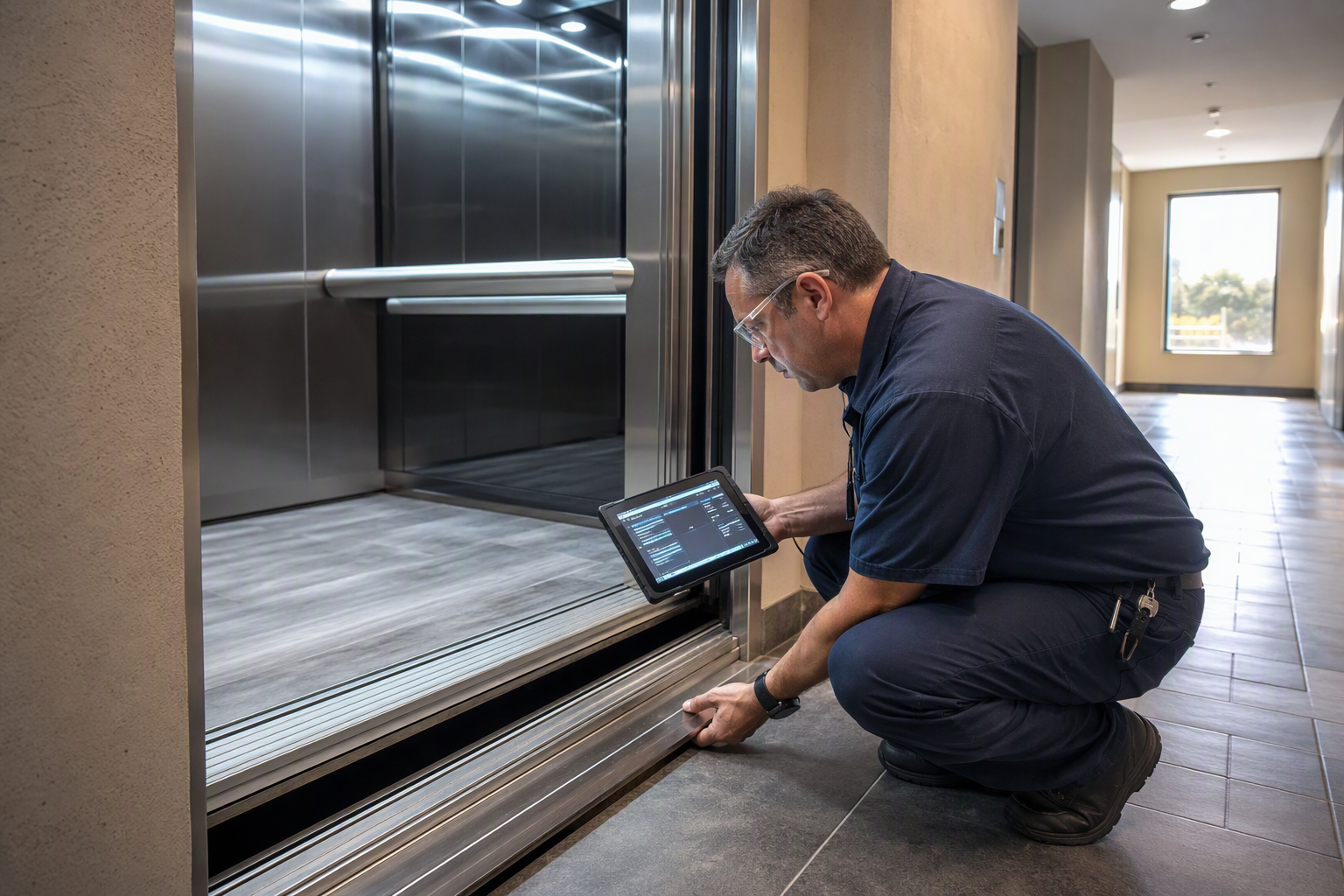
Should an Elevator Be Inspected After a Passenger Entrapment, Even If It Has Been Reset?
Yes. A successful reset does not equal a safe elevator. When a passenger entrapment occurs, something caused the elevator to stop unexpectedly between floors or fail to open its doors. Resetting the controller clears the fault code but does not repair the underlying mechanical, electrical, or software condition that triggered the event. A qualified inspection is required to identify the root cause, document the incident, confirm compliance, and protect building owners from liability.
What actually happens during a passenger entrapment?
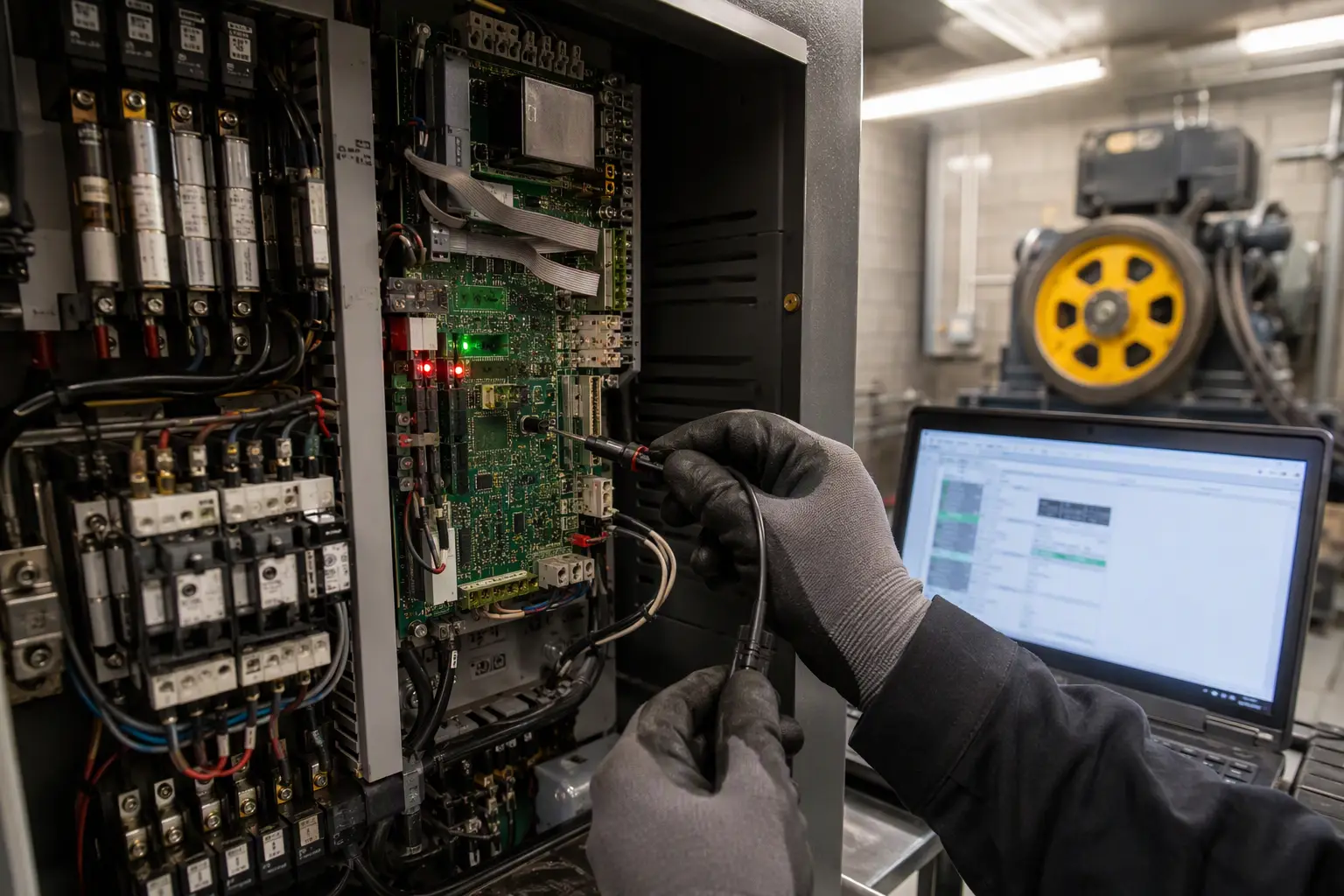
A passenger entrapment occurs when one or more people become trapped inside an elevator car that has stopped in a position where normal egress is not possible.
Entrapments can result from a wide range of causes: door system failures, safeties activating due to overspeed or leveling errors, power interruptions, drive faults, rope or sheave issues, or control system malfunctions. Many of these root causes are not visible without systematic diagnostic testing. Some causes — such as intermittent encoder drift or a door clutch that is wearing at the edge of its tolerance — will produce a normal-looking reset and then recur under load or temperature. The elevator may operate through dozens of normal cycles before failing again, sometimes with passengers onboard.
From a safety engineering standpoint, an entrapment is a system-level event, not a nuisance trip. It warrants the same structured response as any other safety-critical incident.
Is a post-entrapment inspection legally required in California?

California law does not publish a single explicit statute that says “inspect within X hours after entrapment,” but the framework of the California Division of Occupational Safety and Health (Cal/OSHA), Elevator Unit and the ASME A17.1/CSA B44 Safety Code for Elevators and Escalators together create a clear compliance obligation.
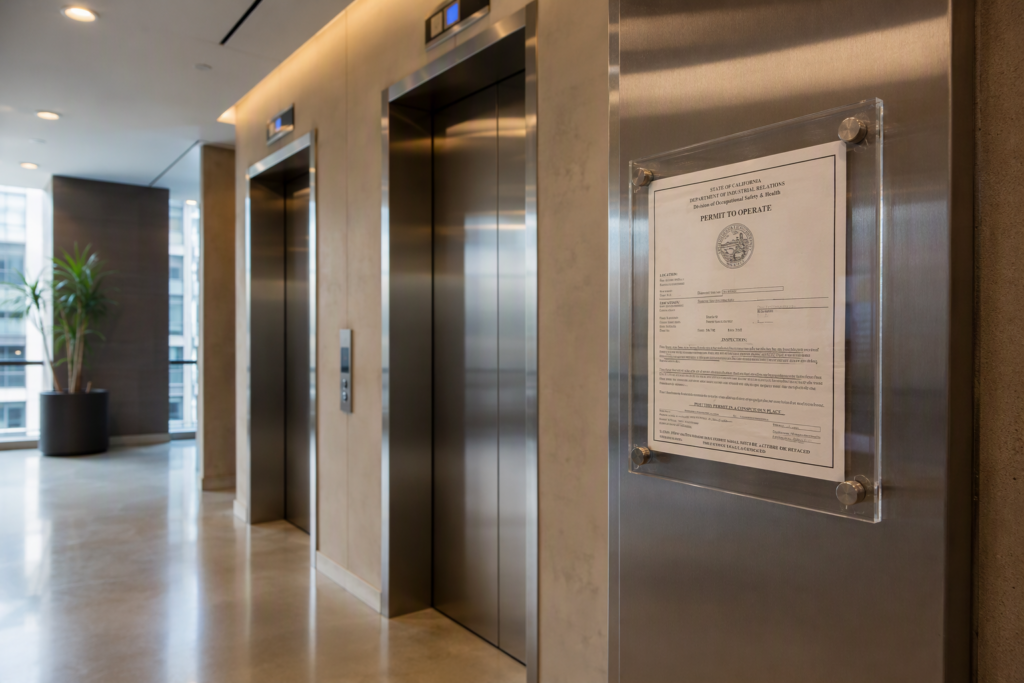
Under California Labor Code Sections 7300–7324.2 and the California Code of Regulations, Title 8, Elevator Safety Orders (Sections 3000–3146), no elevator may be operated in California without a valid, current permit to operate issued by Cal/OSHA. An elevator that continues to operate after a confirmed entrapment — without a documented inspection confirming it is safe — places the building owner at risk of permit revocation, stop orders, and civil liability. Cal/OSHA inspectors can and do conduct unannounced inspections; an undocumented entrapment discovered during such a visit is a serious enforcement risk.
Furthermore, California requires that any work performed on an elevator — including diagnostic inspection following an incident — be carried out only by a Certified Competent Conveyance Mechanic (CCCM) employed by a Certified Qualified Conveyance Company (CQCC). Building staff, general contractors, and uncertified technicians are not legally permitted to perform this work.
What does ASME A17.1 say about post-incident elevator safety?
The ASME A17.1 Safety Code for Elevators and Escalators — the foundational federal standard adopted by California in its 2004 edition — establishes requirements for periodic testing, maintenance, and the documentation of elevator condition. While ASME A17.1 does not use the specific phrase “post-entrapment inspection,” its maintenance and testing provisions require that elevators be kept in safe operating condition at all times, and that maintenance records document the state of the equipment.
ASME A17.1 also establishes requirements for door reopening devices, leveling accuracy, safeties, buffers, and emergency lighting — all systems that may be implicated in an entrapment. If any of these systems are found to be outside tolerance during a post-entrapment inspection, they must be corrected before the elevator returns to public service.
Why is resetting the elevator not sufficient?
Resetting an elevator controller clears the active fault flag, restores power to the drive system, and allows the elevator to resume normal operation — but it does not address the condition that caused the fault.
Consider a door operator with a failing cam follower. The system may produce an entrapment when the follower slips under a specific load condition. A reset allows the door to cycle normally through hundreds of trips. But the follower continues to degrade, and the next failure may occur at a different floor, with a more vulnerable passenger population, or in a way that causes injury. The same logic applies to drive encoder faults, leveling sensor drift, rope tension imbalance, and dozens of other intermittent conditions.
In addition, some entrapments activate safety devices — such as the car safety or the pit buffer — that have specific reset procedures defined under ASME A17.1. Simply powering the controller back on does not constitute a proper safety reset for these devices. Operating the elevator with a safety that has been informally reset, rather than properly inspected and restored, is a code violation.
What steps should a building owner take immediately after a passenger entrapment?
- Secure the elevator. Place the elevator out of service immediately after the entrapment is resolved. Do not allow continued passenger use until a qualified inspection is complete.
- Confirm all passengers are safe. Coordinate with emergency responders if needed. Document any injuries for incident reporting purposes.
- Do not reset the controller without qualified personnel present. If a technician is not on-site, keep the elevator out of service until one arrives. Resetting without documentation destroys diagnostic information stored in the controller’s fault log.
- Contact a Certified Qualified Conveyance Company. Only a CQCC — employing CCC Mechanics — is legally authorized to inspect and work on elevators in California. Contact your elevator service provider immediately.
- Download or record the controller fault log before reset. Instruct the responding technician to capture the fault log, event buffer, and drive diagnostics prior to any reset. This data is critical to root cause analysis.
- Document the incident internally. Record the date, time, floor, number of passengers trapped, duration, and method of rescue. This record is needed for your insurance carrier and for any Cal/OSHA inquiry.
- Notify Cal/OSHA if required. If the entrapment resulted in injury, consult with legal counsel about reporting obligations under California Labor Code and OSHA recordkeeping standards.
- Obtain a written inspection report before returning the elevator to service. The report should identify the root cause, corrective action taken, and a technician certification that the elevator is safe to operate.
What does a proper post-entrapment inspection cover?
A thorough post-entrapment inspection goes well beyond confirming that the elevator moves between floors. A Certified Competent Conveyance Mechanic will systematically evaluate all systems that may have contributed to or been affected by the entrapment.
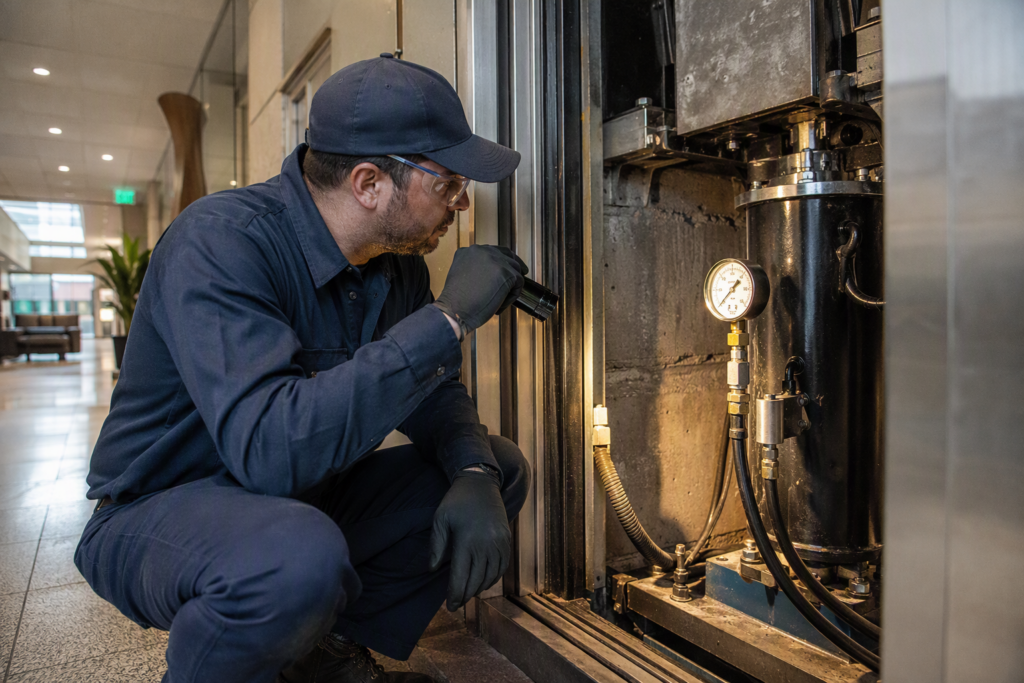
The inspection typically covers: door system operation (operator, clutch, cam, gibs, and reopening devices); leveling and landing accuracy; drive system diagnostics (controller fault log, drive parameters, encoder feedback); safety device condition (governor, safeties, buffers); hoistway alignment; emergency lighting and communication systems; and maintenance record review. For hydraulic elevators, the inspection also includes pump unit condition, valve function, and hydraulic fluid integrity.
The technician will also assess whether the entrapment was caused by a deferred maintenance item — something that should have been corrected during routine service — which has implications for both code compliance and liability.
How does a post-entrapment inspection differ from a routine annual inspection?
| Attribute | Routine Annual Inspection | Post-Entrapment Inspection |
|---|---|---|
| Trigger | Scheduled; required by California law (minimum once per year) | Event-driven; following any confirmed passenger entrapment |
| Performed by | Cal/OSHA safety engineer or Certified Competent Conveyance Inspector (CCCI) | Certified Competent Conveyance Mechanic (CCCM) from a CQCC; may also involve CCCI |
| Scope | Full conveyance inspection per California Elevator Safety Orders | Root cause analysis plus full system check; fault log review |
| Documentation output | Cal/OSHA permit to operate (valid up to one or two years) | Internal inspection report; corrective work order; return-to-service certification |
| Replaces annual inspection? | N/A | No — it is a separate safety obligation |
| Elevator status during process | Elevator typically remains in service until found unsafe | Elevator should be taken out of service until clearance is issued |
| Impact on permit to operate | Renews or issues permit | Does not renew permit; documents incident response |
Who is qualified to perform a post-entrapment inspection in California?
In California, only a Certified Competent Conveyance Mechanic (CCCM) employed by a Certified Qualified Conveyance Company (CQCC) may legally inspect, diagnose, and repair an elevator following an entrapment.
The CQCC certification is issued by Cal/OSHA’s Elevator Unit. To obtain this certification, a company must hold a current C-11 Elevator Contractor license from the California Contractors State License Board (CSLB) and maintain certificates of workers’ compensation and liability insurance. Individual mechanics must hold a CCCM certificate issued by Cal/OSHA. Both company and mechanic certificates are valid for two years and require at least eight hours of continuing education for renewal. Building maintenance staff, general contractors, and elevator mechanics not holding CCCM certification are not authorized to perform this work under California law.
Liftech Elevator operates as a CQCC serving Signal Hill, Long Beach, Los Angeles, and Orange County, deploying CCCM-certified mechanics to post-entrapment service calls.
What are the liability risks of skipping a post-entrapment inspection?
Building owners who return an elevator to service after a passenger entrapment without a documented inspection face several categories of risk.
From a regulatory standpoint, Cal/OSHA can issue a stop order, cite the owner for operating an unsafe conveyance, or suspend the permit to operate if it determines the elevator was returned to service without appropriate corrective action. From a civil liability standpoint, a second entrapment or injury following a documented first event — with no inspection record in between — creates a strong basis for a negligence claim. Plaintiffs’ counsel routinely request maintenance logs and inspection records in elevator injury litigation; the absence of a post-entrapment inspection report is significant evidence of failure to exercise reasonable care.
Insurance carriers that cover commercial properties increasingly require documentation of post-incident inspections. Failure to produce such documentation can affect claim outcomes or renewal terms.
How long does a post-entrapment inspection typically take?
The duration of a post-entrapment inspection depends on the complexity of the elevator system, the nature of the suspected fault, and whether corrective work is needed immediately. A diagnostic inspection of a standard traction passenger elevator — covering fault log retrieval, door system evaluation, drive diagnostics, and a physical walk-through of the hoistway — typically requires several hours of qualified technician time.
If corrective repairs are identified during the inspection, the elevator should remain out of service until those repairs are completed and documented. Returning an elevator to service with a known defect — even a minor one — is inconsistent with California’s requirement that elevators be maintained in safe operating condition.
Does a passenger entrapment need to be reported to Cal/OSHA?
California law and Cal/OSHA’s Elevator Safety Orders establish reporting requirements for elevator accidents and serious incidents. Building owners and elevator contractors should consult the Cal/OSHA Elevator Unit directly regarding current reporting obligations for entrapments, particularly those involving injury.
Under federal OSHA recordkeeping standards, employers are generally required to record and in some cases report work-related injuries and illnesses. If a building employee was among the passengers trapped, OSHA recordkeeping rules may apply. Legal counsel familiar with California workplace safety law should be consulted for incident-specific guidance.
What causes most passenger entrapments?
Entrapments can originate from virtually any major elevator system, but certain categories account for a disproportionate share of field incidents. Door system failures are among the most common — worn door gibs, misaligned door tracks, failing cam followers, and door operator motor issues can all cause a door to fail to open, leaving passengers trapped with the car at a floor but inaccessible. Drive system faults, including controller errors, encoder failures, and brake issues, can cause the car to stop between floors. Power supply problems, including phase imbalance and transient voltage events, can trigger safety circuits that hold the elevator in a stopped state.
Hydraulic elevators have their own entrapment profile: valve failures, pump motor overheating, and hydraulic fluid contamination can all cause the car to settle below the landing level or fail to respond to hall calls. In all cases, the root cause is a maintainable condition — one that a proper service program should identify before it produces an entrapment.
Can a building owner perform their own inspection after an entrapment?
No. California law is explicit: only a Certified Competent Conveyance Mechanic working for a Certified Qualified Conveyance Company may inspect, maintain, repair, alter, or replace components on a conveyance. A building owner who performs their own elevator inspection — or who engages an uncertified contractor — is operating outside the California Labor Code and the Title 8 Elevator Safety Orders. Such an inspection also has no legal standing; it cannot serve as documentation of safe condition for Cal/OSHA compliance purposes or for liability defense.
What documentation should be retained after a post-entrapment inspection?
Building owners should retain the following documentation from every post-entrapment inspection. First, a written inspection report from the responding CQCC identifying the root cause, systems evaluated, findings, and corrective actions taken. Second, a copy of the fault log or drive diagnostic data retrieved before reset. Third, work orders or invoices documenting any parts replaced or adjustments made. Fourth, a return-to-service statement signed by the CCCM certifying that the elevator is safe to operate. Fifth, the building’s own internal incident report documenting the entrapment event itself.
These records should be maintained with the elevator’s maintenance log and made available for any Cal/OSHA inspection. California’s permit to operate must be posted conspicuously in the elevator car, and the underlying maintenance records support the validity of that permit.
How does entrapment history affect a Cal/OSHA inspection outcome?
Cal/OSHA safety engineers and Certified Competent Conveyance Inspectors review maintenance logs as part of the annual inspection process. A pattern of recurring entrapments — particularly ones involving the same system or component — can indicate that a full maintenance contract is not being performed adequately, or that a major component is approaching end of life. This can affect the inspector’s determination of whether the elevator receives a full one-year permit to operate or is flagged for additional scrutiny.
California law provides that an elevator covered by a full maintenance contract with a C-11 licensed elevator company may receive a permit to operate for up to two years, rather than one, when Cal/OSHA determines it is in safe condition. A history of uninspected entrapments works against that outcome.
Are ADA requirements relevant to a post-entrapment situation?
The Americans with Disabilities Act (ADA) requires that elevators in covered facilities be accessible and operational. When an elevator serving passengers with disabilities is taken out of service following an entrapment, building owners must consider their ADA obligations regarding alternative access. An extended outage that leaves a floor inaccessible to people with mobility impairments may constitute an ADA compliance failure, independent of the elevator safety issue.
This is one more reason to prioritize a prompt, thorough post-entrapment inspection: restoring the elevator to verified safe service as quickly as possible protects both safety and accessibility compliance.
What is the difference between a safety reset and a controller reset?
A controller reset (also called a power reset or fault reset) clears the active fault in the elevator’s control system and allows the drive to restart. It does not mechanically inspect or restore any physical safety device. A safety reset, as defined under ASME A17.1, refers to the specific, documented procedure required to restore a safety device — such as a car safety, governor, or buffer — after it has been activated. ASME A17.1 requires that safety devices be inspected and properly reset by a qualified mechanic before the elevator is returned to service after a safety activation.
Building staff or property managers who perform a controller reset without realizing that a physical safety device was triggered during the entrapment may unknowingly return an elevator to service with an improperly restored safety system — a serious code violation and a significant safety hazard.
How often should high-traffic elevators be maintained to reduce entrapment risk?
California law requires a minimum of one inspection per year for every conveyance. However, inspection frequency and maintenance frequency are different concepts. High-traffic elevators — such as those in hospitals, high-rise office buildings, and mixed-use residential towers common in Los Angeles and Orange County — experience accelerated wear on door systems, drive components, and control systems. Monthly or quarterly maintenance visits, depending on usage profile, are consistent with industry best practice for keeping these systems within safe tolerances and catching degrading components before they cause entrapments.
A full maintenance contract with a Certified Qualified Conveyance Company covers all labor and parts for scheduled maintenance, emergency calls, and post-incident response. California law specifically recognizes full maintenance contracts as the basis for extended two-year permit cycles — an administrative benefit that reflects the higher level of equipment oversight these contracts provide.
What should building owners in Los Angeles specifically know about elevator entrapment response?
Los Angeles operates its own elevator and conveyance inspection program through the City of Los Angeles Department of Building and Safety (LADBS). Building owners in Los Angeles should be aware that LADBS has its own inspection authority and procedures that operate alongside Cal/OSHA’s statewide program. Following a passenger entrapment, Los Angeles building owners should consult both the Cal/OSHA Elevator Unit and LADBS regarding any local reporting or inspection obligations.
Liftech Elevator serves building owners and property managers throughout Los Angeles, and is familiar with the operational environment of this dual-authority jurisdiction.
How can a full maintenance contract reduce future entrapment risk?
A full maintenance contract with a Certified Qualified Conveyance Company ensures that all major systems are regularly inspected, adjusted, lubricated, and tested by CCCM-certified mechanics on a scheduled basis. Proactive maintenance identifies wear patterns in door systems, drive components, ropes, and buffers before they reach failure thresholds. It also ensures that fault logs are reviewed regularly — not just after an incident — so that intermittent faults can be diagnosed and corrected before they produce an entrapment.
Building owners in Signal Hill, Long Beach, Los Angeles, and Orange County who work with Liftech Elevator under a full maintenance agreement benefit from structured, documented service visits that support both Cal/OSHA compliance and long-term equipment reliability. A maintenance contract also positions the building for the two-year permit cycle that California law makes available to elevators under full maintenance agreements with C-11 licensed companies.
Contact Liftech Elevator for a free elevator assessment at 562-997-3639.
Need elevator service you can rely on? Liftech Elevator is ready to help.