
A missing repair quote is more than an administrative inconvenience — in California, an elevator that needs repair but sits idle while paperwork stalls can accumulate compliance risk under Cal/OSHA’s Elevator Unit and California Labor Code Sections 7300–7324.2. The guidance below walks building owners and facility managers through every step of tracking down a lost quote, evaluating what comes back, and making sure the repair process moves forward without putting a permit to operate at risk.
What is the fastest way to follow up on a missing elevator repair quote?
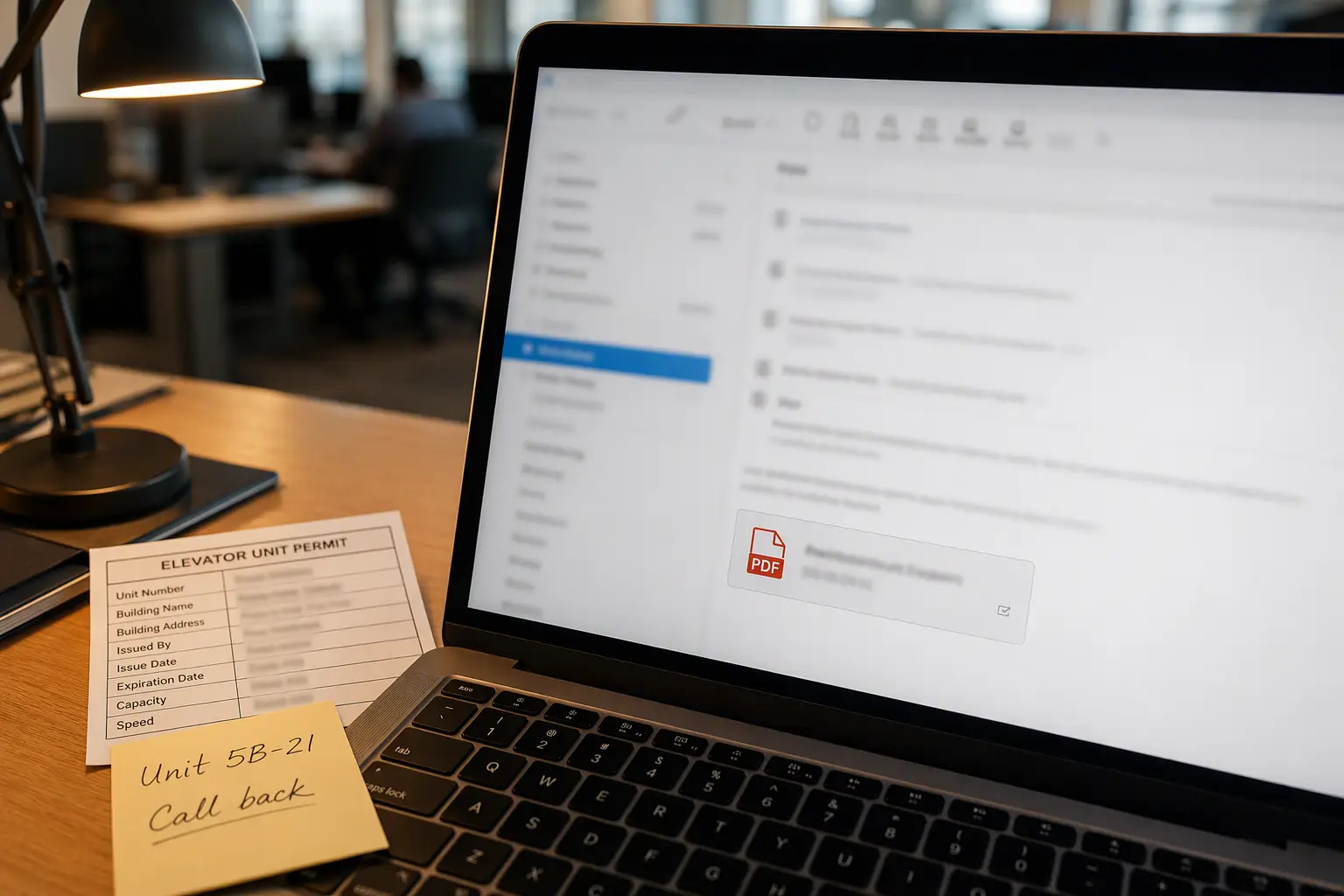
Call the company directly, state the original request date and equipment address, and ask for the quote to be resent within 24 hours while simultaneously sending a follow-up email that creates a written record of your request.
Phone contact gets immediate attention because it places a live person on the inquiry. Follow the call within minutes with an email that documents the date of the original request, the scope of work described, the address and elevator identification number, and the deadline by which the quote is needed. Sending both channels simultaneously removes any claim that the message was missed. Keep copies of all correspondence — if a compliance deadline is approaching, that paper trail demonstrates due diligence to regulators.
If the vendor does not respond within the agreed window, escalate to a supervisor or service manager rather than a dispatcher, and note the escalation date in writing. A vendor who cannot manage quote delivery may also struggle with scheduling, parts procurement, and documentation — factors that matter when a Cal/OSHA inspector arrives.
Why do elevator repair quotes go missing in the first place?
Quotes most commonly go missing because of email filtering, incorrect contact details on file, internal routing delays at the elevator company, or the quote being held pending a parts or pricing confirmation that was never completed.
Spam filters are the single most common culprit for lost quotes. PDF attachments from unknown domains are frequently intercepted by enterprise email security systems. Asking the vendor to resend the quote as plain text or through a different sending address often resolves this instantly.
Internal delays at the contractor are also common. A technician may have submitted field notes but a service writer or estimator has not yet converted those notes into a formal document. Asking specifically whether the quote has been “generated” versus “sent” exposes this gap early and lets you push for a concrete completion date.
What information should be ready before calling to follow up?
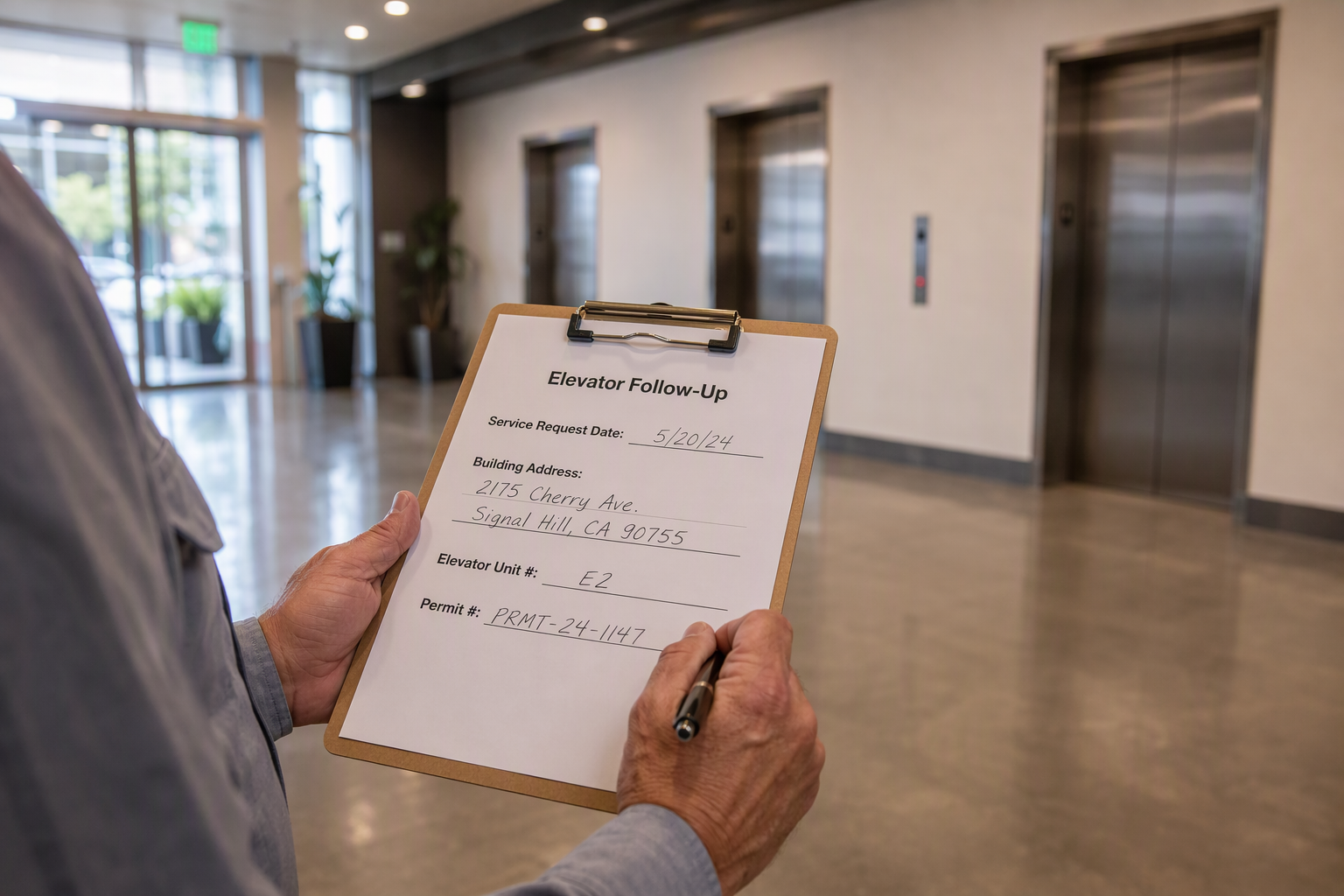
Have the original service request date, the building address, the elevator unit number or Cal/OSHA permit number, the name of the technician or representative who visited, and the email address to which the quote was supposed to be sent.
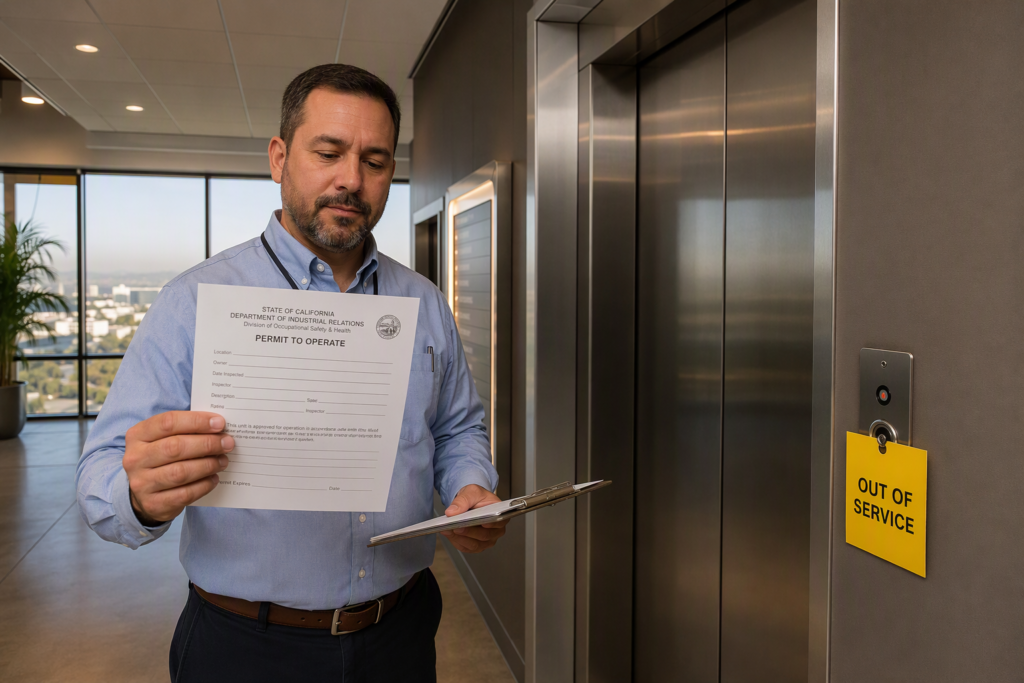
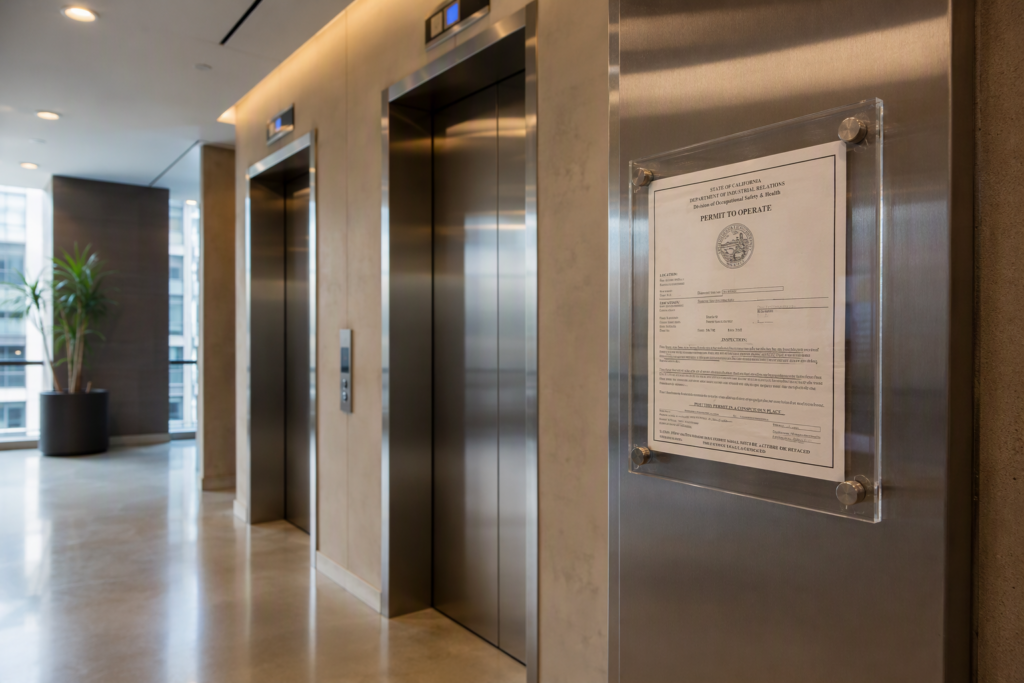
The Cal/OSHA permit to operate is posted conspicuously inside the elevator car under California law — the permit number on that document ties directly to the unit in the state’s conveyance database and removes any ambiguity about which elevator is being discussed. Having that number on hand shortens the conversation significantly.
Also note the scope of repairs that were discussed during the site visit. Technicians sometimes quote line items selectively if parts prices are in flux; knowing exactly what was requested lets the building owner verify that the returned quote covers the full scope and not a reduced version of the work.
How long should a building owner wait before requesting a competing quote?
If a quote has not arrived within five to seven business days of a follow-up contact with no explanation given, requesting a competing quote from a second licensed contractor is reasonable and prudent.
For routine maintenance pricing, three to five business days is a standard turnaround. For complex modernization or major component replacement, two weeks may be reasonable. However, if a follow-up call or email produces no response at all, the vendor has effectively signaled an inability to prioritize the account. At that point, building owners in Los Angeles, Long Beach, Signal Hill, and Orange County should contact a second Cal/OSHA-certified Qualified Conveyance Company (CQCC) without further delay.
The urgency increases substantially when the elevator is out of service. California law requires a valid permit to operate for any elevator in service, and a unit that remains offline while a quote sits in limbo still accrues maintenance and compliance obligations for the owner.
What should a complete elevator repair quote contain?
A complete elevator repair quote should include the scope of work with specific components named, part numbers or descriptions, labor hours estimated, applicable code references, warranty terms, and the contractor’s CQCC certification number.
| Quote Element | Why It Matters | Red Flag if Missing |
|---|---|---|
| Scope of Work Description | Defines exactly what repairs are included | Contractor may exclude key components mid-job |
| Component / Part Names | Allows apples-to-apples comparison with competing quotes | Cannot verify OEM vs. aftermarket parts |
| Labor Estimate | Reveals whether technician hours are realistic | Hidden overruns likely |
| Code Reference (ASME A17.1, Title 8) | Confirms repair meets California’s adopted standard | Work may fail Cal/OSHA inspection |
| CQCC Certification Number | Confirms legal authority to work in California | Contractor may be unlicensed — illegal in CA |
| Permit / Alteration Notice | Material alterations require a Cal/OSHA permit before work begins | Owner may face stop-work order |
| Warranty Terms | Protects against early component failure | No recourse if repair fails quickly |
| Quote Validity Period | Locks pricing while owner reviews | Price may change without notice |
California’s Elevator Safety Orders, found in the California Code of Regulations, Title 8, Sections 3000–3146, require that a permit from Cal/OSHA be obtained before any material alteration is performed on a conveyance. A reputable quote will acknowledge this requirement and describe who is responsible for pulling the alteration permit — typically the CQCC, not the building owner.
Does California law require a licensed company to provide elevator repair quotes?
California law does not regulate the act of quoting specifically, but any company that ultimately performs elevator work in California must hold a Certified Qualified Conveyance Company (CQCC) certification from Cal/OSHA and a C-11 Elevator Contractor license from the California Contractors State License Board (CSLB).
Receiving a quote from an unlicensed company is a warning sign even if the price appears attractive. Under California Labor Code Sections 7300–7324.2, only a CQCC may maintain, repair, alter, or replace components on a conveyance in California, and all mechanics performing unsupervised work must hold a Certified Competent Conveyance Mechanic (CCCM) certification from Cal/OSHA. Work performed by an uncertified company can void inspection approvals and expose the building owner to liability.
When comparing quotes, ask each contractor to provide their CQCC number and C-11 license number in writing. Both can be verified through the California Department of Industrial Relations and the CSLB respectively.
What steps should be followed if the elevator is currently out of service while awaiting the quote?
- Post clear, visible out-of-service notices at every floor landing and at the elevator entrance, noting that the unit is undergoing assessment.
- Contact the elevator company that performed the initial assessment and ask for an expedited verbal or written estimate within 24 hours, citing the out-of-service status explicitly.
- Verify whether the unit’s Cal/OSHA permit to operate is still valid — a permit does not automatically lapse when an elevator is taken offline, but any repair work must be completed and inspected before the unit is returned to service.
- If the repair involves a material alteration, confirm that the CQCC will apply for a Cal/OSHA alteration permit before work begins.
- Notify building occupants and, where applicable, ADA accommodation coordinators, since extended downtime in a building with only one elevator may trigger obligations under the Americans with Disabilities Act.
- If the original vendor remains unresponsive after 24 hours, contact a second CQCC-certified elevator contractor to obtain a competing quote without waiting further.
- Document every contact attempt with date, time, and method — this record protects the building owner if a Cal/OSHA inspector inquires about the delay in returning the unit to service.
How should a building owner compare multiple elevator repair quotes?
Compare quotes by aligning each line item against a common scope, verifying that all referenced parts meet the California-adopted ASME A17.1/CSA B44 standard, and weighting contractor credentials alongside price.
The lowest price does not always represent the best value. A quote that omits a Cal/OSHA alteration permit, uses non-OEM components in a safety-critical assembly, or underestimates labor hours creates cost and compliance risk that exceeds any upfront savings. Align each quote against the exact scope described during the site visit — if two quotes diverge significantly in scope, call each contractor and ask them to revise against an identical written scope before making a final comparison.
Credential verification should be non-negotiable. Liftech Elevator operates as a CQCC-certified elevator company serving Signal Hill, Long Beach, Los Angeles, and Orange County, and routinely provides written quotes that clearly identify the certification numbers required by California law. Building owners should hold all competing vendors to the same documentation standard.
Can the building owner be held responsible for delays caused by a missing quote?
Yes — under California law, arranging annual reinspection and maintaining a valid permit to operate is the elevator owner’s responsibility, and Cal/OSHA does not recognize vendor unresponsiveness as a formal exemption from compliance obligations.
This is why pursuing a competing quote quickly is not just a business best practice — it is a compliance strategy. If a Cal/OSHA inspection finds that a known deficiency went unrepaired because a quote was never received, the liability rests with the building owner. Documented follow-up attempts demonstrate that the owner acted in good faith, but they do not substitute for completed repairs when a safety issue is involved.
Under California Labor Code Sections 7300–7324.2, no elevator may operate without a valid permit, and permits are tied to the elevator being in a safe condition. A known deficiency that prevents safe operation means the unit should not be in service — delaying repair for administrative reasons does not change that legal reality.
What should a building owner do if a vendor says the quote was sent but it was never received?
Ask the vendor to confirm the exact email address used, request a read receipt or delivery confirmation on the resent quote, and ask them to also deliver it by a second method such as text, fax, or a customer portal link.
A vendor who claims a quote was sent should be able to provide the outbound email timestamp from their system within minutes. If that confirmation is not forthcoming, the quote likely was never generated. Requesting delivery through a second channel — a direct PDF link, a customer portal, or even a printed copy delivered on the vendor’s next site visit — removes any further technical excuse.
Keep the email exchange. If the vendor later claims payment is due on work performed against an undisclosed quote, the documented absence of a received quote is important evidence in any dispute.
How does ADA compliance factor into a delayed elevator repair?
Under the Americans with Disabilities Act, buildings covered by Title II or Title III must maintain accessible features in operable condition, meaning an elevator that is the only accessible route cannot simply remain out of service indefinitely while a quote is chased down.
The ADA requires that accessibility features be maintained in working condition except for isolated or temporary interruptions due to maintenance or repair. An extended outage caused by administrative delays in obtaining a repair quote could be interpreted as a failure to maintain accessibility. Building owners should treat elevator downtime with the same urgency as any other ADA compliance matter and pursue alternative quotes immediately if the primary vendor is unresponsive.
For buildings in Los Angeles, the Department of Building and Safety (LADBS) operates its own elevator and conveyance inspection program. Building owners should be aware that local compliance obligations may exist alongside state-level Cal/OSHA requirements, and that an extended elevator outage may attract attention from both agencies.
What is the role of a Cal/OSHA permit to operate during the repair process?
A Cal/OSHA permit to operate authorizes the elevator to be in service and must remain valid throughout the repair process; for material alterations, a separate alteration permit must be obtained before work begins and inspected before the elevator is returned to service.
The permit to operate is posted inside the elevator car as required by California law. When a repair is classified as a material alteration under the California Code of Regulations, Title 8, Elevator Safety Orders, the building owner and CQCC must coordinate an alteration permit through Cal/OSHA before a single component is replaced. The CQCC typically manages this process, but the building owner should confirm it is underway before authorizing work to begin.
California law allows Cal/OSHA to issue a permit to operate for up to two years for an elevator in safe condition that is covered by a full maintenance contract with a C-11 licensed elevator company. This extended permit interval is one tangible benefit of maintaining a full-service agreement with a qualified contractor — and one more reason why selecting the right CQCC matters before a repair situation arises.
What questions should be asked when the quote finally arrives?
Upon receiving a long-delayed quote, verify that the scope matches the original request, confirm the Cal/OSHA alteration permit responsibility is assigned, check the parts warranty, and ask whether the quoted labor rate reflects the current technician availability and scheduling lead time.
A quote that sat in process for an extended period may carry outdated parts pricing. Verify that the validity period stated on the document is still current — some quotes expire after 30 days, and if the quote was generated weeks ago but only just delivered, the pricing may no longer be honored. Ask the estimator to confirm in writing that the price is valid as of the date of receipt, not the date of generation.
Also ask specifically about the scheduling lead time for the repair itself. A quote with attractive pricing that comes with a six-week scheduling delay may not serve a building with an urgent compliance need. Understanding the realistic start date is as important as understanding the repair cost.
Should building owners consider a full maintenance contract after a problematic repair experience?
Yes — a full maintenance contract with a CQCC-certified company typically provides faster response, dedicated technician familiarity with the specific equipment, and in California, eligibility for a two-year permit to operate from Cal/OSHA, which reduces annual inspection coordination burden on the owner.
Building owners who have experienced delays in obtaining a repair quote often find that those delays are symptomatic of a vendor relationship that treats their account as reactive rather than proactive. A full maintenance contract formalizes the relationship, establishes response expectations, and keeps technicians familiar with the equipment — meaning diagnostics are faster, parts are more likely to be stocked, and quotes for non-routine repairs are generated by technicians who already know the unit’s condition.
Liftech Elevator provides maintenance services for elevator systems across Long Beach, Signal Hill, Los Angeles, and Orange County, and building owners in those markets can request a maintenance consultation to understand what a full-service agreement would include for their specific conveyance type and usage.
How does elevator age and modernization need affect the quoting process?
Older elevator systems, particularly those installed before the California-adopted ASME A17.1-2004 standard took effect in 2008, may require longer quoting lead times because parts must be sourced from specialty suppliers, and modernization scopes require more detailed engineering assessment before pricing.
California’s adopted elevator safety code — ASME A17.1/CSA B44, 2004 edition — applies to installation contracts signed on or after May 1, 2008. Elevators installed under earlier standards are evaluated against the existing installation standard applicable at the time of installation, but repairs and alterations must be made in compliance with the current Elevator Safety Orders. For older equipment, this can mean that a repair quote must address code upgrade requirements in addition to the presenting deficiency, which legitimately extends the time needed to generate an accurate quote.
California has also proposed a Group V update to its Elevator Safety Orders that would incorporate portions of ASME A17.1-2019; a public hearing was held in June 2026 and no effective date has been posted as of this writing. Building owners planning major modernizations should ask their CQCC how a pending code update may affect the scope and cost of planned work.
What records should a building owner keep after resolving a missing quote situation?
Retain all correspondence related to the quote request and follow-up, the final signed quote, the repair completion documentation, any Cal/OSHA alteration permits, and the updated permit to operate — these records support compliance defense and future vendor accountability.
California law places inspection and compliance responsibility on the elevator owner. Maintaining a well-organized file for each conveyance — including every quote, work order, inspection report, and permit — means that any future audit by Cal/OSHA or a local authority can be responded to quickly and completely. For buildings in Los Angeles, where LADBS operates its own inspection program, both state and local records may be relevant.
A best practice is to create a digital folder for each elevator unit identified by its Cal/OSHA permit number, with subfolders for each calendar year. Quotes, even declined ones, belong in that file — they document what conditions were known at a given point in time, which can be relevant if a subsequent incident is alleged to have been foreseeable.
What are the most common repair categories for which building owners seek quotes?
The most frequently quoted elevator repairs involve door operator systems, hydraulic pump units, controller and relay panel replacements, rope and sheave inspections, and cab interior refurbishment — each with different parts availability timelines and permit implications.
Door operator failures are among the most common service calls because door systems interact with safety circuits governed by the ASME A17.1 Safety Code for Elevators and Escalators. A quote for door operator work should identify whether the repair restores the existing operator or replaces it with a modern unit, since replacement may constitute a material alteration requiring a Cal/OSHA permit.
Hydraulic system repairs — common in low-rise buildings throughout Signal Hill and Long Beach — often involve the pump unit, jack cylinder, or hydraulic fluid system. These quotes may also include environmental compliance considerations for fluid containment under California environmental regulations, which a knowledgeable CQCC will incorporate into the scope. Liftech Elevator’s service teams are familiar with the hydraulic equipment common across commercial properties in these markets.
How should a building owner evaluate vendor responsiveness as a selection criterion?
Quote turnaround time and communication quality during the sales process are reliable predictors of how a vendor will behave during emergency service calls, inspection coordination, and permit management — treat a slow or silent quote response as meaningful data about the vendor.
A CQCC that cannot deliver a quote within a stated timeframe without follow-up is demonstrating its service culture before any contract is signed. Conversely, a vendor that responds quickly, provides a detailed and clearly documented quote, explains permit requirements proactively, and offers to answer questions before the quote is accepted is showing that it has the organizational capacity to manage California’s layered compliance environment effectively.
Building owners across Los Angeles, Long Beach, Orange County, and Signal Hill have access to multiple CQCC-certified contractors. Competition in the market means that responsiveness is a reasonable expectation, not a premium service — and vendors who fail to meet that expectation during the quoting process should be evaluated accordingly when selecting a long-term service partner.
When should a building owner escalate a missing quote situation to a formal complaint?
A formal complaint to Cal/OSHA or the CSLB is warranted if a contractor performed a site visit, charged an assessment fee, and then refused or failed to provide a quote while also refusing to return the elevator to a serviceable state — not simply for administrative slowness.
Most missing quote situations are resolved through direct follow-up without regulatory involvement. However, if a contractor has collected payment for an assessment, identified deficiencies that prevent safe operation, and then gone dark — leaving the building owner with an out-of-service elevator and no quote — that conduct may cross into actionable territory. The Cal/OSHA Elevator Unit oversees CQCC conduct in California, and the CSLB handles complaints against C-11 license holders.
Document every interaction before filing any complaint, and keep the focus on the safety and compliance consequences of the delay rather than the administrative inconvenience alone. Regulatory agencies are most responsive to complaints that identify a specific safety risk to elevator users.
How can building owners in Signal Hill, Long Beach, Los Angeles, and Orange County find a reliable elevator repair contractor quickly?
Verify CQCC certification through the Cal/OSHA Elevator Unit directory, confirm the C-11 license through the CSLB, check for local references in the specific market, and request a written quote with a stated turnaround time before authorizing any site visit.
California’s requirement that all elevator work be performed by a CQCC-certified company narrows the field appropriately — the certification process requires a current C-11 contractor license and proof of workers’ compensation and liability insurance, which means certified companies carry a baseline of accountability that unlicensed vendors do not. Confirming certification takes minutes and eliminates a significant category of risk.
Local market knowledge also matters. An elevator company that regularly works in Long Beach, Signal Hill, and the surrounding cities will have established relationships with local parts suppliers, familiarity with the equipment types common to those markets, and experience navigating the Los Angeles LADBS inspection program where applicable. Liftech Elevator serves all four of these markets and brings that local familiarity to every repair assessment and quote it provides.
Contact Liftech Elevator for a free elevator assessment at 562-997-3639.
Need elevator service you can rely on? Liftech Elevator is ready to help.