Signs Your Building Elevator Is About to Fail — And How to Prevent an Emergency Shutdown
Building elevators rarely fail without warning. In most cases, a pattern of subtle mechanical, electrical, and operational symptoms appears weeks or even months before a full shutdown occurs. Property managers, building engineers, and facilities directors who learn to recognize these early indicators — and who maintain a proactive service relationship with a qualified elevator company — can avoid costly emergency repairs, liability exposure, and the disruption of an unplanned outage. The sections below answer the most common questions property professionals ask about elevator failure, prevention, and compliance.
What are the earliest warning signs that an elevator is approaching mechanical failure?
The earliest warning signs include unusual audible changes, leveling problems, and increased callback frequency — often months before a complete shutdown.
Elevator systems communicate impending failure through predictable symptom clusters. Grinding or squealing from the hoistway typically indicates worn guide shoes or dry hoist ropes. A “clunk” at the start or stop of travel often points to worn motor mounts or deteriorating drive sheave grooves. Leveling errors — where the cab stops two or more inches above or below the floor — signal worn braking components, encoder drift, or hydraulic fluid irregularities in hydraulic units.
A sudden increase in the number of service calls to reset a fault code is one of the strongest statistical predictors of impending failure. When a single fault type recurs more than twice within a 30-day period, it warrants immediate diagnostic evaluation rather than a simple reset. Experienced elevator technicians treat callback patterns as data, not nuisance events.
What sounds indicate an elevator needs urgent attention?
Grinding, banging, squealing, and rattling sounds during travel or door operation each point to specific mechanical failures that require prompt inspection.
Different sounds correspond to different systems. A grinding noise during travel usually involves guide shoes, roller guides, or the rail lubrication system. Banging at the top or bottom of travel may indicate buffer contact or counterweight issues. A high-pitched squeal during door operation is often a worn door operator motor or mis-adjusted clutch roller. Rattling from the cab interior can signal loose car sling components or failed cab isolation mounts.
None of these sounds should be dismissed as cosmetic. Under the ASME A17.1 Safety Code for Elevators and Escalators, a qualified elevator mechanic must inspect and correct any condition that indicates the unit is not functioning as designed. Continuing to operate a noisy elevator without inspection may also create liability under California Code of Regulations Title 8, which governs elevator safety in the state.
How do door malfunctions signal a broader elevator problem?
Door failures are the single most common cause of elevator-related incidents, and recurring door faults almost always indicate a system problem beyond the door itself.
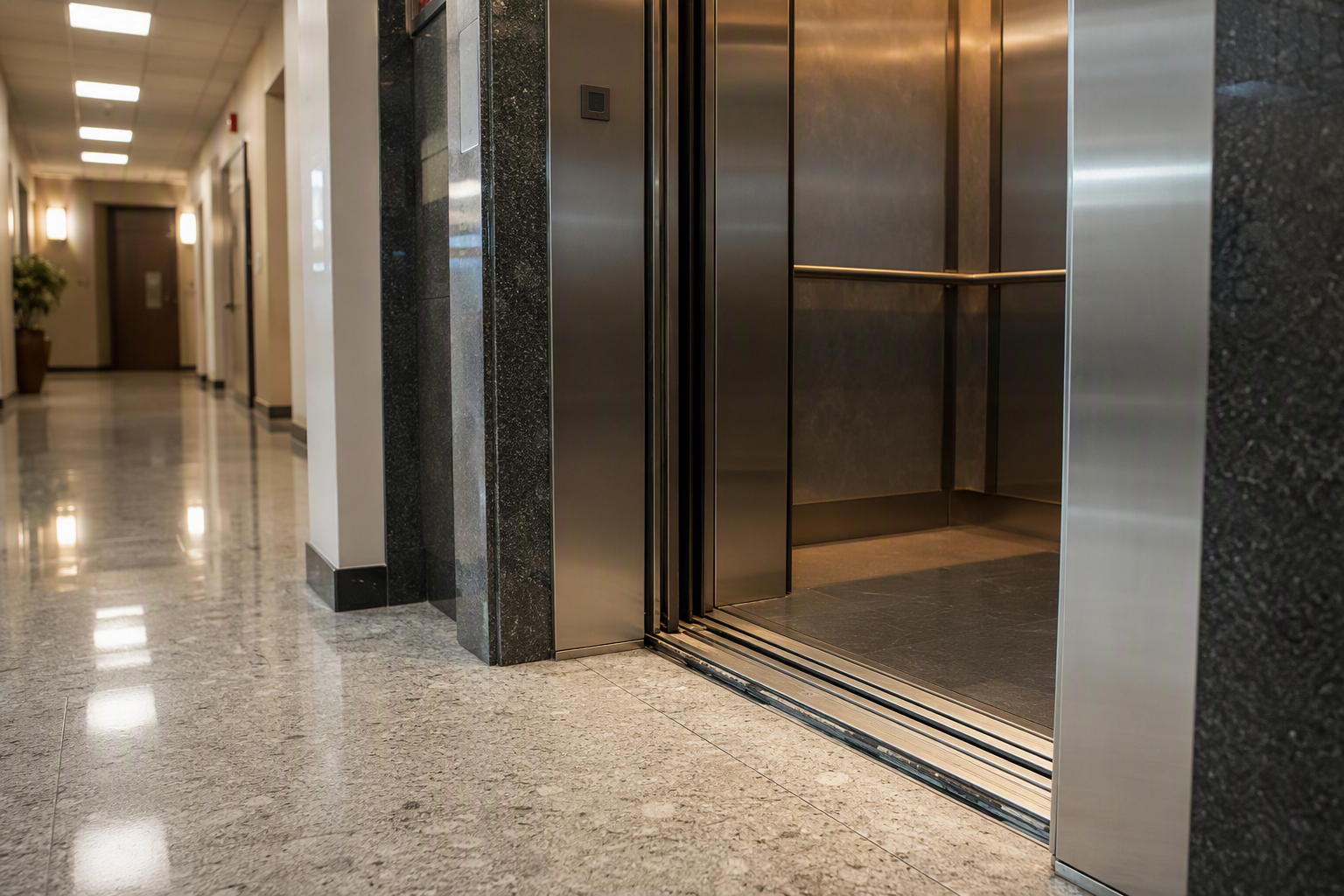
Elevator doors that hesitate, reverse without obstruction, close too slowly, or repeatedly trigger safety edges are showing signs of worn door operator components, misaligned sill tracks, or a deteriorating landing zone sensor system. In traction elevators, door timing problems can also be a symptom of a failing drive controller, because door open and close commands originate from the same control board that manages travel.
Property managers who notice that door-related service calls are increasing — especially if those calls involve different floors — should treat this as a systemic warning sign. A floor-specific door fault usually means a mechanical issue at that landing. A building-wide pattern of door faults often means the controller or door operator system is degrading globally.
What does elevator leveling error mean and why is it dangerous?
Leveling error — when a cab stops significantly above or below the floor — is a tripping hazard, an ADA compliance violation, and a symptom of brake, drive, or hydraulic system deterioration.
Acceptable floor-to-landing alignment under ADA guidelines and industry practice is typically within half an inch. When an elevator consistently misses the floor sill by a larger margin, passengers face a real fall risk at every exit. Beyond the immediate safety concern, persistent leveling errors accelerate wear on the landing zone vanes and sensors, potentially cascading into door failures or safety circuit trips.
In hydraulic elevators, leveling errors are frequently caused by worn packing seals leaking hydraulic fluid, causing the jack to drift after stopping. In traction elevators, brake shoe wear or encoder calibration drift are common culprits. Neither condition corrects itself — both require hands-on technical service.
How often should elevators be inspected to prevent emergency shutdowns?
California law requires annual safety inspections by a certified elevator inspector, but industry best practice — and ASME A17.1 guidance — calls for monthly maintenance visits to prevent between-inspection failures.
Annual inspections mandated by California’s Division of Occupational Safety and Health (Cal/OSHA) establish a legal minimum, but they are not a substitute for ongoing maintenance. The ASME A17.1 Safety Code for Elevators and Escalators provides detailed maintenance task tables (Part 8) that classify tasks by frequency — some tasks are monthly, some quarterly, and some annual. A compliant maintenance program executes all of them on schedule.
Buildings with high call volume, older equipment (generally 15 or more years), or a history of callbacks should consider maintenance visit frequency above the monthly baseline. Liftech Elevator develops customized maintenance schedules for properties in Signal Hill, Long Beach, Los Angeles, and Orange County based on actual equipment age, usage data, and observed fault trends rather than a one-size-fits-all contract.
What is a maintenance control program and does my building need one?
A Maintenance Control Program (MCP) is a written, equipment-specific maintenance plan required under ASME A17.1-2019 and later editions, and most commercial buildings in California are now required to have one on file.
The MCP requirement, introduced in the ASME A17.1 Safety Code for Elevators and Escalators, mandates that elevator contractors provide building owners with a written document that lists every maintenance task for the specific equipment installed, including the frequency of each task and a log to confirm completion. This is not a generic checklist — it must reflect the actual make, model, and configuration of each elevator in the building.
California inspectors increasingly check for MCP documentation during annual inspections. Buildings without a current MCP may face compliance violations. Property managers should request a copy of their MCP from their elevator service company and verify that it is being maintained with up-to-date technician entries.
What are the most common causes of unplanned elevator shutdowns?
The most common causes of emergency elevator shutdowns are deferred maintenance, worn braking components, hydraulic fluid contamination or leaks, aging control boards, and safety circuit failures triggered by accumulated minor faults.
| Cause | Early Warning Symptom | Elevator Type Most Affected | Prevention Action |
|---|---|---|---|
| Brake shoe wear | Leveling drift, slow stop response | Traction (MRL & conventional) | Brake adjustment/replacement at maintenance intervals |
| Hydraulic fluid leak or contamination | Slow descent, floor leveling errors, fluid odor | Hydraulic | Fluid analysis, seal inspection, valve testing |
| Control board / PCB failure | Erratic behavior, random fault codes, door timing issues | All types | Board diagnostics during routine visits; board replacement before failure |
| Safety circuit fault accumulation | Intermittent nuisance trips, increasing callback frequency | All types | Root-cause analysis on every fault; never reset without documentation |
| Drive / motor deterioration | Noise, vibration, slow acceleration or deceleration | Traction | Motor insulation testing, drive diagnostics at annual service |
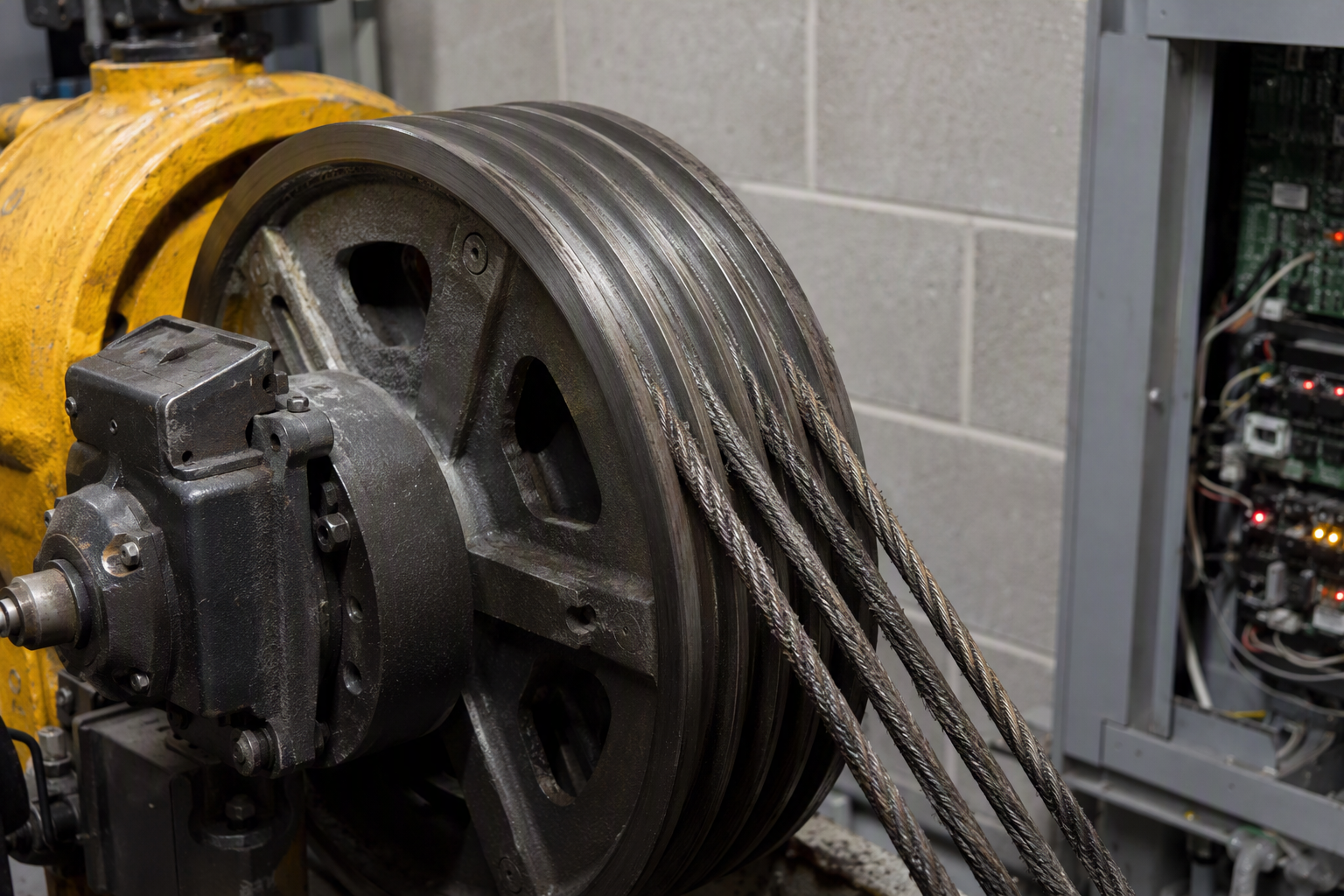
| Worn hoist ropes or belts | Vibration, audible fraying, reduced ride quality | Traction | Rope inspection per ASME A17.1 discard criteria |
| Pit flooding or contamination | Safety device trips, unusual odors, visible moisture | All types | Pit pump inspection, waterproofing review |
How does building age affect elevator failure risk?
Older buildings often have elevators operating on original equipment that has exceeded its service design life, making component failures more frequent and harder to predict.
Most elevator components — drives, controllers, door operators, and hydraulic valves — have a finite service life that is expressed in operating cycles or years. As equipment approaches or exceeds these thresholds, the probability of failure increases non-linearly. Parts for legacy systems also become scarcer, which means longer downtime when failures do occur because components must be sourced, fabricated, or cross-referenced from newer equivalents.
Southern California’s commercial building stock includes a large number of structures from the 1970s through the 1990s, many of which house elevators that have never undergone a full modernization. Property owners in Long Beach, Los Angeles, and Orange County managing these assets should conduct a modernization feasibility assessment to determine whether continued repair of aging equipment remains cost-effective compared to a phased modernization plan.
What should a property manager do immediately if an elevator shows signs of imminent failure?
A property manager who observes serious warning signs should take the elevator out of service immediately, notify occupants, and contact a licensed elevator service company for an emergency inspection.
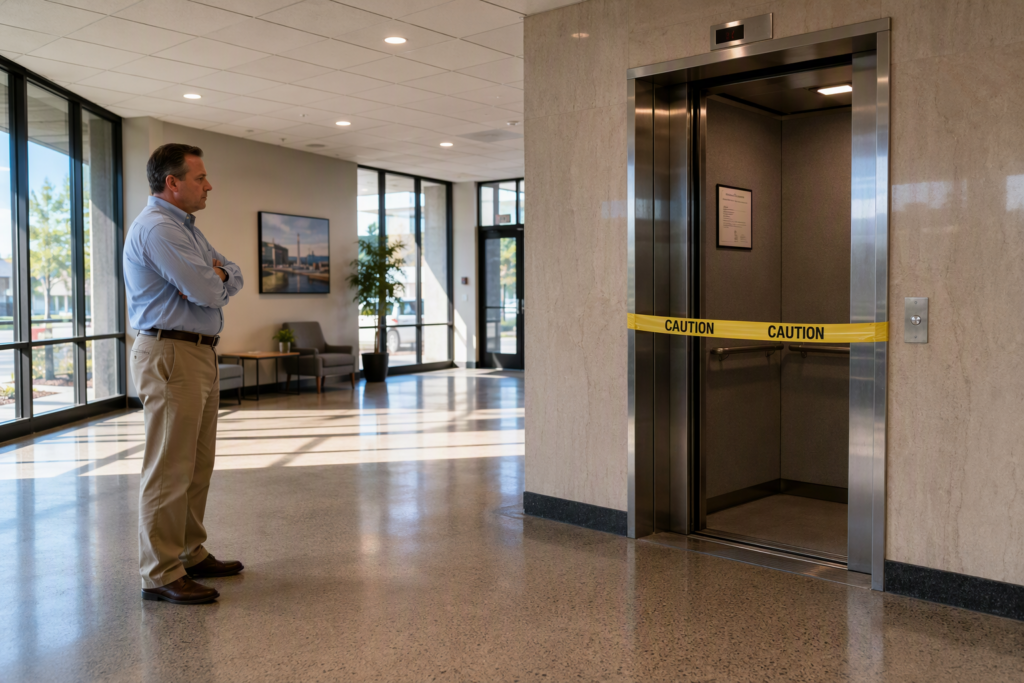
- Place the elevator out of service. Use the key switch in the car or machine room to lock the unit out of service. Do not wait for the elevator to fail with a passenger inside.
- Post clear signage at all landings. Alert building occupants that the elevator is temporarily out of service and direct them to stairwells or accessible alternatives.
- Document the observed symptoms. Note the exact nature of the problem — sounds, floor levels, fault codes displayed, time of occurrence — and provide this information to the service technician. Detailed documentation speeds diagnosis.
- Contact your elevator service company. Report the issue as an emergency service call. Provide the building address, elevator unit number, and a description of the symptoms observed.
- Notify ADA-dependent occupants. If the building serves people with mobility disabilities, immediately arrange alternative accessible access or temporary accommodation in compliance with ADA requirements.
- Do not attempt to reset faults without professional guidance. Repeated manual resets can mask a developing safety hazard and may violate California elevator safety regulations.
- Review your maintenance records. Gather recent inspection reports, maintenance logs, and the current MCP to provide the technician with full service history context.
What elevator problems require immediate shutdown versus a scheduled repair?
Conditions that create an immediate safety risk — including brake failure symptoms, entrapment risk, oil leaks near ignition sources, and active safety device trips — require immediate shutdown; cosmetic or performance issues may be addressed in a scheduled repair window.
Immediate shutdown is warranted when any of the following are observed: the elevator moves with the doors open, the car travels past a floor without stopping, passengers report a sudden drop sensation, an unusual burning smell is present, the safety gear or buffer has been activated, or pit flooding has reached safety device height. These conditions indicate that a fundamental safety system may have already failed or is about to fail.
Scheduled repair — meaning the unit can remain in service until a booked appointment — is appropriate for minor cosmetic damage, a single intermittent door reversal without recurrence, non-critical indicator lights that have failed, or minor vibration without associated fault codes. Even these issues should not be indefinitely deferred; they belong in a scheduled service queue within a reasonable timeframe.
How can a building owner prevent elevator failures through a proactive maintenance contract?
A comprehensive maintenance contract that includes defined task frequencies, parts coverage, callback response commitments, and documented fault tracking is the most effective tool for preventing emergency shutdowns.
Not all maintenance contracts are equal. A full-coverage maintenance agreement typically includes lubrication, adjustment, cleaning, safety tests, parts replacement for normal wear items, and unlimited callbacks. A basic oil-and-grease contract covers only the minimum — lubrication and visual checks — and excludes parts, leaving building owners exposed to unpredictable repair costs for components that routine maintenance would have flagged in advance.
Property managers in Signal Hill, Long Beach, and the surrounding Los Angeles and Orange County markets should carefully review the task appendix in any elevator maintenance contract and compare it against the ASME A17.1 Maintenance Control Program task requirements. Liftech Elevator structures maintenance agreements to align with ASME A17.1 task tables, ensuring that the contract scope matches what the code actually requires rather than what is minimally convenient to provide.
What role does hydraulic fluid condition play in elevator reliability?
Degraded or contaminated hydraulic fluid accelerates valve and seal wear, causes inconsistent leveling, and is a primary driver of hydraulic elevator shutdowns.
Hydraulic elevator systems rely on clean, properly viscous fluid to maintain precise pressure control through the power unit valve. Over time, fluid absorbs moisture, oxidizes, and accumulates metal particulates from internal component wear. This contamination causes control valves to stick or leak, resulting in slow descent speeds, over-travel at landings, and eventually, a failure of the lowering valve to respond predictably — a condition that can trap passengers between floors.
Fluid sampling and analysis — similar in concept to engine oil analysis used in fleet maintenance — is an underutilized tool for hydraulic elevator health monitoring. California environmental regulations also impose specific requirements on hydraulic fluid disposal and leak containment, which building owners should confirm are being addressed in their maintenance program.
How does modernization differ from repair, and when does it become necessary?
Modernization replaces entire subsystems — controls, drives, door operators, or fixtures — rather than individual components, and it becomes necessary when repair frequency and cost exceed the value of maintaining legacy equipment.
The decision to modernize versus continue repairing is a financial and operational calculation. When a building is experiencing multiple component failures within a short period, sourcing replacement parts for discontinued models, or failing inspection items that require code-required upgrades, modernization typically becomes the more economical long-term choice. A phased modernization approach — replacing the controller first, then the door equipment, then the fixtures — can distribute capital costs across multiple budget cycles while progressively improving reliability.
Modernization also provides an opportunity to bring an elevator into compliance with current editions of the ASME A17.1 Safety Code for Elevators and Escalators and with ADA accessibility requirements, reducing liability exposure and improving the building’s competitive position in the Southern California commercial real estate market.
What are the ADA compliance implications of elevator downtime or malfunction?
When a building elevator is the primary accessible route, extended downtime or persistent malfunction can constitute an ADA violation and expose building owners to discrimination complaints and legal action.
The ADA requires that buildings make reasonable accommodations to maintain accessible routes. An elevator that is chronically out of service — whether from deferred maintenance or repeated emergency shutdowns — may be viewed as a failure to maintain accessible features, which the ADA specifically addresses. Building owners cannot simply post an “out of order” sign and consider the obligation met if the elevator is the only accessible means of vertical travel.
Proactive maintenance is therefore not only an operational decision but a legal risk management strategy. Buildings in Los Angeles, Long Beach, Signal Hill, and Orange County that serve mixed occupancies — office, medical, retail — face particular exposure given the diversity of mobility needs among their occupants and visitors.
What workplace safety obligations do building owners have under OSHA regarding elevator failures?
Under OSHA general duty clause standards, building owners and employers must provide a workplace free from recognized hazards, which includes maintaining elevators that serve employees in a safe operating condition.
While elevator-specific federal OSHA standards primarily govern the construction industry, the general duty clause applies broadly to any workplace elevator that presents a recognized hazard. Cal/OSHA, California’s state-level occupational safety authority, enforces elevator safety standards under Title 8 of the California Code of Regulations and conducts both scheduled and complaint-driven inspections. A documented pattern of elevator malfunctions in a commercial building that employs workers is a potential Cal/OSHA enforcement trigger.
Building owners should retain records of every maintenance visit, fault code, callback, and inspection for a minimum period that satisfies both Cal/OSHA records requirements and their liability insurer’s documentation standards. Gaps in maintenance records are frequently cited in elevator-related litigation as evidence of negligence.
How can property managers track elevator health between service visits?
Property managers can monitor elevator health between service visits by maintaining a building-side fault log, reviewing any remote monitoring reports provided by the service company, and conducting brief daily visual checks of the cab and lobby landings.
Many modern elevator controllers — and some retrofittable monitoring systems — log fault codes internally or transmit them to a remote monitoring platform. When a service company provides access to this data, property managers should review fault frequency trends monthly, not only after a breakdown. An uptick in a previously rare fault code is a meaningful signal even if the elevator has not yet stopped running.
A simple daily property manager checklist — noting whether doors open and close cleanly, whether the cab stops level at each floor, whether any unusual sounds are present, and whether the cab interior shows signs of distress — creates a baseline record that is invaluable during a service call. Technicians who receive detailed symptom reports from building staff diagnose problems faster and more accurately.
What happens during an emergency elevator shutdown and how long does restoration typically take?
An emergency elevator shutdown involves automatic or manual activation of the safety circuit, which holds the car in place and prevents operation until the fault is cleared and tested by a licensed technician.
When an elevator’s safety circuit opens — triggered by a governor, safety gear, pit switch, overspeed condition, or door fault — the elevator stops and locks out. Passengers trapped inside must be rescued by a trained technician or, in some jurisdictions, by trained building staff following an approved entrapment procedure. Improper entrapment response is a significant liability risk and a safety concern.
Restoration time depends entirely on the nature of the fault. A tripped pit stop switch caused by flooding may be cleared and reset in under an hour if the pit is drained. A failed control board requires parts procurement, which can take days or weeks for legacy equipment. This variability is precisely why preventing emergency shutdowns through maintenance is far preferable to managing them reactively. Liftech Elevator serves properties throughout Long Beach, Signal Hill, Los Angeles, and Orange County with emergency diagnostic response to help minimize restoration timelines when shutdowns do occur.
What questions should I ask when evaluating an elevator service company for my building?
Property managers should ask prospective elevator service companies about their technician licensing, MCP documentation practices, parts availability for their specific equipment, fault tracking processes, and the scope detail in their maintenance contract.
California requires elevator mechanics to hold a Certified Competent Conveyance Mechanic (CCCM) certification issued by the Division of Occupational Safety and Health. Any company performing elevator work in the state must employ certified personnel, and building owners are entitled to confirm this. Beyond licensing, the key differentiator between elevator service companies is the operational discipline behind the maintenance program: whether they produce and maintain a proper MCP, whether they document fault codes and resolutions on every visit, and whether their contract scope matches ASME A17.1 task requirements.
Comparing the fine print of full-coverage versus basic maintenance contracts — specifically which parts, adjustments, and safety tests are included — is the most important due diligence step a property manager can take before signing a multi-year service agreement.
How much does preventive elevator maintenance cost compared to emergency repairs?
Preventive maintenance is consistently less expensive than emergency repair on a per-incident basis, and deferred maintenance compounds costs by accelerating secondary component failures.
While specific pricing varies by equipment type, building location, contract scope, and market conditions — and Liftech Elevator provides individualized proposals rather than published rates — the cost relationship between prevention and emergency repair is well-established in facilities management. A component replaced on schedule during a planned maintenance visit costs less in labor and parts than the same component replaced after a failure, because failure-mode repairs often involve additional damaged components, overtime labor, expedited parts shipping, and lost productivity for building occupants during extended downtime.
The cost of a passenger entrapment event — including emergency rescue, inspection before return to service, potential regulatory involvement, and reputational impact — typically exceeds the annual cost of a comprehensive maintenance contract many times over. Property owners evaluating whether to upgrade from a basic to a full-coverage contract should frame the decision in terms of risk-adjusted total cost, not just contract line-item price.
What is the difference between a periodic inspection and a maintenance visit?
A periodic inspection is a formal compliance event conducted by a certified elevator inspector for regulatory certification, while a maintenance visit is an ongoing service activity performed by a licensed elevator mechanic to keep the equipment operating safely and reliably.
California’s annual periodic inspection results in a Certificate of Inspection, which must be posted in the elevator cab. This inspection verifies that the equipment meets applicable safety codes at a point in time — it is not a comprehensive maintenance activity. The inspector checks safety systems, functional operation, and code compliance, but does not lubricate, adjust, or repair components.
Maintenance visits, governed by the ASME A17.1 Maintenance Control Program, are the operational work that keeps the elevator performing between inspections. A building that passes its annual inspection but receives no maintenance visits in the months between inspections is accumulating unaddressed wear that will eventually result in a failure. The inspection certificate is a compliance credential, not a guarantee of continued safe operation.
How does Liftech Elevator approach elevator failure prevention for buildings in Southern California?
Liftech Elevator applies a documentation-driven, ASME A17.1-compliant maintenance approach for commercial and residential properties in Signal Hill, Long Beach, Los Angeles, and Orange County, with the goal of identifying and correcting developing faults before they cause service disruptions.
Elevator failure prevention in Southern California’s commercial building market requires accounting for regional factors: coastal air and humidity in Long Beach and Signal Hill that accelerates corrosion of pit components and hoist ropes; high call volumes in Los Angeles high-rise and mixed-use buildings that stress door operators and drive systems; and the aging equipment profile in many Orange County mid-rise properties built during the region’s 1980s commercial expansion.
Liftech Elevator’s service approach prioritizes fault documentation on every visit, root-cause analysis rather than simple resets, and owner-facing communication that translates technical findings into actionable maintenance and capital planning decisions. Building owners and property managers who want to move from reactive to predictive elevator management are encouraged to start with a professional assessment of their current equipment condition and maintenance program.
Get a Free Elevator Assessment From Liftech Elevator
If your building’s elevator is showing any of the warning signs described above — or if your current maintenance program does not include a documented Maintenance Control Program aligned with ASME A17.1 Safety Code for Elevators and Escalators — the right next step is a professional equipment assessment.
Liftech Elevator provides free elevator assessments for commercial and residential properties in Signal Hill CA, Long Beach CA, Los Angeles CA, and Orange County CA. An assessment covers current equipment condition, maintenance program compliance gaps, fault history review, and modernization feasibility — giving building owners the information they need to make confident, cost-effective decisions before a problem becomes an emergency.
Contact Liftech Elevator for a free elevator assessment: 562-609-3478
Need elevator service you can rely on? Liftech Elevator is ready to help.