Full-Service vs. Oil-and-Grease Elevator Contracts for Healthcare Facilities
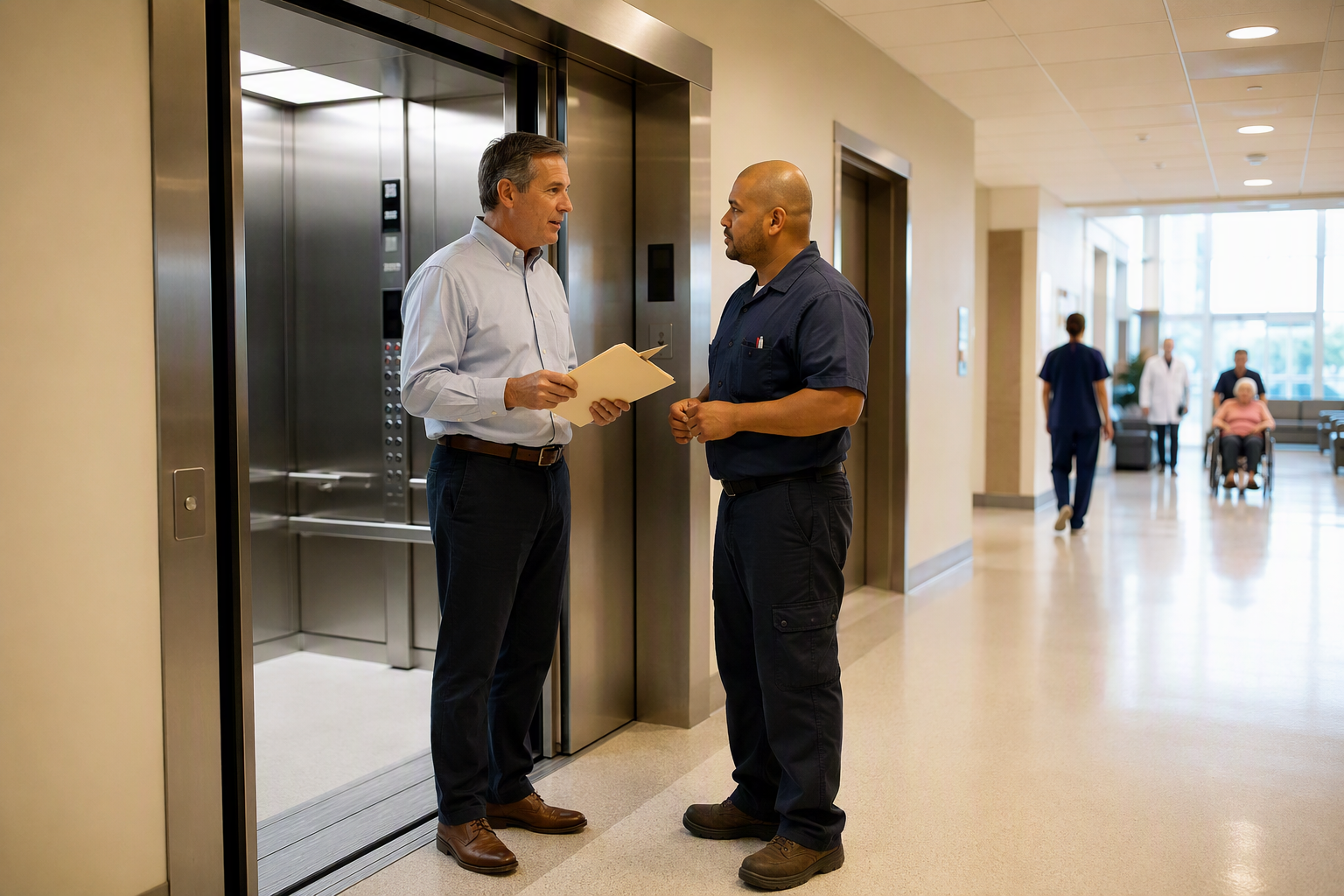
Choosing the right elevator maintenance contract is one of the most consequential facilities decisions a healthcare administrator can make. Elevators in hospitals, outpatient surgery centers, skilled nursing facilities, and medical office buildings throughout Signal Hill, Long Beach, Los Angeles, and Orange County are not simply a convenience — they are a critical component of patient transport, equipment movement, and ADA-mandated accessibility. The wrong contract tier can mean unexpected repair invoices, compliance violations, and, most critically, an elevator that is out of service when a patient needs it most.
This guide breaks down both contract types, applies them specifically to the healthcare environment, and helps facilities managers ask the right questions before signing.
What Is a Full-Service Elevator Maintenance Contract?
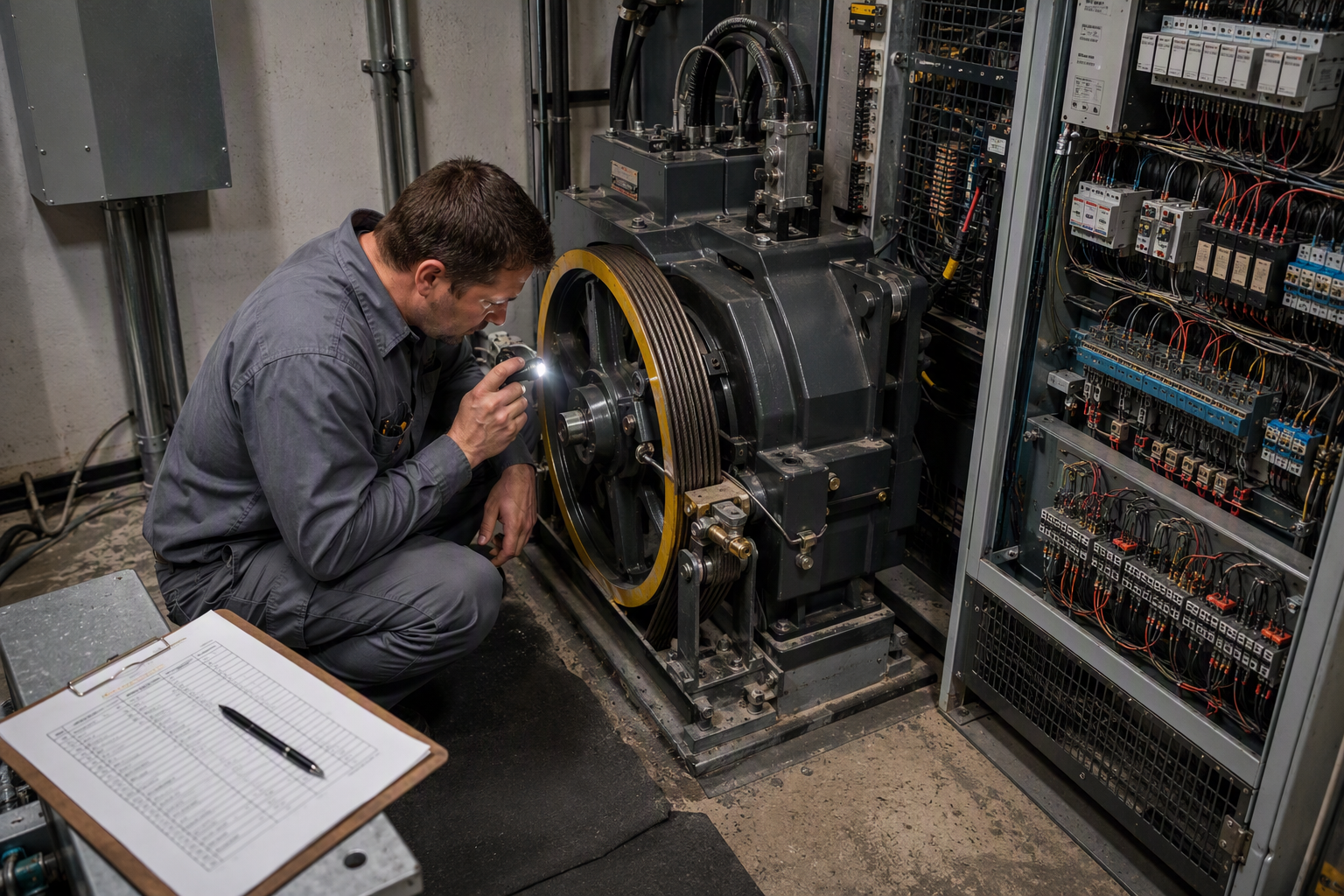
A full-service contract (sometimes called a comprehensive contract) covers routine preventive maintenance visits, lubrication, adjustments, and — critically — the cost of most parts and labor required for repairs discovered during those visits or between them. When a component fails, the service provider replaces it without generating a separate invoice for every part.
In a healthcare setting, this matters because elevator systems run far more hours per day than comparable commercial buildings. Patient beds, medication carts, imaging equipment, and dietary deliveries all depend on vertical transport. Unexpected repair costs can also destabilize a capital budget that was already allocated to clinical operations.
Liftech Elevator offers full-service agreements structured for the higher utilization demands of healthcare campuses across Long Beach, Signal Hill, Los Angeles, and Orange County.
What Is an Oil-and-Grease Elevator Maintenance Contract?

An oil-and-grease contract (also called a lubrication-only or basic maintenance contract) covers scheduled preventive maintenance visits — lubricating moving parts, inspecting safety devices, and making minor adjustments — but does not include the cost of parts or repair labor beyond those basic tasks. Any component replacement generates a time-and-materials invoice.
This contract type can be appropriate for low-traffic, low-criticality installations where budget constraints are significant and the facility has the reserves to absorb occasional repair invoices. For most healthcare environments, however, the unpredictability of out-of-pocket repair costs and the risk of deferred repairs creates exposure that outweighs the lower monthly contract rate.
Which Contract Type Is Required by Healthcare Regulations?
No federal regulation mandates a specific contract tier for healthcare elevator maintenance by name. However, several overlapping compliance frameworks shape what “adequate” maintenance looks like in practice.
The ASME A17.1 Safety Code for Elevators and Escalators establishes the minimum maintenance, inspection, and testing requirements that apply in California and across the country. Under ASME A17.1, all maintenance must be performed by a qualified elevator mechanic, and a maintenance control program (MCP) — a documented record of what tasks are performed and how often — is required. A full-service contract is inherently easier to keep compliant with a robust MCP because the provider has a financial incentive to keep every component in working order.
The Americans with Disabilities Act (ADA) requires that elevators serving the public remain accessible and operational. A healthcare facility with an elevator that is out of service for extended periods due to deferred maintenance under an oil-and-grease contract may face ADA accessibility complaints — particularly where the elevator is the only accessible route for patients using wheelchairs or mobility aids.
California’s Division of the State Architect (DSA) and the Office of Statewide Health Planning and Development (OSHPD, now known as HCAI — the Department of Health Care Access and Information) impose additional requirements on construction and alteration of healthcare facilities, including elevator equipment rooms and shaft dimensions. Facilities managers in Los Angeles and Orange County should confirm that any elevator service agreement aligns with the current California Elevator Safety Construction Code (Title 8, California Code of Regulations) as enforced by the Division of Occupational Safety and Health (Cal/OSHA).
Workplace safety obligations for elevator machine rooms and maintenance procedures fall under OSHA standards, and a qualified service provider will have documented lock-out/tag-out and confined space procedures regardless of contract type.
How Does Equipment Type Affect the Contract Decision?
Healthcare facilities often operate multiple elevator types simultaneously: hydraulic elevators for low-rise medical office buildings, traction elevators for mid- and high-rise hospital towers, and specialty clinical elevators (such as bariatric or stretcher-rated units). Each has a different failure mode profile.
Hydraulic elevators, common in older Signal Hill and Long Beach medical buildings, have hydraulic power units with seals, valves, and cylinders that can degrade over time. A seal failure or valve malfunction is a repair event — not a lubrication task — and would be billed separately under an oil-and-grease contract. Traction elevators have motor drives, sheaves, and rope systems where worn components require parts and labor that can be significant. Under a full-service contract, those costs are absorbed by the provider.
The older the elevator system, the stronger the case for a full-service contract, because aging components fail more frequently and parts can be expensive to source.
What Are the Hidden Costs of an Oil-and-Grease Contract in a Hospital Setting?
The monthly rate difference between contract types can appear attractive, but healthcare facilities managers should account for costs that do not appear in the contract itself:
- Emergency callback labor rates, which are typically billed at premium rates outside of business hours — a common occurrence in 24-hour healthcare operations.
- Parts markup, which a service provider may apply to components billed on a time-and-materials basis.
- Patient care disruption costs, including staff overtime for manual patient transport and the reputational impact of visible elevator downtime in patient-facing areas.
- Capital budget volatility, since repair invoices arrive unpredictably and may conflict with clinical capital priorities.
Compliance gap liability, if deferred repairs result in a failed inspection or a regulatory finding during a Joint Commission or CMS survey.
Liftech Elevator works with healthcare facilities teams in the Long Beach and greater Los Angeles area to model the total cost of ownership under each contract tier so that the decision is based on realistic numbers rather than the headline monthly rate alone.
What Should a Healthcare Facility Look for in a Full-Service Contract?
Not all full-service contracts offer the same scope. Before signing, healthcare facilities managers should verify the following with any prospective elevator service provider:
- Confirm exactly which parts and components are included — some contracts exclude proprietary controller components, hydraulic cylinders, or major drive systems. Request a written exclusions list.
- Verify that the provider will supply and maintain an ASME A17.1-compliant Maintenance Control Program (MCP) with documentation accessible to the facility for inspection purposes.
- Confirm callback provisions — understand whether after-hours callbacks for entrapments or outages are included in the contract or billed separately.
- Review the inspection coordination clause — the provider should facilitate California DOSH (Division of Occupational Safety and Health) annual inspections and be present during the inspection.
- Confirm that all mechanics are OEMC (Operating Engineers) or otherwise certified under California’s elevator mechanic licensing requirements.
- Review the term and notice provisions — multi-year terms with automatic renewal clauses and short cancellation windows can limit your flexibility if service quality declines.
- Ask about the provider’s familiarity with the specific elevator makes and models in your building, particularly for older or proprietary equipment common in legacy hospital buildings.
- Confirm that the agreement addresses ADA accessibility obligations and that the provider will prioritize repairs on elevators that serve as the primary accessible route.
How Often Are Healthcare Elevators Inspected in California?
California requires annual inspections of elevators by a certified inspector under the authority of the Division of Occupational Safety and Health (Cal/OSHA). The ASME A17.1 Safety Code for Elevators and Escalators also specifies periodic testing intervals for safety devices such as buffers, safeties, and pressure relief valves — some of which are required on a five-year cycle in addition to the annual inspection.
Healthcare facilities with elevators serving surgical suites, intensive care units, or emergency departments should treat the annual inspection as a minimum, not a ceiling. A proactive full-service provider will conduct additional safety checks between annual inspections as part of a documented maintenance schedule.
What Happens During an Elevator Entrapment in a Healthcare Facility?
An entrapment — where passengers are trapped between floors — triggers both a safety response and a regulatory record. In a healthcare setting, the consequences are heightened if the elevator carries patients, medical staff during an emergency, or critical equipment. Under California law, the building operator must have a documented emergency plan, and all entrapments must be logged.
Under a full-service contract, the service provider typically responds to entrapments as a covered callback. Under an oil-and-grease contract, after-hours emergency response is usually billed at time-and-materials rates, which creates both a financial and a response-time consideration.
Liftech Elevator serves healthcare clients across Signal Hill, Long Beach, Los Angeles, and Orange County and structures its agreements to address the after-hours response needs of facilities that operate around the clock.
Is a Full-Service Contract Always More Expensive Overall?
Not necessarily. The higher base rate of a full-service contract is offset when the facility experiences repair events that would have been billed separately under an oil-and-grease arrangement. For newer elevator systems still within their manufacturer’s recommended service life with no known component issues, an oil-and-grease contract may result in lower total spending in a given year — but that assumes no unexpected failures. For healthcare facilities, that assumption carries significant risk.
A reasonable approach is to request a full-service quote and an oil-and-grease quote simultaneously, then ask the provider to outline the specific repair scenarios most likely for your equipment type and age. That comparison provides a realistic basis for the decision rather than a theoretical one.
How Do Joint Commission or CMS Surveys View Elevator Maintenance Records?
The Joint Commission’s Environment of Care (EC) standards and the Centers for Medicare and Medicaid Services (CMS) Conditions of Participation both require that healthcare facilities maintain their physical environment in a manner that does not pose a risk to patients or staff. While neither standard specifies a contract type by name, surveyors routinely review maintenance logs, inspection certificates, and documentation of corrective actions.
A full-service contract supported by a well-documented Maintenance Control Program provides a clear paper trail demonstrating that the facility has taken proactive steps to keep elevator systems in compliance. Gaps in maintenance documentation — more likely under a less structured oil-and-grease arrangement — can become survey findings even if the elevator itself is functioning.
Questions Your Inspector Will Ask
Whether the inspector is a California DOSH elevator inspector, a Joint Commission surveyor, or a CMS representative, healthcare facilities managers should be prepared to answer the following:
- Can you produce the current elevator inspection certificate for each unit on the premises?
- Where is the Maintenance Control Program (MCP) documentation kept, and is it current?
- What is the name and license number of the elevator service provider currently under contract?
- When was the most recent five-year safety test performed on each unit, and is the test documentation on file?
- How are entrapments logged, and what is the facility’s emergency response procedure?
- Have any open violations, repair orders, or deficiencies been issued, and what is the remediation timeline?
- Are all elevator machine rooms secured, properly ventilated, and free of stored materials not related to elevator operation?
- Is the elevator that serves as the primary ADA-accessible route currently operational, and what is the downtime history for that unit?
A qualified service partner such as Liftech Elevator will help facilities managers prepare documentation that addresses each of these questions before an inspection occurs, not after.
How Should a Healthcare Facility Transition Between Contract Types?
If a facility is currently on an oil-and-grease contract and considering an upgrade to full-service, the transition process typically involves the following steps:
- Commission a condition assessment of all elevator units on the premises. A prospective full-service provider will want to inspect the equipment before agreeing to absorb repair costs, and the assessment will identify any deferred maintenance that must be addressed prior to contract start.
- Request a list of excluded components in writing before the new contract is signed, and negotiate coverage for items identified in the condition assessment.
- Obtain all existing maintenance records and MCP documentation from the outgoing provider — this documentation belongs to the facility, not the service company.
- Confirm inspection certificate transfer so that the new provider is on record with the state as the responsible maintenance entity.
- Schedule a baseline maintenance visit within the first 30 days of the new contract to establish the current condition of each unit in writing.
What Makes Healthcare Elevator Maintenance Different from Commercial Elevator Maintenance?
Several factors distinguish elevator service requirements in healthcare settings from standard commercial environments:
- Utilization intensity: Hospital elevators may run continuously across three shifts, accumulating substantially more cycles per year than a comparable commercial building elevator.
- Load profile: Bariatric patient beds, mobile imaging units, and food service carts place different demands on elevator components than standard commercial passenger loads.
- Infection control requirements: Maintenance visits in clinical areas may require coordination with infection control protocols, personal protective equipment, and scheduling around patient care activities.
- Regulatory overlap: Healthcare facilities operate under multiple overlapping regulatory frameworks simultaneously — state elevator codes, ASME A17.1, ADA, Joint Commission, and CMS — requiring a service provider who understands that compliance landscape.
- Consequence of downtime: In a hospital or skilled nursing facility, an out-of-service elevator is not an inconvenience — it is a potential patient safety event.
Get a Free Elevator Assessment for Your Healthcare Facility
The right maintenance contract protects patients, staff, and the facility’s regulatory standing. Liftech Elevator provides elevator maintenance services to healthcare facilities throughout Signal Hill, Long Beach, Los Angeles, and Orange County — including full-service and oil-and-grease contract options structured for the demands of clinical environments.
Contact Liftech Elevator for a free elevator assessment: 562-609-3478
Need elevator service you can rely on? Liftech Elevator is ready to help.