Who Should I Contact for an Elevator Emergency Phone Number? A Complete FAQ Guide
Who is the right first contact for an elevator emergency phone number?
The right first contact for an elevator emergency phone number is the building’s licensed elevator service and maintenance contractor, whose emergency dispatch line should be posted inside every elevator cab and recorded in the building’s emergency response plan.
Under ASME A17.1 Safety Code for Elevators and Escalators, every passenger elevator must be equipped with a two-way emergency communication device that connects trapped occupants to a live monitoring point. The responsibility for maintaining that communication link — and making the callback number available to building staff — falls on the elevator service provider. Building managers in Los Angeles, Long Beach, Signal Hill, and Orange County should ensure that the maintenance contractor’s emergency line is documented in the building operations manual, posted at the elevator machine room, and known to every property management team member.
When a passenger is trapped or a mechanical failure occurs after hours, minutes matter. Having the correct number immediately accessible eliminates dangerous delays. Liftech Elevator provides clients with a dedicated emergency contact number as part of every service agreement, ensuring that building staff never have to search for help when it counts most.
When should 911 be called instead of the elevator service company?

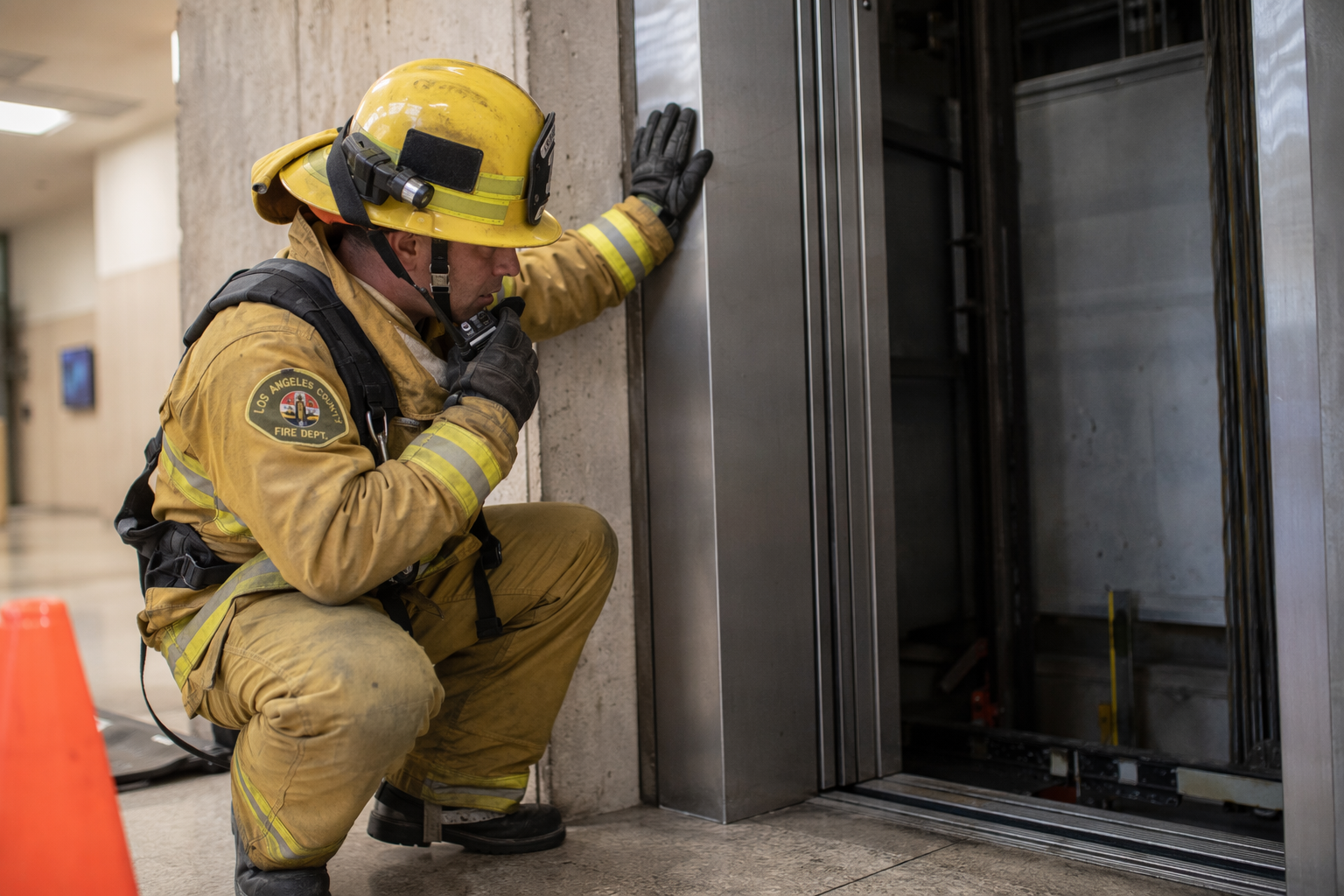
911 should be called immediately whenever there is a medical emergency, smoke or fire in or near the elevator shaft, flooding in the pit, or any situation in which a person’s life is at immediate risk inside or around the elevator.
Elevator service technicians are trained to handle mechanical entrapments and equipment failures, but they are not emergency medical responders. If a trapped passenger reports chest pain, difficulty breathing, or loss of consciousness, fire departments in Los Angeles County and Orange County have specialized elevator rescue units capable of safely extracting passengers without requiring the car to be moved mechanically. After calling 911, building staff should also contact the elevator service contractor so a qualified technician can assist responders and assess equipment damage post-rescue.
Never attempt a manual release or open hoistway doors without a qualified technician present, as doing so can create a fall hazard under OSHA general industry standards.
What emergency communication equipment is required inside an elevator cab?
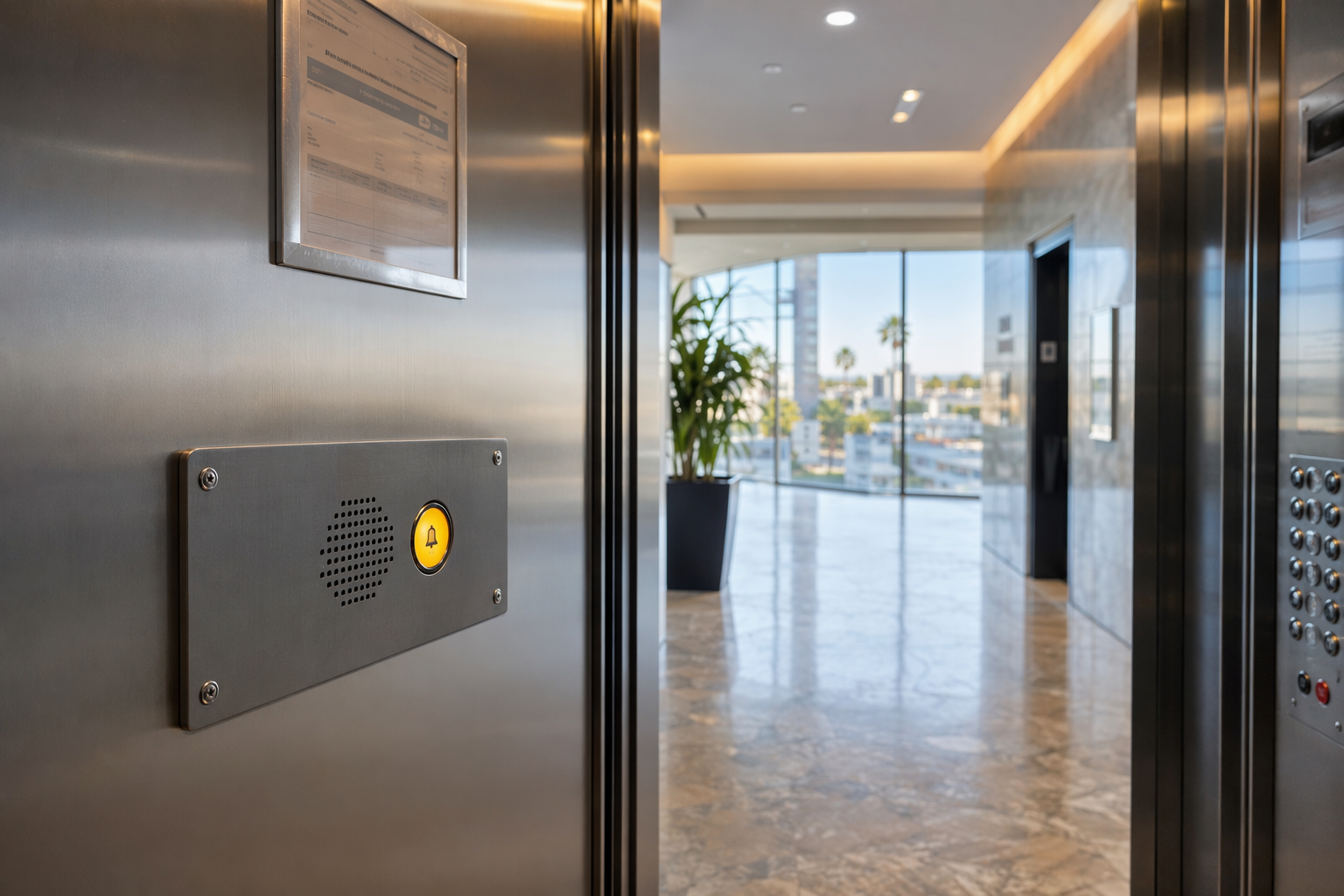
Every passenger elevator is required by ASME A17.1 Safety Code for Elevators and Escalators to have a two-way, hands-free communication device that allows trapped passengers to reach a live attendant without using a telephone handset.
The device must operate on a dedicated line or cellular network, must not require a coin or any action other than pressing a single button, and must connect to a location staffed 24 hours a day. In California, the Department of Industrial Relations (DIR) Division of Occupational Safety and Health (Cal/OSHA) enforces elevator safety through the Elevator, Escalator, and Chair Lift Safety Order, which references ASME A17.1 as the applicable standard. Building owners who allow emergency communication devices to fall out of service risk citation during state inspections and, more critically, leave passengers unable to summon help.
The monitoring station that answers the two-way call is typically operated by the elevator service contractor or a third-party answering service contracted by the building. The emergency phone number posted in or on the cab is the direct line to that station.
What information should be posted alongside the elevator emergency phone number?
Alongside the emergency phone number, every elevator should display the elevator’s unit identification number, the building address, the floor or location of the cab, and the name of the maintenance contractor — all of which help dispatchers and first responders locate and access the correct equipment quickly.
California elevator regulations require each elevator to carry a current inspection certificate with the permit number issued by the Division of Occupational Safety and Health. That permit number is critical during an emergency because dispatchers and responding technicians use it to pull the equipment history and identify the specific make, model, and configuration of the car. Building managers should confirm that posted information is legible, current, and matches the records on file with the state elevator inspection authority.
What steps should building staff take immediately when a passenger is trapped?
Building staff should follow a structured protocol to keep the trapped passenger calm, summon qualified help, and preserve safety until a technician arrives.
- Communicate with the trapped passenger through the elevator’s intercom or by speaking through the hoistway door. Confirm the number of people trapped, their physical condition, and whether any medical assistance is needed.
- Call 911 if anyone inside reports a medical emergency, or if there is smoke, fire, or flooding near the shaft.
- Contact the elevator service contractor’s emergency line immediately. Provide the building address, elevator unit number, the number of trapped passengers, and any abnormal sounds or smells reported.
- Keep passengers calm by communicating regularly. Instruct them not to attempt to force open doors, climb out of the car, or jump.
- Do not attempt manual door release unless you are a trained, authorized individual with explicit instruction from a technician over the phone, and only when the car is confirmed to be at a landing level.
- Clear the area around hoistway doors on all floors to allow unobstructed access for technicians and emergency responders.
- Document the incident — time of entrapment, time of calls made, technician arrival time, and outcome — for compliance records and insurance purposes.
- Do not restore elevator to service until the technician confirms it is safe to do so and any required inspection has been completed.
How is the elevator emergency phone number monitored and by whom?
The emergency phone line in an elevator cab must connect to a location staffed by a live person 24 hours a day, seven days a week, as required by ASME A17.1, and is typically monitored by the elevator service contractor’s dispatch center or a contracted monitoring service.
Some larger property management companies operate their own building management centers that serve as the answering point, while others rely entirely on their elevator contractor’s dispatch infrastructure. In either case, the monitoring party must be able to identify the location of the call, confirm the nature of the emergency, and dispatch a qualified technician or alert 911 as appropriate. Building managers should verify with their elevator contractor how calls are routed after hours, on weekends, and on holidays to ensure no gap in coverage exists.
Does the ADA require specific emergency communication features for elevator users with disabilities?
Yes — the Americans with Disabilities Act (ADA) requires that emergency communication systems in elevators be accessible to individuals who are deaf or hard of hearing, which means visual or tactile confirmation that a call has been connected must be provided.
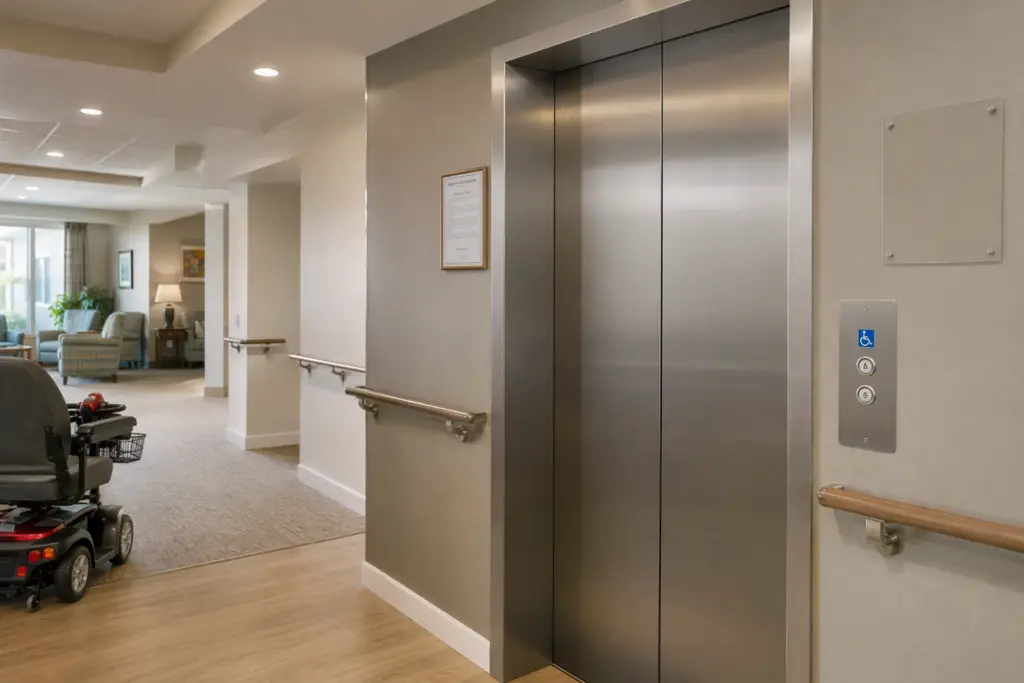
ADA Standards for Accessible Design specify that the emergency call system must include a visual signal to acknowledge that a call has been received. The button used to activate the system must be located at a height accessible to wheelchair users, and the system must not require voice communication as the sole means of obtaining help. Property owners who have not audited their emergency communication equipment for ADA compliance risk both civil complaints and denial of occupancy permits during renovation projects. Compliance with both ASME A17.1 and ADA requirements should be verified during every routine maintenance visit.
What is the difference between an elevator emergency line and a routine maintenance service line?
An elevator emergency line is a dedicated, 24/7 dispatch number specifically for urgent situations such as entrapments, power failures, or safety hazards, while a routine maintenance service line is used during business hours to schedule inspections, repairs, and non-urgent service calls.
These are typically two separate numbers. Building managers should store both, but it is the emergency line that must be immediately accessible to all building staff. Confusing the two during an entrapment can result in a delayed response if the routine line routes to voicemail after hours. When onboarding a new elevator service provider, building management should request both numbers in writing, confirm how each is staffed, and update the building’s emergency response documentation accordingly.
How do I find the correct elevator emergency number if I have lost it or changed contractors?
If the emergency contact number is lost or a contractor has changed, building managers should first check the elevator permit certificate displayed inside the cab, the machine room logbook, and any maintenance contract paperwork on file, then contact the state elevator inspection authority if the contractor identity is unknown.
In California, the Division of Occupational Safety and Health maintains elevator permit records that include contractor information. Building managers can contact Cal/OSHA’s Elevator Unit with the elevator permit number to identify the currently registered service contractor. When transitioning between contractors, the outgoing provider is obligated to transfer all relevant documentation, including emergency contact protocols, to the building owner. Liftech Elevator assists new clients in documenting emergency procedures as part of every onboarding process, ensuring no coverage gap occurs during contractor transitions in Los Angeles, Long Beach, Signal Hill, and Orange County.
Are elevator service contractors required to respond to emergencies within a specific timeframe?
California regulations and ASME A17.1 do not prescribe a universal maximum response time for contractor arrival at entrapment emergencies, but service contracts routinely specify response commitments, and prolonged entrapments may trigger regulatory review.
The absence of a state-mandated response window makes the contractual language in a maintenance agreement critically important. Building managers should review their service contracts carefully to understand what response commitment has been made for after-hours emergencies and entrapments specifically, as these situations differ in urgency from standard service calls. When evaluating elevator service providers, the clarity and enforceability of emergency response terms should weigh heavily in the decision.
What should a building’s emergency response plan include regarding elevator emergencies?
A building’s emergency response plan should include the elevator service contractor’s emergency phone number, the elevator unit ID numbers for every cab in the building, the location of the machine room and shut-off controls, and a clear chain of communication for notifying building ownership and management.
Best practice is to document this information in a dedicated elevator emergency section of the building’s overall life safety plan. That plan should be reviewed with all property management staff at least annually, updated whenever a contractor or equipment configuration changes, and kept accessible at the front desk or security station where it can be retrieved instantly. For multi-elevator buildings in high-rise environments common in Los Angeles and Long Beach, the plan should also designate which elevator — if any — is the designated firefighters’ service elevator and document its specific operational procedures.
How does elevator emergency communication technology differ between older and newer installations?
Older elevator installations often rely on analog telephone landlines for emergency communication, while newer or modernized systems use cellular or VoIP-based two-way communication devices that do not depend on a physical phone line in the building.
| Feature | Analog Landline Systems | Cellular / VoIP Systems |
|---|---|---|
| Infrastructure dependency | Requires active building phone line | Operates independently via cellular signal |
| Vulnerability to power outages | High — line may fail if building power is cut | Lower — battery backup typically integrated |
| ASME A17.1 compliance (2019+) | May require retrofit for current code compliance | Designed to meet current code requirements |
| ADA visual confirmation | Often absent in legacy installations | Typically included in modern units |
| Maintenance complexity | Dependent on telecom provider uptime | Dependent on cellular carrier coverage |
| Remote diagnostics capability | None | Available on many platforms |
| Recommended for new installations | No | Yes |
Buildings with older analog systems should consult a qualified elevator contractor about upgrading the emergency communication device, particularly as telecom providers continue to sunset traditional copper landline infrastructure. A failure of the emergency communication device is a code violation that can result in an elevator being taken out of service by state inspectors.
What role does the building owner play in maintaining the elevator emergency phone system?
The building owner bears ultimate legal responsibility for ensuring that the elevator emergency communication system is functional, code-compliant, and connected to a monitored answering point at all times, regardless of which contractor maintains the equipment.
Under California’s elevator safety regulations administered through Cal/OSHA, the building owner or their authorized agent is the permit holder. As permit holder, they are the party cited when violations are found during inspection — including a non-functioning emergency phone. This responsibility cannot be fully transferred to a maintenance contractor through a service contract, though a well-structured agreement will make the contractor accountable for keeping the system operational. Building owners should request written confirmation from their elevator service provider after each maintenance visit that the emergency communication device was tested and found functional.
How often should the elevator emergency phone be tested?
The elevator emergency communication device should be tested at every routine maintenance visit, and ASME A17.1 requires that it be verified as functional during each periodic inspection to confirm a live connection is established when the call button is activated.
In practice, many service contracts specify monthly maintenance visits, which means the emergency phone should be tested monthly at minimum. Building staff can also perform a simple functional check by pressing the emergency button and confirming that a live operator answers — this check costs nothing and can reveal a failed connection before an actual emergency exposes the problem. Any failure should be reported to the elevator contractor immediately and documented in the maintenance log. California state inspectors will test the device during annual inspections; a failed test during a state inspection can result in removal from service orders.
What happens if the elevator emergency phone fails during an entrapment?
If the emergency phone fails during an entrapment, trapped passengers should shout or knock on the cab walls to alert people on adjacent floors, while building staff must immediately call 911 and the elevator contractor using the numbers stored in the building’s emergency response plan.
A failed emergency phone during an active entrapment is both a life-safety failure and a code violation. After the entrapment is resolved, the building owner is required to have the device repaired before the elevator is returned to service. The failure must be documented and, depending on the circumstances, may need to be reported to Cal/OSHA. To prevent this scenario, building managers should ensure the emergency phone is tested regularly and that all building staff know the external emergency contacts to use if the in-cab system does not function. This redundancy — the two-way phone backed up by staff knowledge of the contractor’s emergency line — is the foundation of a sound elevator emergency protocol.
Can tenants or residents access the elevator emergency number directly?
While the two-way emergency phone inside the cab is the primary mechanism for tenants and residents to summon help, some building operators also post the elevator contractor’s emergency number in common areas such as lobbies, mailrooms, and tenant information boards so that anyone who observes an emergency can call for help directly.
This practice is advisable in residential buildings, hotels, and mixed-use properties where building staff may not be present at all times. Posting the number transparently also reduces panic: a bystander who sees an elevator malfunction can take immediate action without needing to locate a building manager first. The number posted should be the 24/7 emergency dispatch line, not the routine service number, and it should be updated immediately whenever the service contractor changes.
How do elevator emergency protocols differ for freight and commercial elevators versus passenger elevators?
Freight and commercial elevators are subject to many of the same ASME A17.1 safety requirements as passenger elevators, but emergency communication requirements may vary based on cab configuration and the specific use classification of the equipment, making contractor guidance essential for each unit type.
Freight elevators that are not designed to carry passengers may have different communication configurations than passenger cabs. However, if workers routinely operate or ride freight elevators — even incidentally — OSHA general industry standards for workplace safety apply, and a means of summoning emergency assistance must be available. Building and facility managers with mixed elevator inventories should confirm with their elevator service contractor that each unit type meets the applicable communication requirements for its specific classification.
What should property managers in Los Angeles, Long Beach, Signal Hill, and Orange County know about local elevator emergency requirements?
Property managers in these Southern California markets must comply with California state elevator regulations administered by Cal/OSHA, which incorporate ASME A17.1 by reference, and should be aware that local fire and building departments may have additional requirements for high-rise properties regarding firefighter service operations and emergency power.
Los Angeles high-rise buildings are subject to the Los Angeles Fire Code, which specifies elevator recall and firefighter service requirements that building managers must understand in the context of elevator emergencies. Orange County jurisdictions may have their own adopted amendments to the California Building Code. Liftech Elevator serves property managers across these markets and can help ensure that emergency communication systems and emergency response protocols are aligned with both state and local requirements. Staying current with code editions — including updates reflected in 2026 guidance from ASME and state regulatory bodies — is an ongoing responsibility, not a one-time review.
How should elevator emergency contact information be updated when changing service contractors?
When changing elevator service contractors, building management must immediately update the emergency phone number in all posted locations inside the elevator cabs, in the building’s emergency response plan, with the front desk or security team, and with any tenant-facing communications — before the old contractor’s line is discontinued.
A gap in emergency contact coverage — even one day when the old contractor is no longer responding and the new contractor’s line has not yet been distributed — represents a genuine safety risk. The transition checklist should include: written confirmation of the new emergency dispatch number, updated posting inside every cab, updated building documentation, staff briefing, and a test call to the new line to confirm it routes to a live operator. Liftech Elevator provides new clients with complete onboarding documentation to eliminate this risk during contractor transitions in Signal Hill, Long Beach, Los Angeles, and Orange County.
How can building owners verify that their elevator emergency system is fully compliant before an inspection?
Building owners can verify compliance by requesting a written maintenance report after each service visit that specifically confirms the emergency communication device was tested and connected to a live monitoring point, reviewing the current state elevator permit for the unit, and conducting their own functional test of the emergency button between maintenance visits.
For a more thorough pre-inspection review, building owners should ask their elevator contractor to conduct a code compliance audit that checks the emergency phone system against the applicable edition of ASME A17.1, reviews ADA communication accessibility requirements under ADA Standards for Accessible Design, and confirms that all posted information — permit certificates, unit IDs, and emergency numbers — is current and legible. Proactive compliance review is far less costly than addressing violations discovered during a state inspection, particularly when removal from service orders are issued for high-occupancy buildings.
Ready to Ensure Your Elevators Have a Reliable Emergency Contact System?
A functioning elevator emergency phone number and a clear emergency response protocol are not optional — they are legal requirements and fundamental building safety obligations. From verifying two-way communication compliance under ASME A17.1 to updating emergency contact information after a contractor change, every detail matters when a passenger is trapped and every second counts.
Liftech Elevator serves building owners, property managers, and facility teams throughout Signal Hill, Long Beach, Los Angeles, and Orange County with comprehensive elevator maintenance, emergency response, and compliance services designed to keep every unit safe and every emergency protocol airtight.
Contact Liftech Elevator for a free elevator assessment. Call 562-609-3478 today to speak with the Liftech Elevator team about your building’s elevator emergency communication system, maintenance contract, and compliance status.
Need elevator service you can rely on? Liftech Elevator is ready to help.