Failed Elevator Inspection in California: What Healthcare Facilities Need to Know
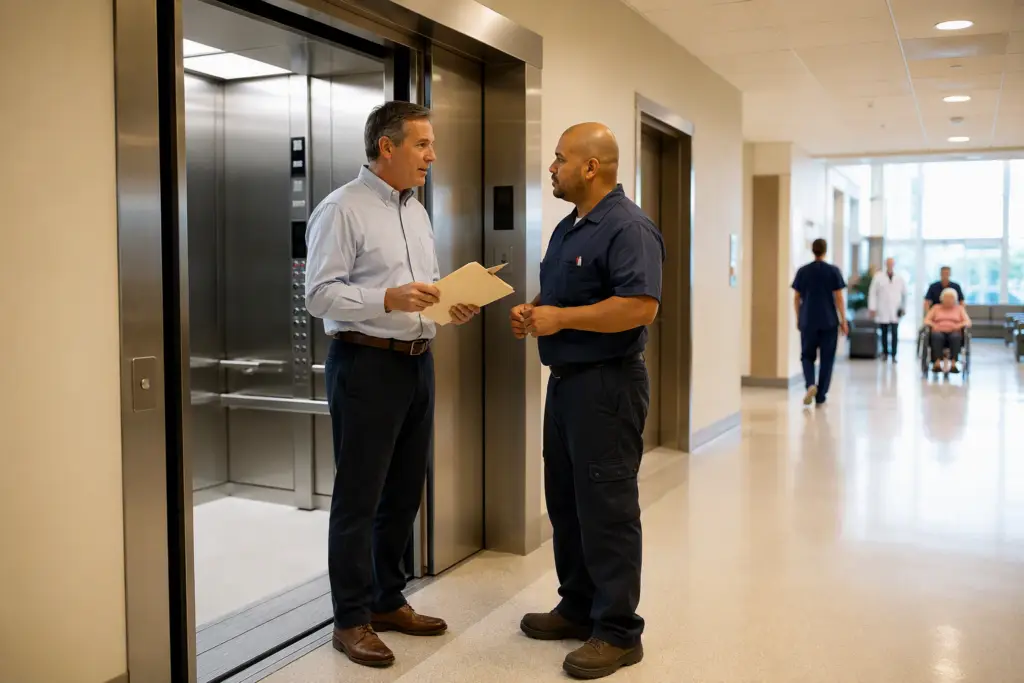
For hospitals, medical office buildings, skilled nursing facilities, and outpatient clinics across Signal Hill, Long Beach, Los Angeles, and Orange County, a failed elevator inspection is far more than a paperwork problem. Patient transport, wheelchair accessibility, and emergency response all depend on vertical access. Understanding the full compliance and remediation process protects patients, staff, and your facility’s operating license.
—
What Happens Immediately After a Failed Elevator Inspection in California?
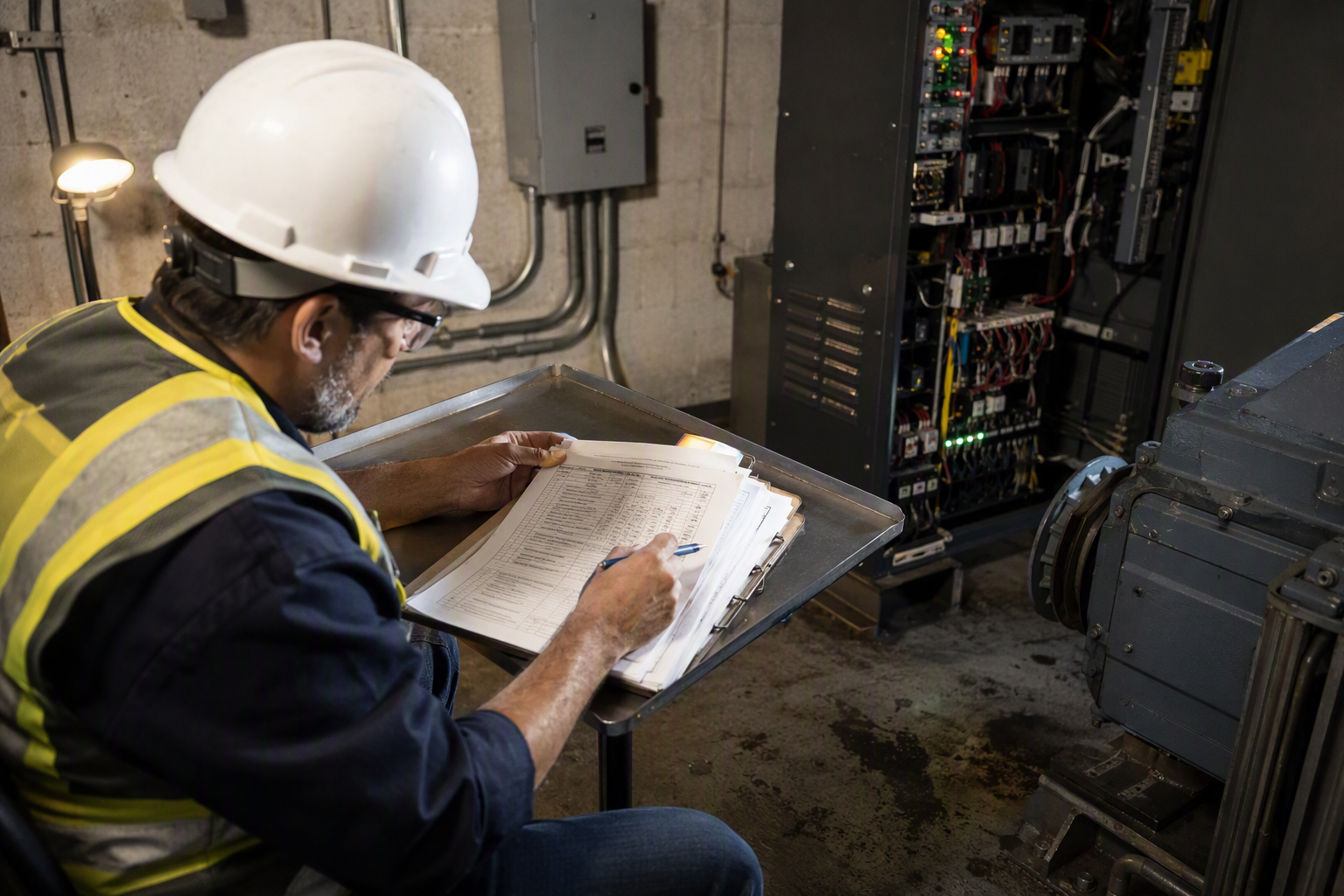
When a California-licensed elevator inspector — whether a Cal/OSHA inspector or a Qualified Elevator Inspector (QEI) conducting a periodic inspection — identifies a violation, the following sequence occurs:
- Written notice of violation is issued. The inspector documents every deficiency on an official inspection report, categorizing violations by severity.
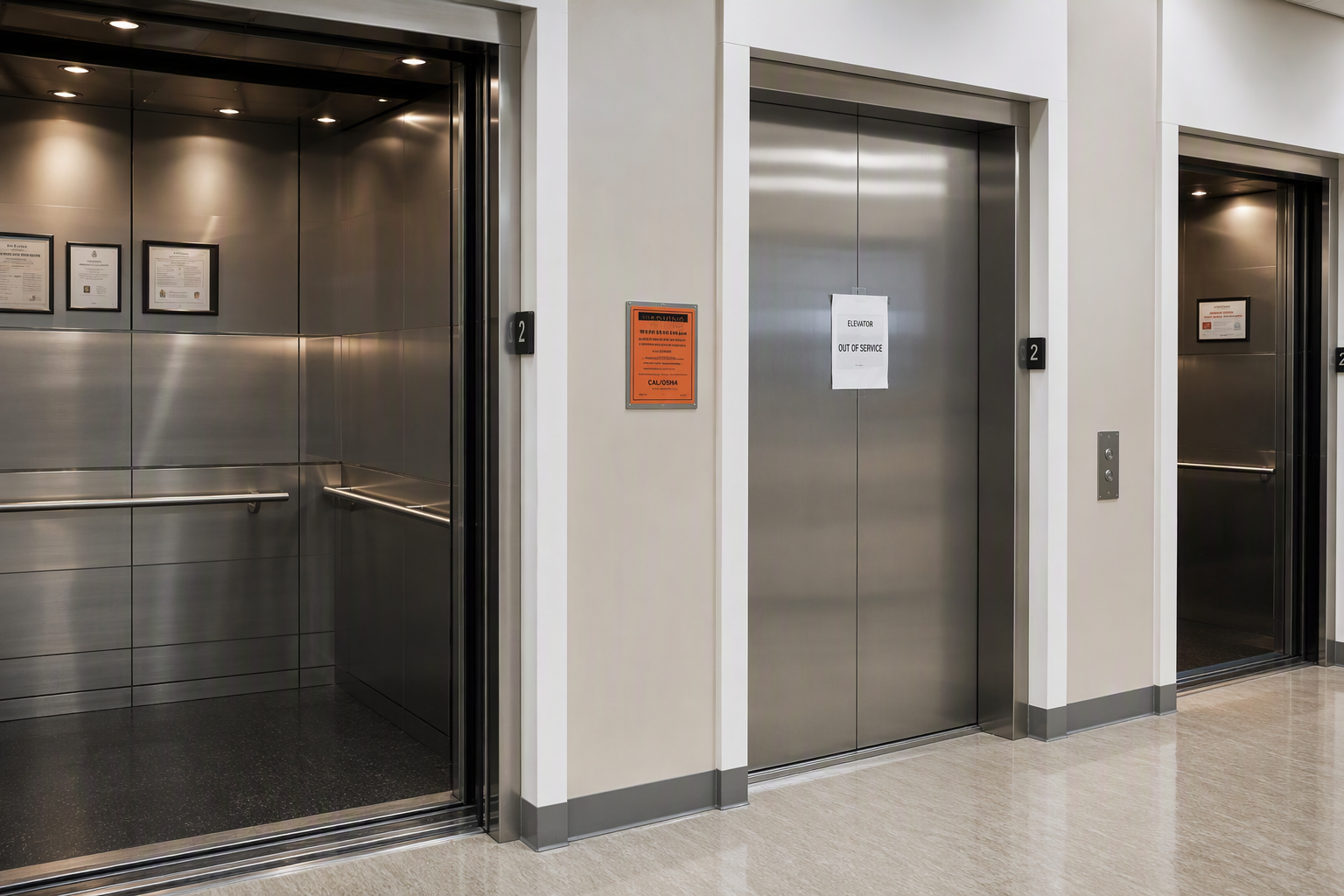
- The elevator is placed out of service. Elevators with safety-critical violations are immediately shut down and posted with an out-of-service notice. No passengers may ride the unit.
- The building owner receives a correction deadline. Cal/OSHA assigns a compliance deadline based on the severity of each cited deficiency. Critical safety hazards carry shorter deadlines than minor administrative violations.
- Repairs or corrections must be completed by a licensed elevator contractor. California law requires that all elevator work be performed by a licensed contractor operating under a valid Elevator Mechanic license issued by the state.
- A re-inspection is requested. Once corrections are complete, the owner or contractor submits documentation and requests a follow-up inspection before the elevator may return to service.
- Re-inspection is conducted and certificate is reissued (or further violations are cited if corrections are inadequate).
Liftech Elevator works with healthcare facility managers throughout this process — from identifying the root cause of each cited violation to coordinating the re-inspection scheduling with Cal/OSHA.
—
What Are the Most Common Elevator Violations Found in California Healthcare Facilities?
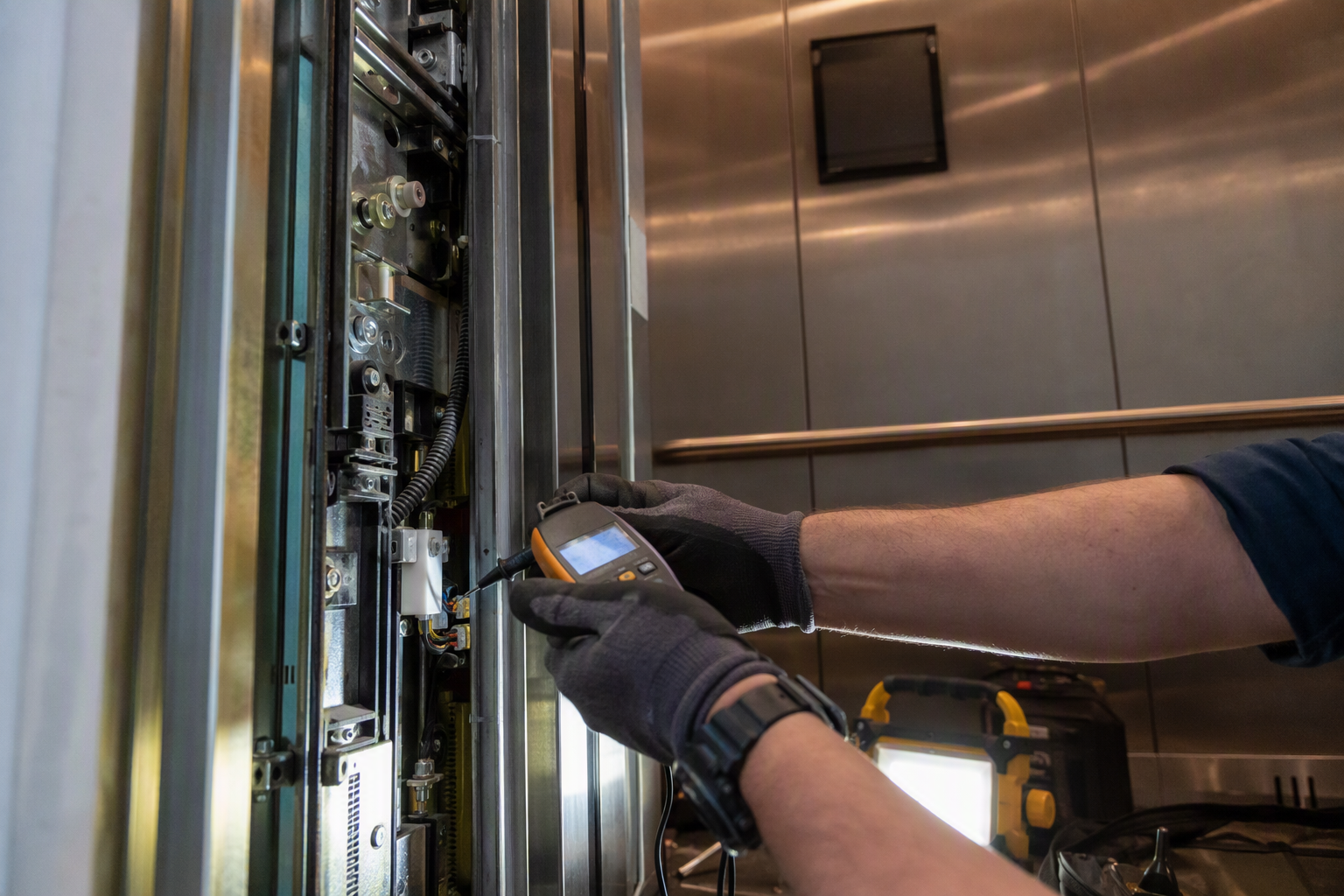
Healthcare environments place unique demands on elevators: heavy patient-transport equipment, frequent door cycling, and around-the-clock operation accelerate wear. Inspectors commonly cite the following deficiencies in medical settings:
- Door safety device failures — malfunctioning door reopening devices that could trap or injure patients on stretchers or in wheelchairs
- Car leveling errors — floors that do not align with landings, creating a tripping hazard for patients with mobility impairments
- Emergency lighting and communication failures — non-functional in-car phones or inadequate lighting, both of which are critical when patients or elderly residents are inside
- Overloading capacity ratings — inadequate signage or mechanical governors not calibrated to posted capacity
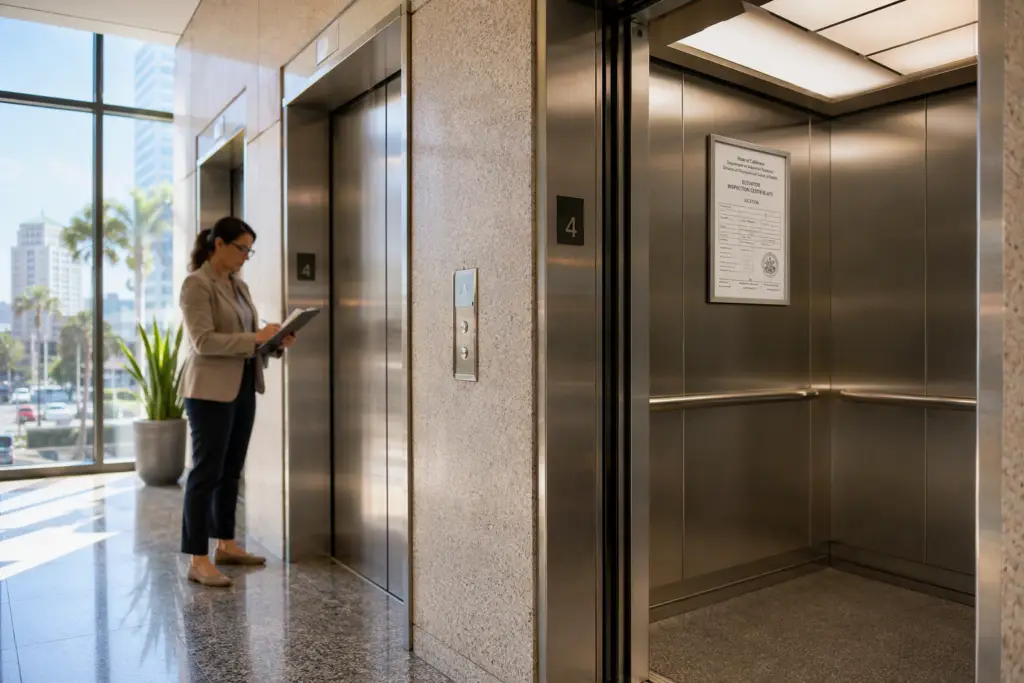
- Missing or expired certificates — California requires a valid permit to operate displayed inside the elevator cab
- Oil leaks or hydraulic fluid contamination — particularly in older hydraulic units common in medical office buildings
- Failure to meet current ASME A17.1 Safety Code for Elevators and Escalators requirements during periodic upgrades
—
What Are the ADA and ASME Compliance Requirements for Healthcare Elevators?
Healthcare facilities are subject to overlapping regulatory frameworks that inspectors evaluate simultaneously:
ASME A17.1 Safety Code for Elevators and Escalators is the foundational engineering standard governing elevator design, installation, testing, and periodic inspection in California. The 2019 edition (with California amendments) remains the primary reference for inspectors in 2026. It governs everything from car enclosure dimensions to governor rope requirements to firefighters’ emergency operation.
Americans with Disabilities Act (ADA) Standards for Accessible Design require that passenger elevators in multi-story healthcare facilities provide accessible entry, adequate cab dimensions, Braille and raised character floor designations, and audible signals. In a healthcare context — where patients may use wheelchairs, stretchers, or assistive devices — ADA non-compliance carries both federal enforcement risk and patient safety risk.
California Code of Regulations, Title 8 (administered by Cal/OSHA’s Elevator Unit) governs inspection intervals, permit requirements, and licensed contractor mandates specific to California. Healthcare facilities that also hold Joint Commission accreditation or operate under CMS Conditions of Participation face additional vertical-access requirements tied to life safety and patient rights standards.
—
How Long Does a Healthcare Facility Have to Fix a Failed Elevator Inspection?
California does not set a single universal deadline. Correction timeframes depend on the severity classification of each violation:
- Imminent hazard violations result in immediate out-of-service orders. The elevator cannot return to operation until the specific hazard is corrected and verified — there is no grace period.
- Serious violations typically carry a correction deadline assigned by the inspector, often measured in days to a few weeks.
- General violations may allow more time, but the elevator remains out of service until all cited items — not just the most critical — are resolved.
For healthcare facilities where elevator downtime directly affects patient mobility and care workflows, the urgency of fast, code-compliant repairs cannot be overstated. Facilities should not wait for an inspection failure to establish a relationship with a licensed elevator contractor.
—
Can a Healthcare Facility Be Fined for a Failed Elevator Inspection in California?
Yes. Cal/OSHA has authority to issue civil penalties for elevator violations, and operating an elevator after it has been placed out of service is a separate violation that carries additional penalties. For healthcare organizations, the regulatory exposure extends beyond Cal/OSHA: CMS surveyors and Joint Commission reviewers may cite elevator non-compliance as part of broader environment-of-care deficiencies, which can affect facility certification and reimbursement status.
—
What Is the Re-Inspection Process After Corrections Are Made?
- Document all completed repairs. The licensed elevator contractor prepares a written record of every correction made, referencing the specific code section cited in the original inspection report.
- Submit a re-inspection request to Cal/OSHA’s Elevator Unit (or to the certified third-party inspection authority with jurisdiction, where applicable).
- Conduct any required acceptance tests. Certain repairs — such as governor replacement, hydraulic system work, or door operator replacement — require witnessed acceptance tests per ASME A17.1 before the elevator may be returned to service.
- Pass the re-inspection. The inspector verifies each cited item is corrected.
- Receive updated permit to operate. The new certificate must be posted inside the elevator cab before passengers may use the unit.
Liftech Elevator assists healthcare clients in preparing complete correction documentation so that re-inspection proceeds efficiently and without additional citations.
—
How Do I Prevent Elevator Inspection Failures at My Healthcare Facility?
Proactive maintenance and code compliance planning are the most effective tools. Key practices include:
- Enrolling in a full-maintenance agreement with a licensed elevator contractor that covers all parts, labor, and code-mandated testing
- Scheduling periodic internal audits against current ASME A17.1 requirements and ADA standards before official inspections
- Tracking California’s periodic inspection intervals and ensuring your facility’s permit renewal is never allowed to lapse
- Addressing door performance and leveling issues immediately — these are among the most frequently cited violations and the most visible to patients and staff
- Maintaining a log of all service calls, repairs, and test results as required by California regulations
—
Does Elevator Downtime in a Hospital or SNF Create a Life Safety Emergency?
In most multi-story healthcare facilities, yes. Hospitals and skilled nursing facilities (SNFs) are required under CMS Conditions of Participation and applicable NFPA life safety codes to maintain accessible means of egress and patient transport routes. When an elevator serving upper-floor patient rooms or operating suites goes out of service, facilities must implement documented contingency procedures — including patient relocation protocols, staff notification, and coordination with emergency services if needed.
Facilities in Long Beach, Los Angeles, and Orange County should have those contingency plans documented in their Environment of Care management plans, and should ensure their elevator service provider is capable of prioritizing healthcare accounts during restoration.
—
What Should I Ask a California Elevator Contractor Before Hiring Them for Violation Corrections?
- Is the company licensed by the State of California to perform elevator work?
- Are the mechanics NEIEP-trained or otherwise formally qualified under California labor standards?
- Can the contractor provide documentation of completed repairs formatted for Cal/OSHA re-inspection submissions?
- Has the contractor worked in healthcare environments and is familiar with Joint Commission environment-of-care expectations?
- Can the contractor perform the required acceptance tests — including any witnessed tests — necessary to return the elevator to service?
Liftech Elevator serves healthcare facilities across Signal Hill, Long Beach, Los Angeles, and Orange County and is equipped to manage the full remediation and re-inspection process for California-regulated elevators.
—
Questions Your Inspector Will Ask
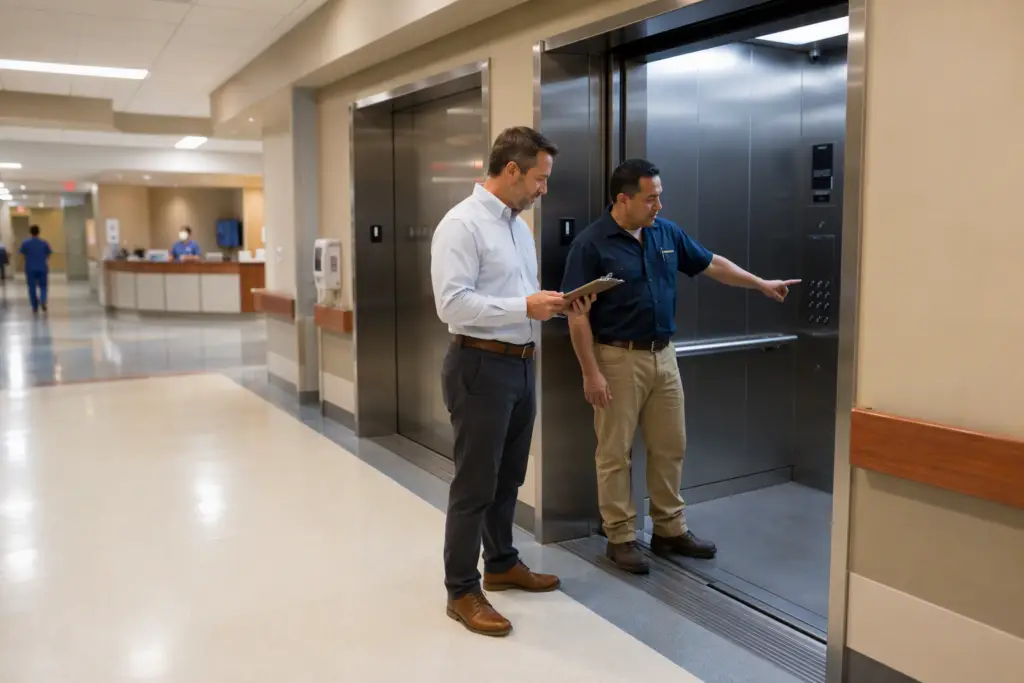
During a California elevator inspection at a healthcare facility, inspectors assess both documentation and physical equipment condition. Be prepared to answer or provide records for the following:
- “Where is your current permit to operate?” — It must be posted inside the cab. An expired or missing permit is an automatic violation.
- “Can you provide the maintenance log for this unit?” — California requires that maintenance records be available for inspector review.
- “When was the last five-year full-load safety test performed?” — ASME A17.1 and California regulations require periodic full-load and safety tests at defined intervals. Inspectors will verify these are current.
- “Who is your licensed elevator contractor of record?” — Inspectors may request proof that maintenance is being performed by a state-licensed contractor.
- “Have there been any modifications or repairs to this unit since the last inspection?” — Certain repairs require permits and acceptance tests; undocumented work is a compliance red flag.
- “Are the emergency phone and lighting functional?” — Inspectors test these during every inspection. In a healthcare facility, these failures carry heightened severity.
- “Is the car leveling within acceptable tolerance?” — Uneven landings are a patient safety issue and an ADA concern in healthcare settings.
- “Are the door reopening devices functioning correctly under load?” — Door safety devices are tested actively, not just visually.
—
Why Healthcare Facilities in Southern California Choose Liftech Elevator
Healthcare facility managers in Signal Hill, Long Beach, Los Angeles, and Orange County choose Liftech Elevator because elevator compliance in a medical environment requires more than routine maintenance. It requires a contractor who understands the intersection of Cal/OSHA elevator regulations, ASME A17.1, ADA accessibility mandates, and the operational realities of patient care environments.
Liftech Elevator is a certified elevator service company providing inspection preparation, violation correction, and full-maintenance programs designed to keep healthcare elevators operating safely, legally, and with minimal disruption to patient services.
—
Schedule Your Free Elevator Assessment Today
Don’t wait for an inspection failure to find out your elevators aren’t compliant. Contact Liftech Elevator for a free elevator assessment and let a licensed team evaluate your California healthcare facility’s elevators against current code requirements — before an inspector does.
Contact Liftech Elevator for a free elevator assessment: 562-609-3478
Serving healthcare facilities in Signal Hill, Long Beach, Los Angeles, and Orange County, CA.