Best Elevator Maintenance Company in Signal Hill, CA: Complete FAQ Guide
After 15-plus years of inspecting, repairing, and maintaining elevators across Signal Hill, Long Beach, Los Angeles, and Orange County, I’ve seen what separates a genuinely safe elevator from a liability waiting to happen. This guide answers every question building owners, property managers, and facility directors ask when evaluating elevator maintenance companies in Signal Hill and the surrounding communities. Read it from top to bottom, or jump to the section that matters most to you right now.
What makes Liftech Elevator the best elevator maintenance company in Signal Hill, CA?
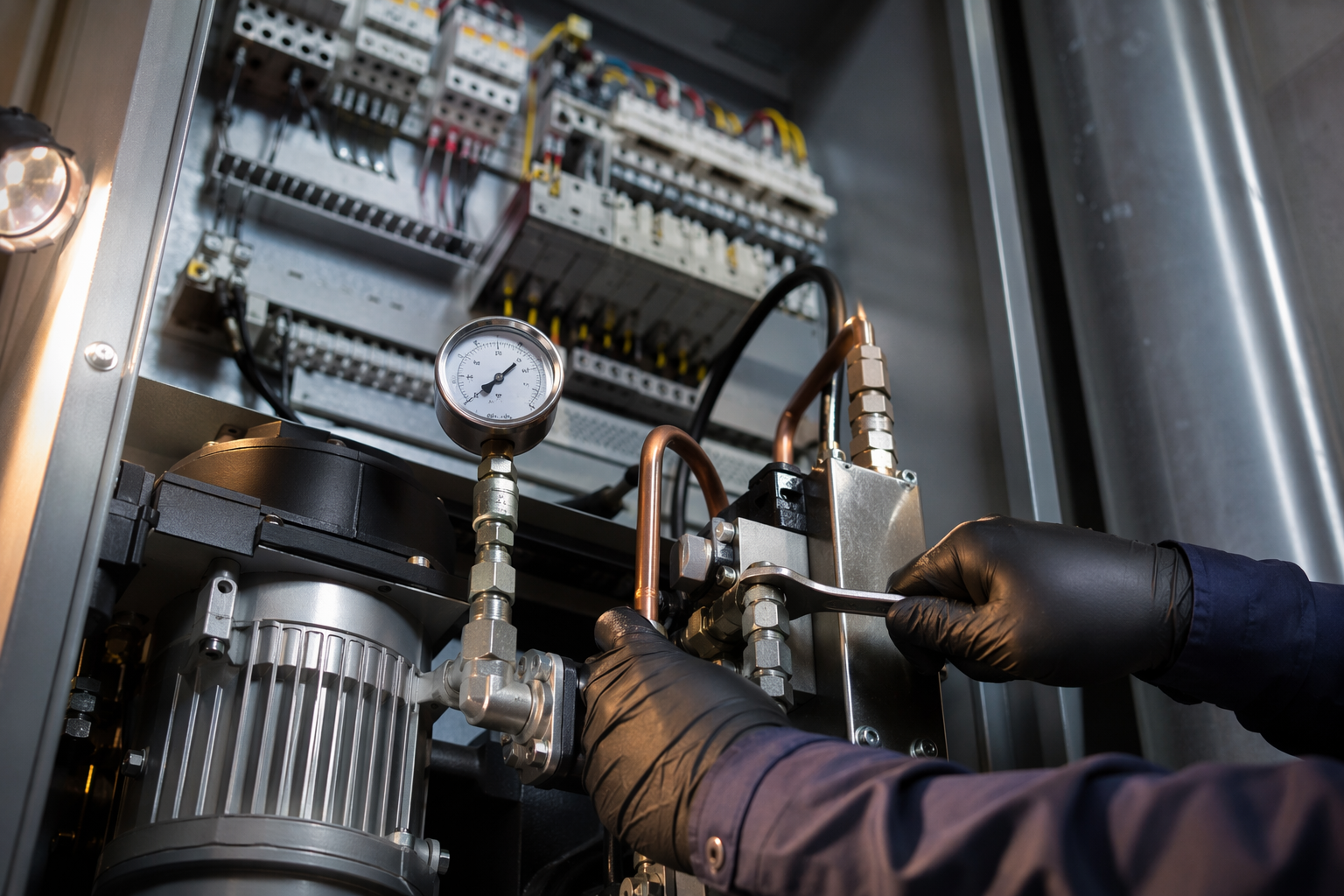
Liftech Elevator combines IUEC-certified field technicians, same-jurisdiction code expertise, and local response times that larger national chains simply cannot match in Signal Hill.
Signal Hill is a geographically compact, incorporated city surrounded by Long Beach, and its building stock includes everything from mid-rise commercial towers on Cherry Avenue to residential condominiums and oil-industry facilities. That mix demands a maintenance partner who understands California’s Title 8 elevator regulations, the specific inspection timelines enforced by the Division of Occupational Safety and Health (Cal/OSHA), and the practical realities of servicing older hydraulic units alongside modern traction systems. Liftech Elevator’s technicians are trained and tested under the ASME A17.1 Safety Code for Elevators and Escalators and hold active IUEC (International Union of Elevator Constructors) certifications, meaning every maintenance visit is performed to the highest recognized industry standard.
Beyond credentials, response time is everything when a cab stops mid-run and a tenant is waiting. Liftech Elevator guarantees a 2–4 hour emergency response window for clients in Signal Hill, a metric most regional competitors cannot promise in writing.
How often should elevators in Signal Hill be professionally maintained?
California law and ASME A17.1-2022 both require a minimum of monthly preventive maintenance visits for most commercial elevator installations, with quarterly inspections recommended for heavily trafficked units.
The state of California enforces elevator maintenance through Title 8, CCR, Division 1, Chapter 4, Article 12. Under this framework, elevators in commercial buildings must be maintained under a written maintenance control program (MCP) that documents every visit, lubrication cycle, adjustment, and replacement. Monthly visits are the baseline, but elevators that log more than 200 trips per day — common in Signal Hill office buildings and parking structures — benefit significantly from bi-monthly technician visits.
Hydraulic elevators, which are prevalent in Signal Hill’s two- and three-story commercial properties, also require an annual oil sampling and hydraulic fluid integrity check under California’s underground hydraulic elevator regulations. Skipping this test can result in permit suspension.
What does a standard elevator maintenance contract in Signal Hill cost?
In 2026, elevator maintenance contracts in the Signal Hill and Long Beach area typically range from $180 to $650 per month per unit, depending on elevator type, age, number of stops, and contract coverage level.
| Contract Tier | Monthly Cost (Per Unit) | Coverage Included | Best For |
|---|---|---|---|
| Basic Inspection-Only | $180 – $250 | Monthly lubrication, visual inspection, safety test documentation | Low-traffic residential buildings, 2-stop hydraulics |
| Standard Preventive | $280 – $420 | All basic services + parts (belts, brushes, minor components), callback coverage 8–5 M–F | Mid-rise commercial, retail, small office |
| Full Comprehensive | $450 – $650 | All preventive services + 24/7 emergency callback + major parts (motor, controller) + annual load test | High-traffic commercial, hospitals, government buildings |
| Modernization-Inclusive | $600 – $950 | Full comprehensive + phased modernization credits toward controller or cab upgrades | Buildings with elevators 20+ years old |
These figures reflect 2026 market rates in Los Angeles and Orange County jurisdictions. Always request an itemized scope-of-work from any vendor — contracts that bundle “full coverage” without specifying parts lists can leave you responsible for $8,000–$15,000 controller replacements.
What California codes and regulations govern elevator maintenance?
California elevator maintenance is primarily governed by Title 8, CCR, Division 1, Chapter 4, Article 12, supplemented by ASME A17.1-2022 and enforced by the California Division of Occupational Safety and Health (Cal/OSHA) Elevator Unit.
Key compliance requirements that every Signal Hill building owner must understand include: annual permit renewal through Cal/OSHA, a quinquennial (every-five-year) full safety inspection called the Category 5 test, monthly maintenance documentation retained for a minimum of five years, and immediate incident reporting within 24 hours of any elevator-related injury. The OSHA federal framework also applies to any elevator used by employees, adding lockout/tagout (LOTO) requirements during maintenance windows.
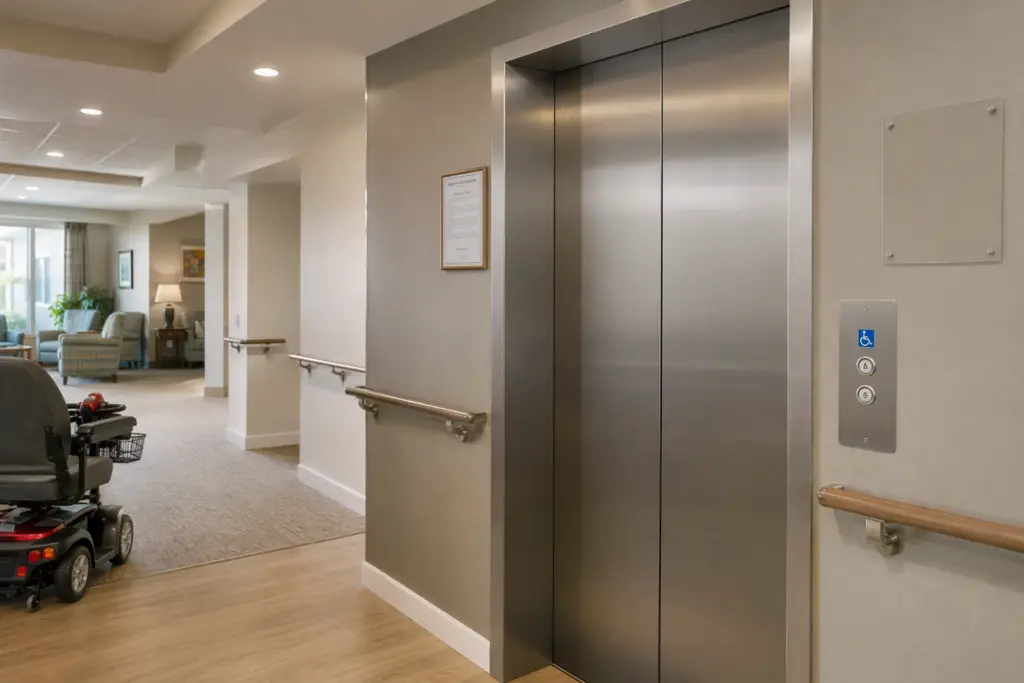
ADA compliance adds another layer: the ADA requires that elevators in facilities subject to Title II or Title III meet specific cab dimensions (minimum 80 inches depth), door clear-width standards (minimum 36 inches), and tactile button requirements. Existing facilities undergoing alteration must bring elevator access into compliance during renovation.
What is the ASME A17.1 code and why does it matter for my building?
ASME A17.1 is the national safety standard for elevators and escalators that defines minimum design, installation, inspection, testing, and maintenance requirements — and California has adopted its most current version as the benchmark for state enforcement.
The ASME A17.1 Safety Code for Elevators and Escalators is updated on a regular revision cycle; the 2022 edition is the current reference standard used by Cal/OSHA inspectors in Signal Hill, Long Beach, and the greater Los Angeles area. When a maintenance company tells you they work “to code,” you should ask specifically: which edition of ASME A17.1? Older editions lacked requirements for car-top inspection stations, seismic emergency operation devices (mandatory in California under ASME A17.1 Rule 8.4), and updated rope inspection intervals. A technician who cannot cite the current code edition by year is a red flag.
How do I know if my elevator needs modernization vs. standard maintenance?
If your elevator is older than 20 years, requires more than 3 unscheduled service calls per year, or uses relay-logic controllers, it is almost certainly a modernization candidate rather than a simple maintenance case.
Modernization becomes the financially smarter decision when cumulative repair costs in a rolling 36-month window exceed 50–60% of the estimated modernization cost. Specific indicators include: relay-logic or early microprocessor controllers (pre-2000), original drum-style motors on hydraulic units, non-seismic-rated buffers, and cab interiors that do not meet current ADA dimensional standards. A qualified elevator modernization assessment — which Liftech Elevator offers as a complimentary service for Signal Hill building owners — will produce a documented cost-benefit comparison so you can make an informed capital planning decision rather than reacting to the next breakdown.
What should I do immediately if an elevator in my building malfunctions?
The priority sequence after an elevator malfunction is passenger safety first, then documentation, then service dispatch — never attempt to manually rescue trapped passengers without trained personnel.
- Assess passenger status. Communicate with anyone in the cab via the emergency phone or intercom. Confirm whether passengers are trapped between floors or simply unable to exit at a landing.
- Call 911 if passengers are in distress. Medical emergencies, heat-related illness, or panic attacks require emergency services, not just an elevator technician.
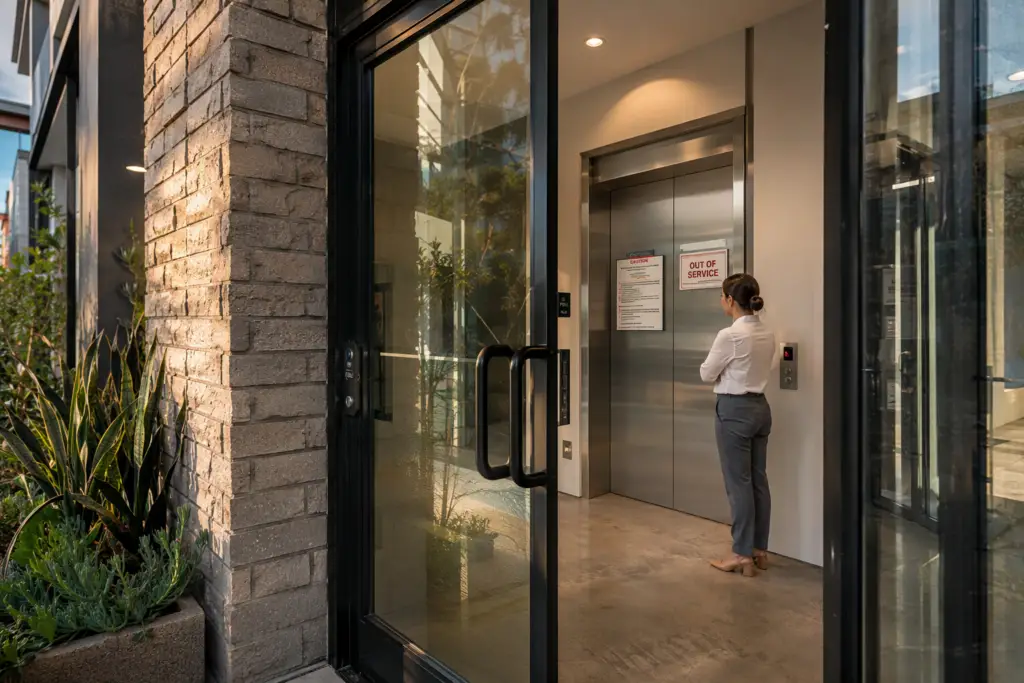
- Place the elevator out of service. Post a clear “Out of Service” sign at each floor landing and disable the call buttons if your control room allows it.
- Contact your elevator maintenance company. Provide the elevator permit number (displayed on the certificate inside the cab), the building address, the floor the cab is stopped at, and the number of passengers if any are trapped.
- Do not attempt manual rescue without authorization. Manually forcing open hoistway doors without proper equipment can cause falls of 10–20 feet into the pit. Only trained technicians or firefighters with proper tools should perform non-landing rescues.
- Document the incident. Record the time, any error codes displayed on the controller, witness accounts, and any prior warning signs (unusual noises, slow door operation, leveling issues).
- File a Cal/OSHA incident report within 24 hours if any injury occurred during or as a result of the malfunction, as required under California Title 8.
How do elevator maintenance companies differ from elevator repair companies?
Maintenance companies focus on scheduled, proactive servicing under long-term contracts, while repair-only companies respond reactively to breakdowns — but the best providers, like Liftech Elevator, integrate both functions under a single service agreement.
The practical difference matters enormously for budgeting. A maintenance-only vendor will keep your elevator running well between visits but may subcontract emergency repairs or charge premium rates for after-hours callouts. A repair-only vendor responds to failures but contributes nothing to preventing them. Comprehensive service providers embed preventive maintenance, emergency dispatch, parts procurement, and compliance documentation into a single contract — eliminating the gap where most elevator failures and liability exposures actually occur.
How do I verify that an elevator maintenance company is properly licensed in California?
In California, elevator companies must hold a valid Cal/OSHA Elevator Unit contractor certification, and individual technicians must hold a current Certified Competent Conveyance Mechanic (CCCM) credential.
You can verify contractor certifications directly through the Cal/OSHA Elevator Unit in Sacramento. Always request the company’s Cal/OSHA contractor number and cross-reference it before signing any agreement. Additionally, confirm that the company carries a minimum of $1 million in general liability insurance and workers’ compensation coverage — request certificates of insurance naming your building ownership entity as an additional insured. Companies operating without verified credentials expose your property to regulatory fines that in 2026 can reach $25,000 per violation for serious elevator non-compliance under California Labor Code Section 7200.
What is the difference between a Category 1 and Category 5 elevator inspection?
Category 1 is an annual no-load safety test performed by a licensed inspector, while Category 5 is a full-load, full-speed test performed every five years that subjects the elevator’s safety devices to maximum operational stress.
Under ASME A17.1, Category 1 tests verify that the governor, safeties, and oil buffers operate correctly under no-load conditions. Category 5 tests — also called the “five-year test” or “full-load test” — require a licensed elevator inspector and a certified mechanic to apply 125% of rated load at full speed while activating the governor and safeties. Failing a Category 5 test results in permit revocation until deficiencies are corrected. Buildings in Signal Hill that defer this test often discover during the inspection that components they assumed were functional have degraded to the point of requiring immediate replacement. Scheduling Category 5 tests proactively, with your maintenance provider present, allows you to identify and budget for repairs before the formal inspection rather than scrambling under a suspended permit.
How quickly should an elevator maintenance company respond to an emergency in Signal Hill?
Industry best practice is a 2–4 hour emergency response window for urban and suburban markets, with a 1-hour target for passenger entrapments — anything slower than 4 hours is unacceptable for a company claiming Signal Hill service.
Signal Hill’s central location between Long Beach and Los Angeles should give any competent local provider a geographic advantage. Ask prospective vendors to provide their guaranteed contractual response time in writing. Verbal commitments are unenforceable. Liftech Elevator documents response time guarantees directly in its service agreements, and clients receive technician GPS confirmation when dispatch is en route. For comparison, national elevator chains operating out of regional dispatch hubs in downtown Los Angeles or Anaheim frequently log 5–8 hour response times to Signal Hill addresses, which is not an acceptable risk when a passenger is trapped or a building’s only accessible vertical travel route is offline.
What are the most common elevator problems in Signal Hill commercial buildings?
The five most common elevator problems in Signal Hill’s commercial building stock are hydraulic oil leaks, door operator failures, leveling drift, controller faults, and worn rope or chain assemblies — all of which are preventable with consistent monthly maintenance.
Hydraulic oil leaks are particularly relevant in Signal Hill given the area’s oil-field legacy and the prevalence of older hydraulic elevator installations. California’s underground hydraulic elevator regulations (Title 8, Section 3097.8) require double-bottom cylinders or liner systems on all units installed after a specific date, and older single-bottom cylinders must be tested annually for soil contamination risk. Door operator failures account for approximately 40% of all elevator service calls nationally in 2026, typically caused by worn clutches, misaligned rollers, or door edge sensor drift — issues that a monthly maintenance visit catches before they strand a passenger. Rope elongation and sheave wear on traction elevators are frequently underestimated in older Signal Hill mid-rise buildings; a competent technician will use a rope gauge and sheave groove templates to measure wear against ASME A17.1 replacement thresholds at every scheduled visit.
Does ADA compliance affect elevator maintenance requirements?
Yes — ADA compliance is an ongoing operational obligation, not just a one-time installation standard, meaning your maintenance provider must verify ADA-required features such as audible signals, tactile floor indicators, and cab lighting at every service visit.
The ADA Standards for Accessible Design require that elevator call buttons be a minimum of 3/4 inch in diameter, that audible and visible floor arrival signals function correctly, that Braille and tactile characters on control panels remain legible, and that door reopening devices respond to obstructions at both 5 inches and 29 inches above the floor (the low and high detection zones). A maintenance technician who skips button and sensor verification during routine visits is leaving your building exposed to ADA complaints, which in California are compounded by the Unruh Civil Rights Act — allowing for statutory damages of $4,000 per violation per visit, separate from federal ADA remedies.
How do I compare elevator maintenance companies before signing a contract?
Evaluate elevator maintenance companies on five criteria: verifiable certifications, documented response time guarantees, contract transparency (no hidden exclusions), local service density, and client references from buildings similar to yours in size and use type.
When requesting proposals, use this structured comparison checklist:
- Ask for the Cal/OSHA contractor number and verify it independently.
- Request a sample maintenance control program (MCP) document — if they cannot produce one, they are not compliant with California Title 8.
- Confirm which parts are excluded from the contract (most “full coverage” agreements quietly exclude major components like motors, controllers, and cylinders).
- Ask for the average response time for the last 12 months at Signal Hill or Long Beach locations they currently service.
- Request three references from property managers in your building category (commercial, residential, or industrial).
- Confirm whether the company has in-house parts inventory or relies entirely on third-party suppliers — in-house inventory can reduce downtime by 24–48 hours on common components.
What questions should I ask before signing an elevator maintenance contract?
The ten questions that separate a solid elevator maintenance contract from a liability trap are centered on exclusions, escalation clauses, technician credentials, response guarantees, and termination rights.
- Is my elevator’s make and model serviced by your in-house technicians, or is it subcontracted?
- What specific parts and components are excluded from coverage?
- Does the contract include an automatic annual price escalation clause, and if so, what is the cap?
- Are your technicians IUEC-certified and licensed under California’s CCCM credential?
- What is your guaranteed emergency response time, and is it in writing?
- Who handles the annual Cal/OSHA permit renewal and Category 1 inspection coordination?
- What happens if a Cal/OSHA inspection reveals a deficiency — is correction included in the contract?
- What is the contract term length, and what are the early termination penalties?
- Do you maintain maintenance logs digitally, and can I access them through a client portal?
- What is the process for escalating a dispute if I am unsatisfied with a service visit?
How long does an elevator maintenance visit typically take?
A standard monthly preventive maintenance visit on a single-unit hydraulic or traction elevator should take between 2 and 4 hours; rushed visits under 90 minutes are a strong indicator that required tasks are being skipped.
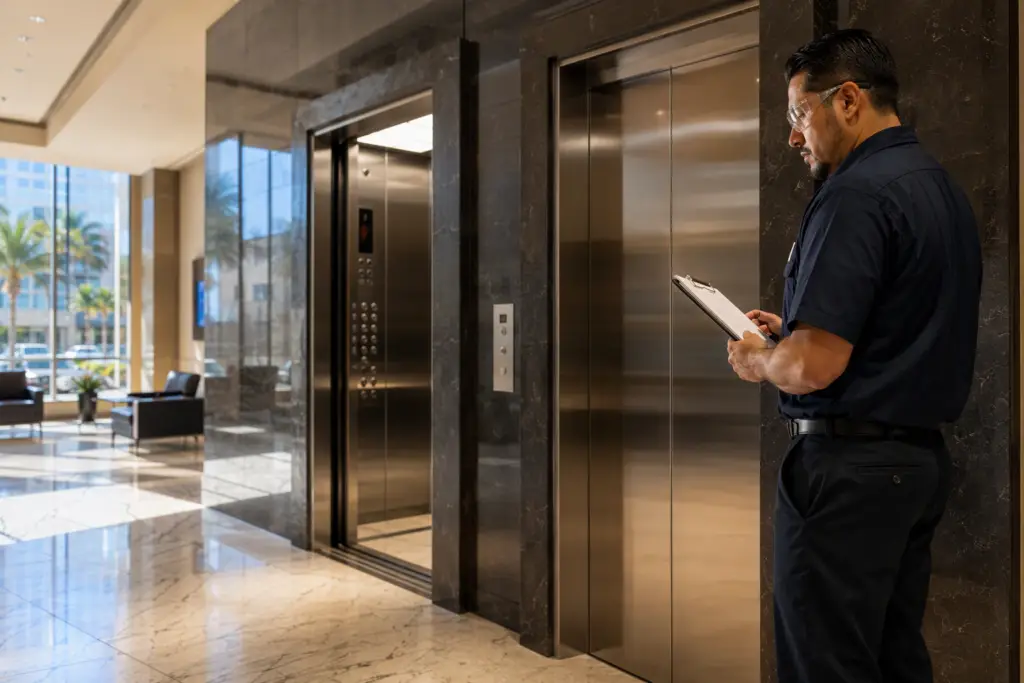
A compliant maintenance visit under California’s Title 8 maintenance control program requirements includes lubrication of all moving components, inspection of governor and safety devices, door operator adjustment and timing measurement, controller fault log review, pit and overhead inspection, emergency lighting and phone tests, buffer and compensation rope checks, and written documentation of all findings. Technicians who complete this checklist in under 90 minutes are almost certainly skipping line items. Request a copy of the completed maintenance log after every visit and compare it against the MCP checklist your contract specifies. If items are consistently unmarked or marked complete without corresponding notes, escalate immediately.
What elevator brands and types does Liftech Elevator service in Signal Hill?
Liftech Elevator services all major elevator brands and types found in Signal Hill and surrounding communities, including Otis, KONE, Schindler, ThyssenKrupp, Dover, Montgomery, and independent hydraulic units from manufacturers such as Savaria and Federal Elevator.
Equipment types serviced include: hydraulic elevators (both above-ground cylinder and underground cylinder configurations), geared traction, gearless traction, machine-room-less (MRL) traction systems, limited-use limited-application (LULA) elevators, platform lifts, and residential elevator systems. This breadth matters because many smaller maintenance companies specialize in a single drive type — typically hydraulic — and either decline service on MRL traction systems or service them without the specialized training those units require. When evaluating providers, confirm that the technician assigned to your specific elevator model has documented training or factory certification for that platform.
What are the risks of deferring elevator maintenance in California?
Deferred elevator maintenance in California creates three compounding risk categories: regulatory penalties including permit revocation, personal injury liability exposure, and accelerated equipment degradation that converts a $3,000 maintenance cost into a $30,000 replacement cost.
From a regulatory standpoint, Cal/OSHA can issue Serious citations carrying fines up to $25,000 per violation for elevator safety violations discovered during unannounced inspections. Permit revocation — which forces the elevator out of service immediately — triggers ADA accessibility violations simultaneously if the elevator is the only accessible vertical route in the building, creating a compounding liability chain. From a liability standpoint, a single elevator-related personal injury claim in California averaged between $280,000 and $1.2 million in settlement value in 2025 according to industry insurance underwriting data, and property owners who cannot produce consistent maintenance records face near-automatic negligence findings. The equipment degradation math is equally stark: a hydraulic pump that costs $1,800 to replace during a planned maintenance window typically causes a $4,500–$8,000 total service event when it fails unexpectedly and requires emergency dispatch, after-hours labor, and expedited parts shipping.
How does Liftech Elevator serve customers outside Signal Hill, such as Long Beach, Los Angeles, and Orange County?
Liftech Elevator operates a distributed service model with technicians stationed throughout Signal Hill, Long Beach, Los Angeles, and Orange County, enabling the same response time standards and compliance documentation processes across all four service territories.
For property management companies overseeing portfolios that span multiple jurisdictions — a common scenario in the Signal Hill and Long Beach corridor — Liftech Elevator offers unified contract management with a single point of contact, consolidated compliance reporting, and standardized maintenance control program documentation across all properties. This eliminates the fragmentation that occurs when different buildings in a portfolio use different vendors, each with different documentation formats and inspection schedules. Clients in Los Angeles receive the same ASME A17.1-compliant service protocols as those in Signal Hill, and Orange County clients benefit from technicians familiar with both Los Angeles County and Orange County Cal/OSHA district office requirements, which differ in certain procedural respects despite following the same underlying Title 8 regulations.
What should building owners expect during the first elevator maintenance assessment?
The first maintenance assessment should function as a comprehensive baseline audit — not a sales visit — and should produce a written condition report covering mechanical, electrical, code compliance, and ADA status within 48 hours of the inspection.
A proper initial assessment covers: pit condition and sump pump function, rope or chain inspection with recorded measurements against ASME A17.1 discard criteria, controller age and type documentation, cab interior ADA compliance check including button legibility and door timing measurement, hydraulic oil sample (for hydraulic units), governor and safety visual inspection, door operator timing and force measurement against ASME A17.1 maximum closing force limits (30 pounds kinetic energy maximum), and review of the current maintenance permit and last inspection report. The output should be a prioritized action list categorized by urgency: immediate safety concerns, code deficiencies requiring correction before the next inspection, and long-term capital planning items. Any company that completes a first assessment in under one hour and produces no written report is providing theater, not service.
Ready to Work With Signal Hill’s Most Trusted Elevator Maintenance Team?
If you manage a commercial, residential, or industrial property in Signal Hill, Long Beach, Los Angeles, or Orange County, you deserve an elevator maintenance partner who shows up on time, documents every visit, and keeps your equipment compliant with California Title 8 and ASME A17.1 Safety Code for Elevators and Escalators without billing surprises.
Contact Liftech Elevator for a free elevator assessment. One of our IUEC-certified technicians will perform a full baseline inspection of your elevator, review your current maintenance records, and deliver a written compliance and condition report — at no cost and with no obligation.
Call us today: 562-609-3478
We serve Signal Hill, Long Beach, Los Angeles, and Orange County. Permits. Compliance. 24/7 emergency response. Done right.
Need elevator service you can rely on? Liftech Elevator is ready to help.