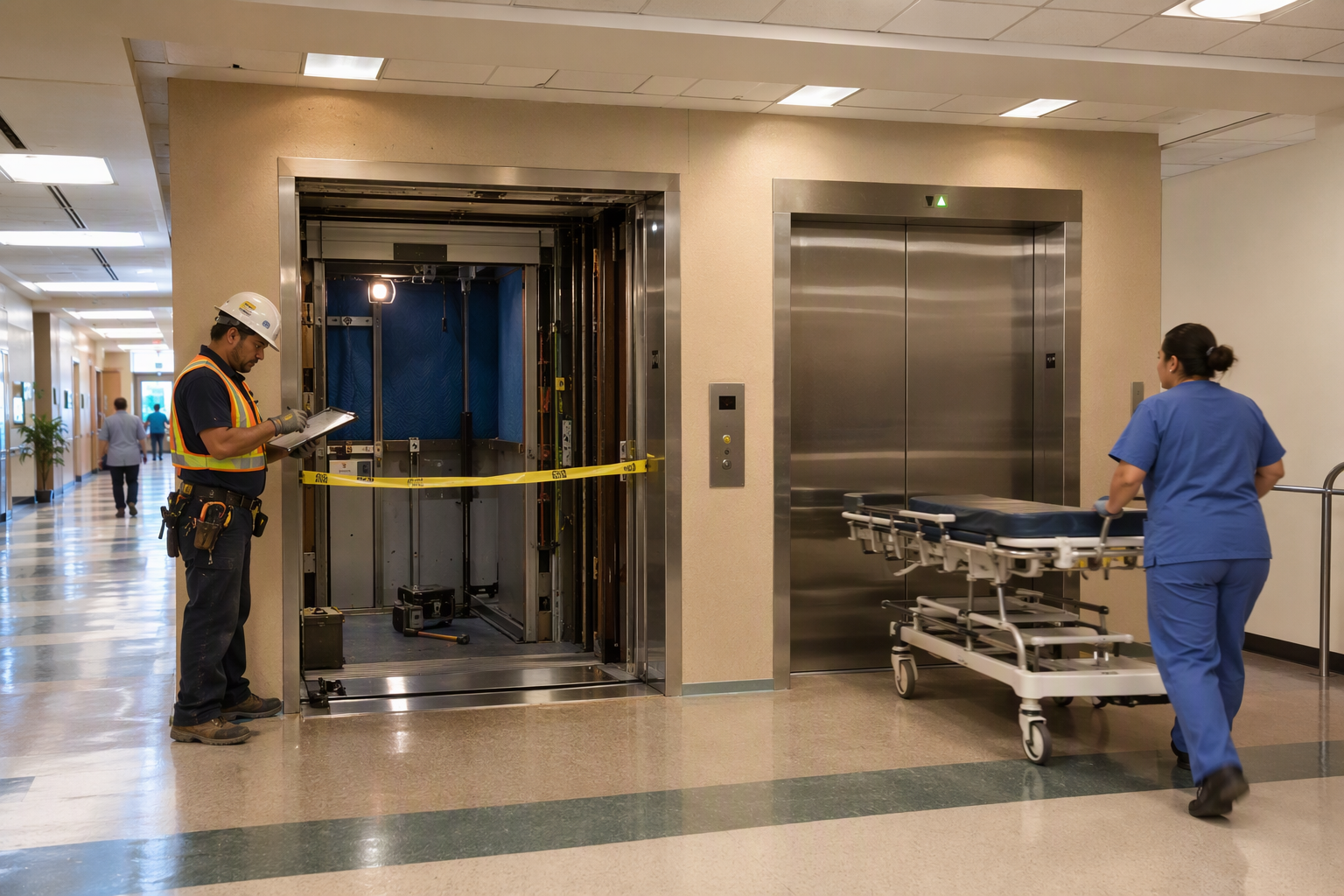
Healthcare facilities in Signal Hill, Long Beach, Los Angeles, and Orange County face a unique challenge during elevator modernization: patient transport, staff movement, and medical equipment delivery cannot pause while major upgrades take place. The good news is that ongoing monthly maintenance and a modernization project are not mutually exclusive — but they require deliberate coordination, clear contractual boundaries, and strict compliance with California elevator law to protect patients, staff, and the facility’s permit to operate.
What Does California Law Require for Elevators During a Modernization Project?
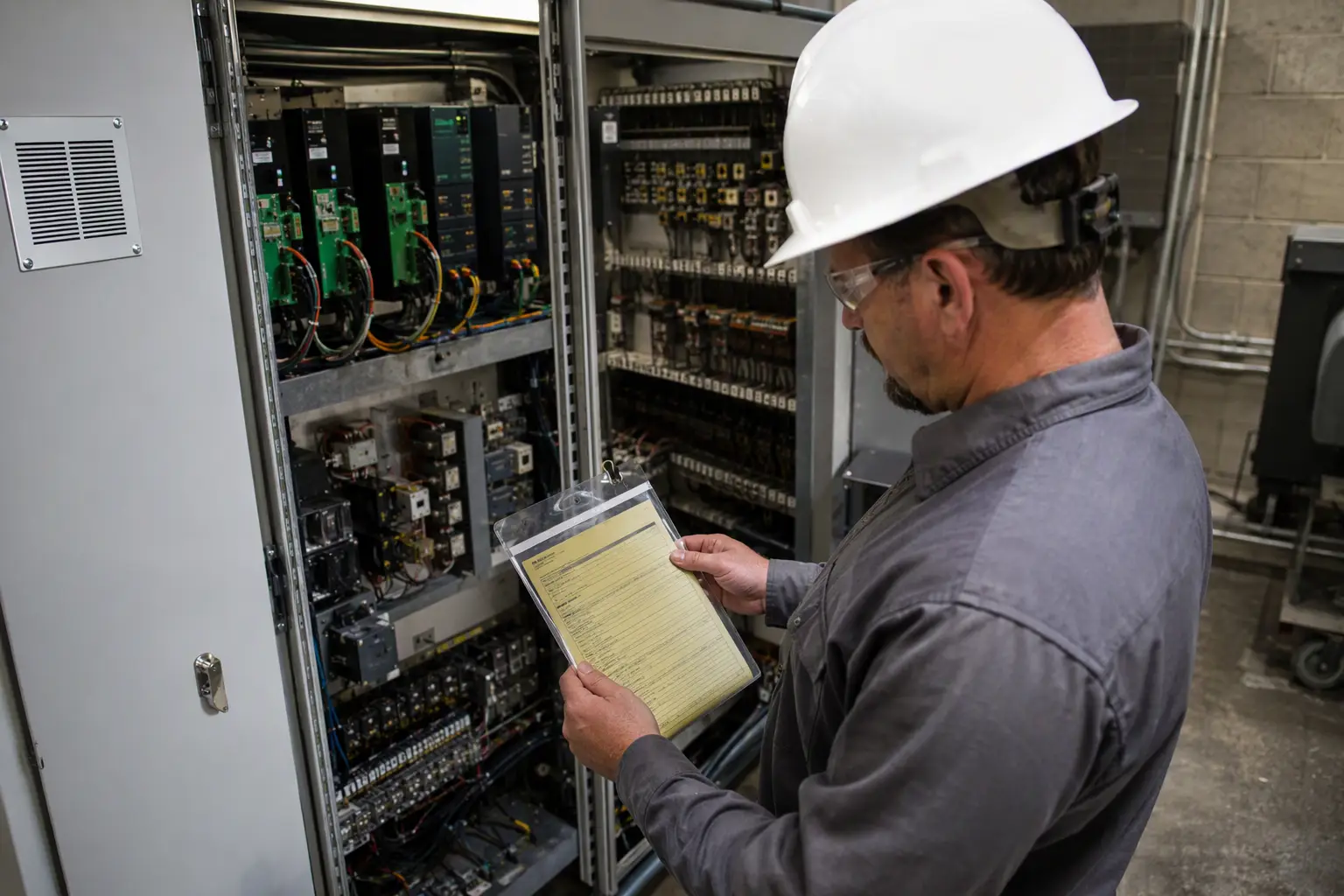
Under Cal/OSHA’s Elevator Unit, administered by the California Department of Industrial Relations, no elevator in California may be operated without a valid, current permit to operate. This requirement, rooted in California Labor Code Sections 7300–7324.2 and the California Code of Regulations, Title 8, Elevator Safety Orders (Sections 3000–3146), does not pause because a modernization is underway.
Critically, California law requires that a permit from Cal/OSHA be obtained before a conveyance is materially altered. A modernization — which typically replaces control systems, drive machinery, doors, or safety components — almost always constitutes a material alteration. That means the healthcare facility or its elevator contractor must secure the appropriate Cal/OSHA permit before modernization work begins on any car that will remain partially in service.
Only a company holding a Certified Qualified Conveyance Company (CQCC) certification from Cal/OSHA — which requires a current C-11 Elevator Contractor license issued by the California Contractors State License Board (CSLB) — may maintain, repair, alter, or replace components on a conveyance in California. All mechanics performing that work must be individually certified by Cal/OSHA as Certified Competent Conveyance Mechanics (CCCMs). Liftech Elevator operates within these requirements when serving healthcare clients across Los Angeles and Orange County.
Why Is Continued Monthly Maintenance Especially Critical in Healthcare Settings?
Hospitals, skilled nursing facilities, ambulatory surgery centers, and medical office buildings operate under a different risk profile than commercial office towers. Patient lifts, gurney transport, and wheelchair accessibility depend on elevator reliability around the clock. A single unplanned shutdown during a modernization phase can delay patient transfers, compromise medication delivery, or trigger a Joint Commission or CMS survey finding related to life-safety systems.
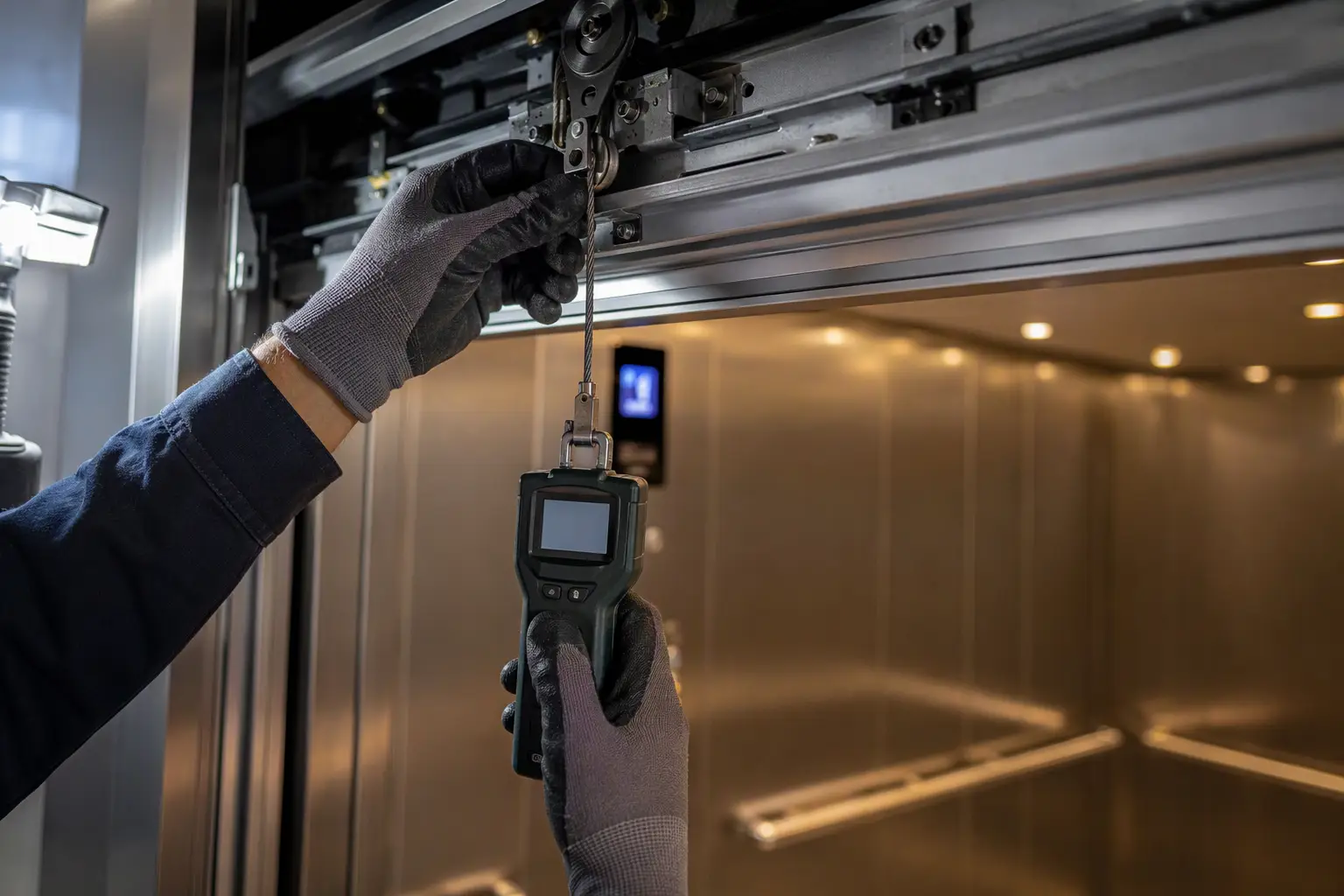
Monthly maintenance during modernization catches emerging issues — lubrication breakdown, door timing drift, safety circuit anomalies — before they escalate into a shutdown. In a healthcare setting where every car in the bank may be carrying patients, that early detection function is not optional; it is a patient safety control.
Additionally, ADA accessibility requirements do not relax during construction phases. Healthcare facilities must ensure that accessible vertical transportation remains available to patients and visitors with disabilities throughout any project. Maintenance records documenting ongoing accessibility compliance support that obligation.
How Does Monthly Maintenance Work Alongside a Modernization Project?
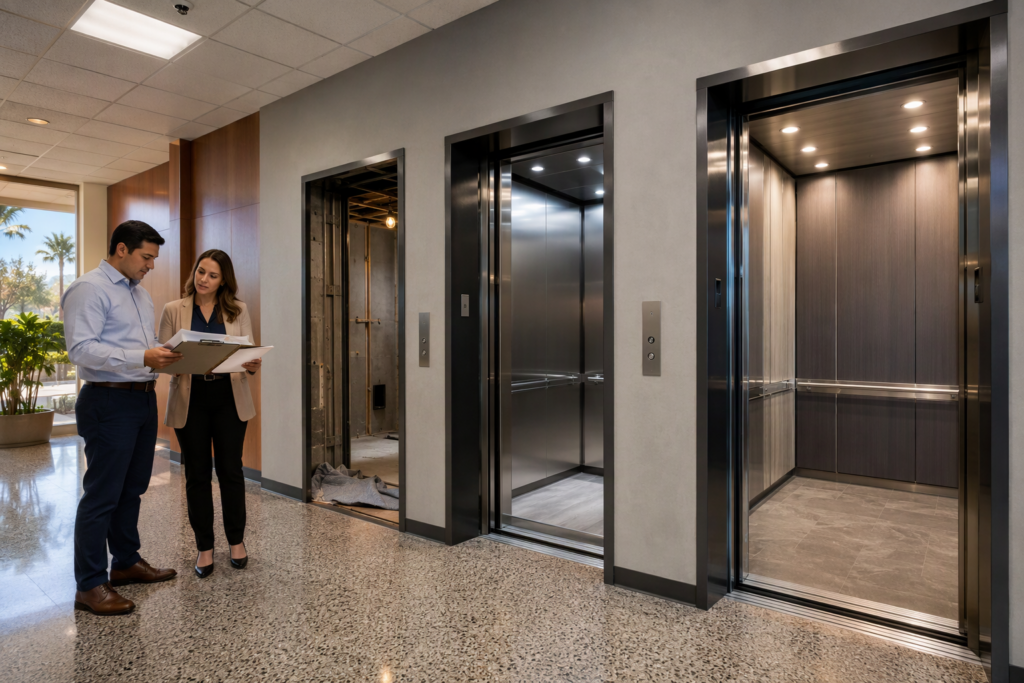
Coordination between the maintenance scope and the modernization scope is the central operational challenge. When components are being replaced as part of the modernization, the maintenance technician must know which systems are in transition so they do not service components that are scheduled for removal or that have been temporarily bypassed by the modernization crew.
A written scope-of-work boundary — sometimes called a “division of responsibility” document — should be established before work begins. This document clarifies which systems the ongoing maintenance contractor covers, which systems the modernization contractor owns, and how handoffs are documented. Liftech Elevator recommends that healthcare facility managers request this document in writing before the first modernization crew arrives on site.
What Are the Step-by-Step Best Practices for Coordinating Maintenance and Modernization in a Healthcare Facility?
- Audit the current permit status. Confirm that every elevator car has a valid Cal/OSHA permit to operate posted conspicuously in the car before any modernization work begins. A lapsed permit on even one car creates a compliance violation independent of the modernization.
- Secure the material-alteration permit from Cal/OSHA. Work with the CQCC-certified modernization contractor to file for the required Cal/OSHA permit before any material alteration begins. Operating a car under active modernization without this permit exposes the facility to stop-work orders.
- Define the scope boundary in writing. Document exactly which systems each party — the ongoing maintenance contractor and the modernization contractor — is responsible for at each phase of the project.
- Establish a phased shutdown schedule. Work with hospital operations, patient transport, and facilities management to schedule individual car outages during lowest-volume periods and ensure at least one compliant car remains available for accessible transport at all times.
- Maintain a continuous maintenance log. Document every monthly maintenance visit, noting which systems were serviced, which systems were excluded due to active modernization, and any deficiencies found. This log is the facility’s primary evidence of ongoing compliance during a Cal/OSHA inspection.
- Coordinate the post-modernization inspection. In California, each newly modernized car must be inspected by Cal/OSHA — or by a Certified Competent Conveyance Inspector (CCCI) — and receive a new permit to operate before it is returned to service. Schedule this inspection early so it does not bottleneck the project’s completion.
- Resume full maintenance scope after commissioning. Once the modernized car has received its new Cal/OSHA permit to operate, update the maintenance contract to reflect the new equipment configuration, and confirm that all maintenance personnel are familiar with the updated systems.
Does a Full Maintenance Contract Affect the Inspection Interval During a Modernization Project?
Under California law, Cal/OSHA may issue a permit to operate for up to two years — rather than the standard annual permit — for an elevator that is in safe condition and covered by a full maintenance contract with a C-11 licensed elevator company. However, a car that is actively undergoing material alteration is not in the same condition as a car covered by a routine full maintenance contract. Healthcare facility managers should confirm with their Cal/OSHA-permitted inspector whether the two-year interval applies to any car that has had components altered, or whether a fresh annual inspection cycle begins after the modernization is complete. Arranging the reinspection is the elevator owner’s responsibility under California law.
What ASME Standards Govern Elevator Maintenance and Modernization in California?
California has adopted the ASME A17.1/CSA B44 Safety Code for Elevators and Escalators, 2004 edition (Group IV Elevator Safety Orders), effective May 1, 2008, for installation contracts signed on or after that date. This code governs maintenance requirements, safety device testing intervals, and the criteria that must be met before a modernized car may be returned to service.
California has also proposed a Group V update that would incorporate portions of ASME A17.1-2019. A public hearing was held on June 18, 2026, but no effective date has been posted as of the date of this page. Healthcare facility managers planning long-term modernization programs should monitor the Cal/OSHA Elevator Unit for updates, as a code transition could affect equipment specifications mid-project.
Does the City of Los Angeles Have Additional Requirements for Healthcare Elevator Projects?
Yes. Los Angeles operates its own elevator and conveyance inspection program through the City of Los Angeles, Department of Building and Safety (LADBS). Healthcare facilities in Los Angeles — including those in Signal Hill and Long Beach that may be subject to overlapping jurisdictions — should confirm with LADBS whether city-level permits or inspections are required in addition to the Cal/OSHA process. Liftech Elevator works with healthcare clients to identify which authority having jurisdiction (AHJ) governs each project so that no permit step is missed.
How Do ADA Requirements Apply to Healthcare Elevators During Modernization?
The Americans with Disabilities Act requires that places of public accommodation and commercial facilities — categories that include hospitals and medical office buildings — maintain accessible routes for individuals with disabilities. When a car is taken out of service for modernization, the facility must ensure that an equivalent accessible car remains available. If all cars must be out of service simultaneously at any point, the facility should document the accommodation plan in advance. Monthly maintenance records that confirm door dwell times, leveling accuracy, and emergency communication function serve as supporting documentation for ADA compliance throughout the project period.
What Happens If Monthly Maintenance Lapses During a Modernization Project?
A lapse in monthly maintenance during a modernization project creates compounding risks. First, deficiencies that develop during the high-vibration, high-dust environment of active construction may go undetected until they cause an unplanned shutdown or a safety device activation. Second, a gap in maintenance records can complicate the Cal/OSHA inspection required before the modernized car returns to service — inspectors reviewing the maintenance history may question whether the car was properly cared for during the project. Third, for healthcare facilities seeking the two-year permit interval, a documented lapse in full maintenance coverage may disqualify the car from that extended cycle.
Can the Same Company Perform Both Monthly Maintenance and the Modernization?
Yes, and in many healthcare settings this is the preferred approach because it eliminates the scope-boundary ambiguity described above. When a single CQCC-certified company holds both the maintenance contract and the modernization contract, the division of responsibility exists internally rather than between two competing parties. The maintenance documentation and the modernization permit documentation are held in one place, which simplifies the Cal/OSHA inspection process. Whether the facility uses a single vendor or two separate firms, the CQCC certification and CCCM credentials of all technicians must be current — California CQCC and CCCM certificates require renewal every two years, with at least eight hours of continuing education per renewal cycle.
Questions Your Inspector Will Ask
- Is the current Cal/OSHA permit to operate posted in the elevator car, and is it valid for this car’s current condition?
- Was a material-alteration permit obtained from Cal/OSHA before modernization work began on this car?
- Who is the CQCC-certified company responsible for maintenance during the modernization period, and can you produce their certification?
- Are all mechanics who worked on this car during the modernization certified as CCCMs by Cal/OSHA?
- Is there a continuous maintenance log documenting every visit during the modernization period, including any systems excluded from service due to active modernization work?
- Has the car been inspected by a Cal/OSHA safety engineer or a CCCI following the completion of the modernization work?
- Does the facility have documentation showing that at least one ADA-compliant car was maintained in service throughout the project?
- If the facility is in Los Angeles: has the LADBS been notified and have any required city-level inspections been completed?
What Should a Healthcare Facility Manager Do Right Now If a Modernization Is Being Planned?
Start the compliance conversation before the project is awarded, not after. Confirm that every candidate contractor holds a current CQCC certification and that all mechanics are individually certified as CCCMs. Request a written scope-of-work boundary document as a contract deliverable. Verify the current permit-to-operate status of every car in the building. Identify the authority having jurisdiction — Cal/OSHA, LADBS, or both — and confirm which permits are required and in what sequence. Liftech Elevator provides assessments for healthcare facilities in Signal Hill, Long Beach, Los Angeles, and Orange County that cover exactly these pre-project compliance checkpoints.
Contact Liftech Elevator for a free elevator assessment at 562-997-3639.
Need elevator service you can rely on? Liftech Elevator is ready to help.