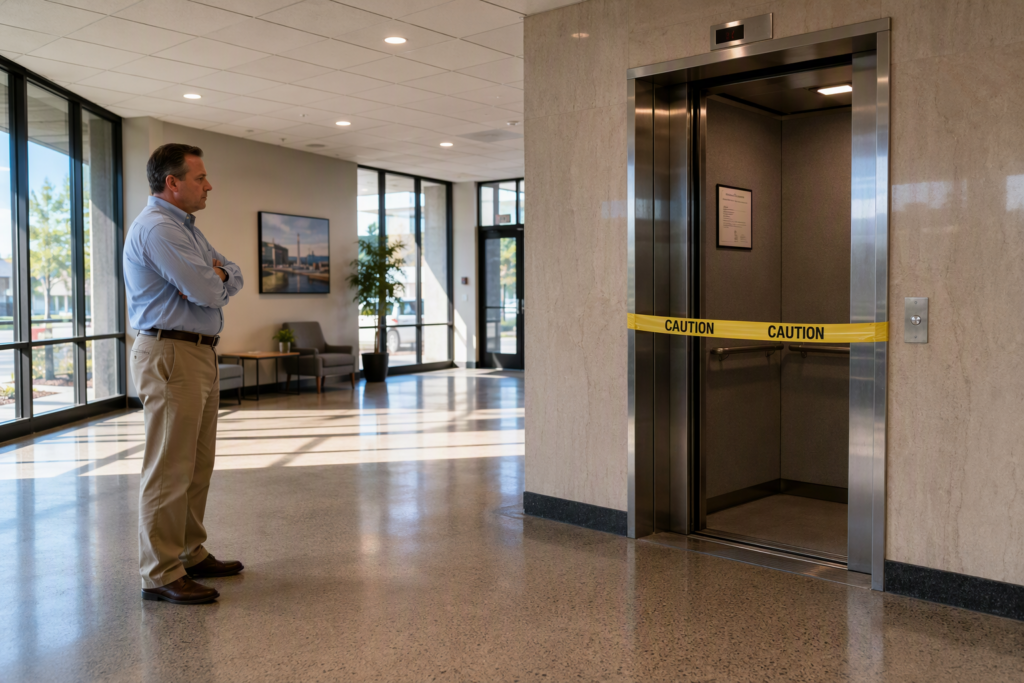

Why does Q4 elevator budget planning matter more than most facility managers realize?
Elevator systems represent some of the highest-liability, highest-cost vertical transportation assets a building can own, and missing a capital planning deadline can delay critical repairs by a full fiscal year, creating compounding compliance risk and equipment degradation.
Commercial buildings in Los Angeles, Long Beach, Signal Hill, and throughout Orange County operate under California’s Title 8 elevator safety regulations enforced by the Division of Occupational Safety and Health (Cal/OSHA), as well as the nationally recognized ASME A17.1 Safety Code for Elevators and Escalators. When deferred maintenance causes a code violation or an unplanned shutdown during Q1 of a new fiscal year, the emergency repair costs almost always exceed what a planned capital expenditure would have required — and the disruption to building tenants is immediate.
Understanding how to sync elevator service cycles with organizational budget calendars is therefore not an administrative convenience — it is a risk management discipline that protects building owners, tenants, and the certifications that keep elevators legally operational.
What is the ideal timeline for scheduling elevator assessments before Q4 budget deadlines?

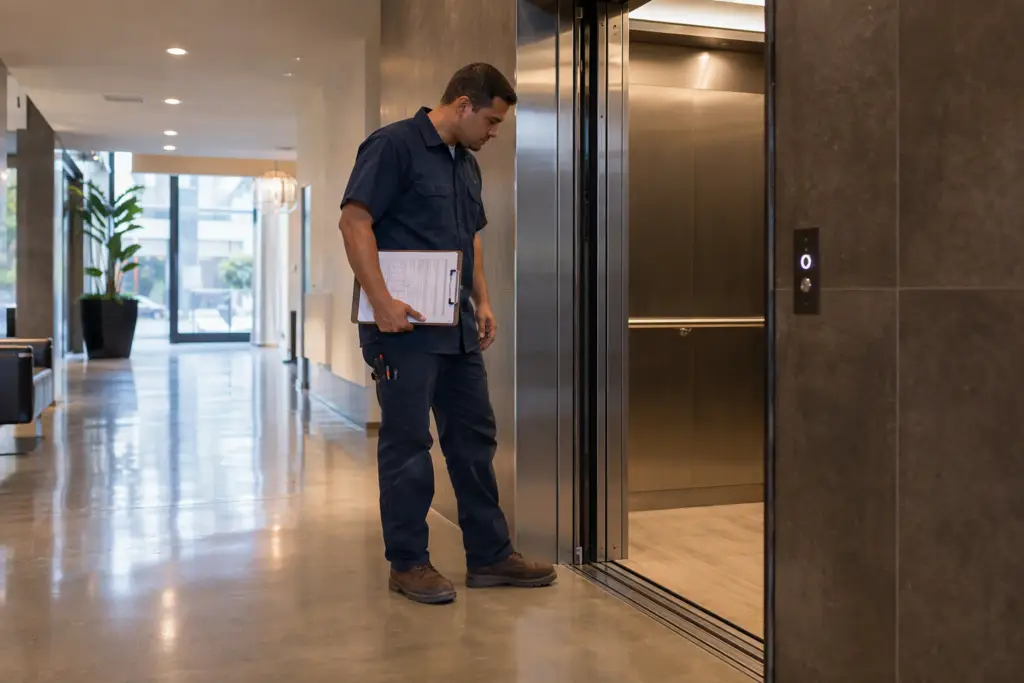
The optimal window for a formal elevator condition assessment is Q2 or early Q3 — typically April through August — so that findings, repair quotes, and prioritization documents are ready for submission when budget approval cycles open in September or October.
Most large commercial property owners, healthcare facilities, and government-managed buildings in Southern California operate on a fiscal year that either mirrors the calendar year (January–December) or runs July–June. In both cases, capital expenditure requests must be submitted six to ten weeks before the fiscal year closes or opens. Working backward from a typical October 1 submission deadline means condition assessments must be complete by mid-August at the latest.
Liftech Elevator recommends that property managers in the Los Angeles, Long Beach, and Orange County markets treat the spring inspection as a dual-purpose event: satisfying the periodic inspection requirement under California elevator code while simultaneously generating the condition documentation needed for capital planning. Combining these two objectives into one site visit reduces administrative burden and ensures the inspection report becomes a budget-ready document.
How should facility managers categorize elevator repairs for capital versus operating budgets?
Elevator expenses should be categorized by three tiers — immediate safety or compliance repairs (operating/emergency), planned component replacements that extend equipment life (capital), and cosmetic or convenience upgrades (capital or deferred) — so budget submissions are structured clearly and approved faster.
This three-tier model maps directly to how finance teams and asset managers evaluate facility spending:
- Tier 1 — Immediate / Compliance: Repairs required to pass a state inspection, address a Cal/OSHA violation, meet ADA accessibility requirements, or correct a life-safety deficiency. These are typically expensed immediately through operating budgets regardless of fiscal timing.
- Tier 2 — Planned Capital Replacement: Drive systems, hydraulic pump units, controller upgrades, rope or cable replacement, and cab refurbishments. These extend useful equipment life and qualify for capitalization under most accounting standards.
- Tier 3 — Deferred Enhancements: Destination dispatch systems, energy efficiency retrofits, interior aesthetic upgrades. These are discretionary and can be scheduled around budget availability.
Presenting repairs in this tiered format gives budget approvers a clear risk profile. Tier 1 items carry immediate legal and liability exposure if unfunded; Tier 2 items carry life-cycle cost consequences; Tier 3 items are genuinely deferrable. This framing significantly improves the speed and completeness of budget approvals.
What does a comprehensive pre-budget elevator condition assessment include?
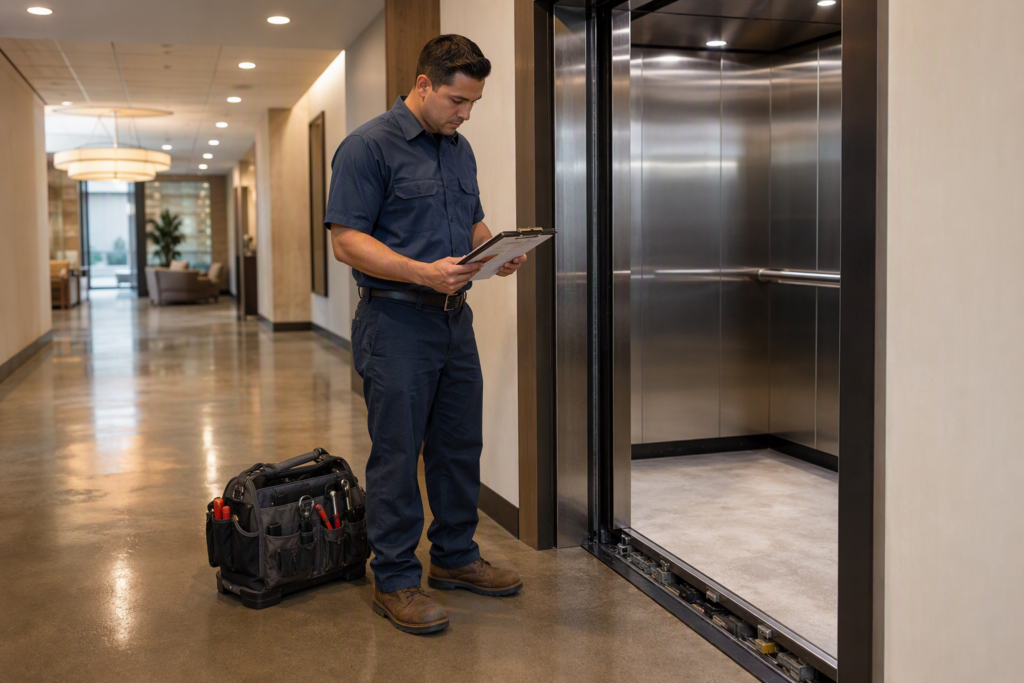
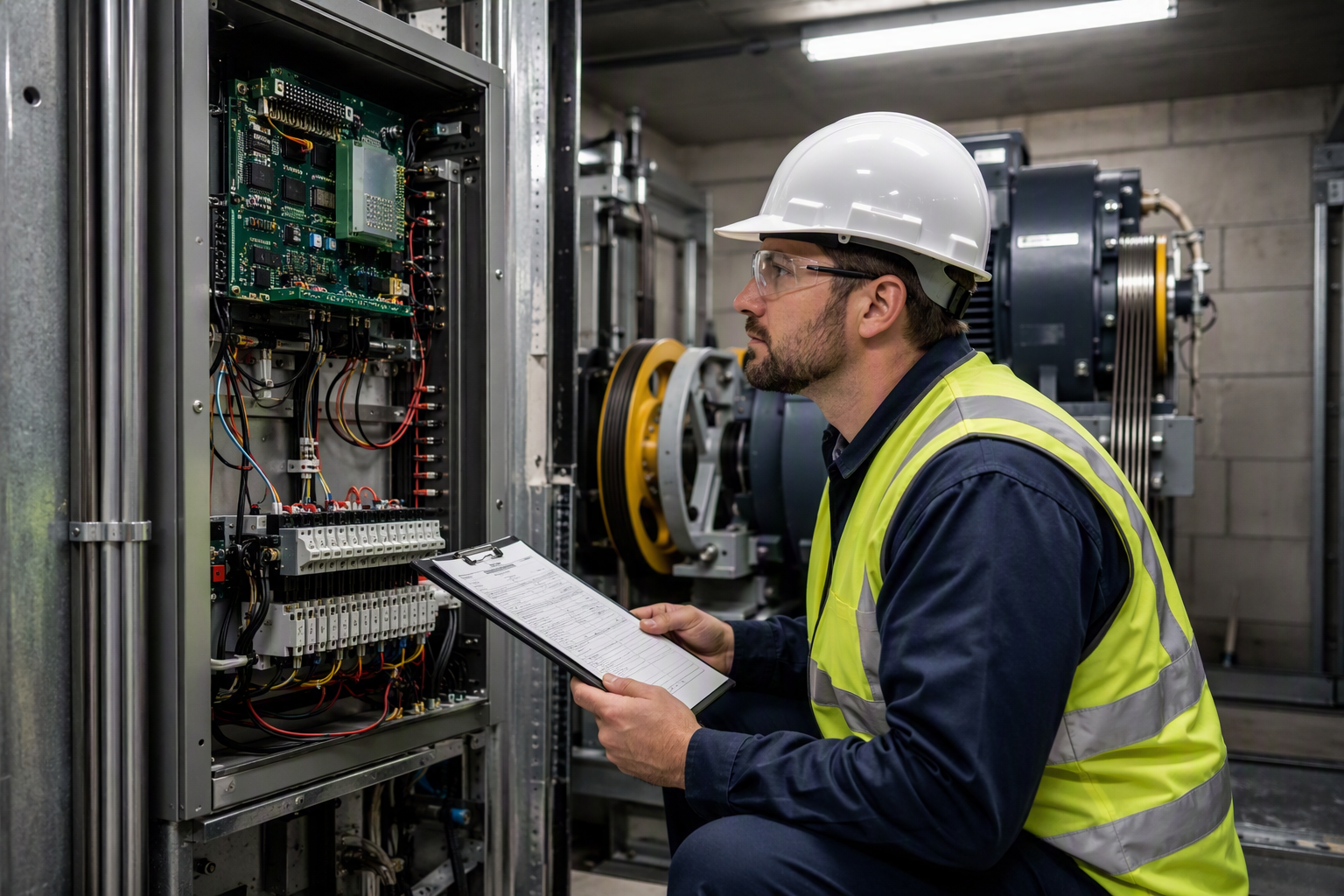
A pre-budget elevator condition assessment should include a detailed inspection of the machine room, hoistway, cab, control systems, door mechanisms, safety devices, and all code compliance documentation — producing a prioritized repair list with cost estimates suitable for capital planning submission.
A thorough assessment examines the following components:
- Drive machine condition (traction or hydraulic)
- Controller and relay/logic board status
- Door operator, sill, and interlock condition
- Hoist ropes, sheaves, and governor
- Safety edges, buffers, and leveling accuracy
- Pit conditions including sump pumps and lighting
- Machine room ventilation and fire protection
- Emergency lighting and communication devices per ASME A17.1
- ADA compliance elements including cab dimensions, control button heights, and auditory signals per ADA Standards for Accessible Design
- Current certificate of operation status and inspection history
The output should be a written report with photographs, remaining useful life estimates for major components, and a line-item cost schedule organized by the three-tier capital/operating framework described above. This document serves directly as a budget justification attachment.
How often do elevators require inspections under California and ASME standards?
California-regulated elevators are subject to periodic inspections enforced by Cal/OSHA or a certified Qualified Elevator Inspector (QEI), with frequency intervals governed by the current edition of ASME A17.1 as adopted by California’s Title 8 regulations.
For facilities managing budget cycles, the critical point is that inspection deadlines are non-negotiable and non-deferrable. A lapsed certificate of operation can result in mandatory shutdown, tenant complaints, and regulatory penalties — all of which create unplanned emergency expenditures that dwarf the cost of a planned maintenance program.
Building owners in Signal Hill, Long Beach, Los Angeles, and Orange County should map every elevator’s next inspection due date onto their fiscal calendar during the Q2 assessment process. If an inspection falls due in Q1 of the new fiscal year, the associated corrective repairs must be funded in the current budget cycle or pre-approved for immediate expenditure.
What is a multi-year elevator maintenance agreement and how does it simplify capital planning?
A multi-year full-service maintenance agreement converts unpredictable elevator repair expenses into a fixed, foreseeable annual cost, making it significantly easier to obtain budget approval and maintain consistent equipment performance over a three-to-five-year capital planning horizon.
Under a comprehensive maintenance contract, the service provider covers scheduled lubrication, adjustments, parts replacement for normal wear items, callback service, and annual inspection support. The building owner exchanges variable, emergency-driven repair costs for a predictable line item that finance teams and asset managers can plan around.
For properties in the Los Angeles and Orange County markets, a well-structured agreement also provides documented service history — a critical asset during property transactions, insurance renewals, and regulatory audits. Liftech Elevator offers maintenance agreements structured to align with both calendar-year and July–June fiscal cycles, helping facilities avoid the mid-year contract renewal disruptions that complicate budget management.
How should building managers compare elevator service vendor quotes for budget submissions?
Vendor quotes submitted for budget approval should be compared on a total-cost-of-ownership basis — not just the lowest per-visit or annual fee — examining scope of work, parts coverage, response commitments, and compliance documentation standards side by side.
| Evaluation Criterion | Full-Service Agreement | Oil & Grease (Basic) Agreement | Time & Materials (No Contract) |
|---|---|---|---|
| Annual cost predictability | High — fixed annual rate | Medium — parts extra | Low — fully variable |
| Parts & components coverage | Included (normal wear) | Not included | Billed separately |
| Inspection report documentation | Typically included | May be extra | Billed per visit |
| Budget planning suitability | Excellent | Fair | Poor |
| Compliance risk exposure | Low — proactive | Medium | High — reactive only |
| Emergency callback coverage | Included | Limited | Full T&M billing |
| Best suited for | Multi-unit, healthcare, commercial | Low-use residential | One-time or transitional |
When assembling a budget package, facility managers should request itemized written quotes from at least two qualified elevator contractors and ensure each quote specifies the exact ASME A17.1 maintenance task categories covered. Vague scope language is the primary source of disputes and unexpected costs mid-contract.
What are the most common elevator components that require capital replacement planning?
The components most frequently requiring planned capital replacement are drive machines and motors, hydraulic pump units, controllers and logic systems, hoist ropes, door operators, and cab interior systems — each with distinct useful life expectations that drive long-range capital forecasting.
Understanding the life-cycle profile of these components allows facility managers to build a rolling five-year capital schedule rather than reacting to failures:
- Hydraulic pump units and cylinders: Older single-bottom cylinders in California are subject to specific corrosion and environmental compliance requirements. Replacement planning often involves coordination with environmental remediation timelines.
- Controllers: Older relay-logic controllers are increasingly difficult to maintain as parts become obsolete. Upgrading to solid-state or microprocessor controllers is a significant capital investment with measurable reliability and energy benefits.
- Hoist ropes: Subject to periodic replacement based on condition criteria defined in ASME A17.1, not simply a fixed calendar interval.
- Door operators: One of the highest-frequency failure points; proactive replacement avoids the service interruptions that generate tenant complaints and emergency call costs.
- Cab interiors: Purely cosmetic but often tied to ADA compliance upgrades for control panel height and braille requirements per ADA Standards for Accessible Design.
How do ADA compliance requirements affect elevator capital planning decisions?
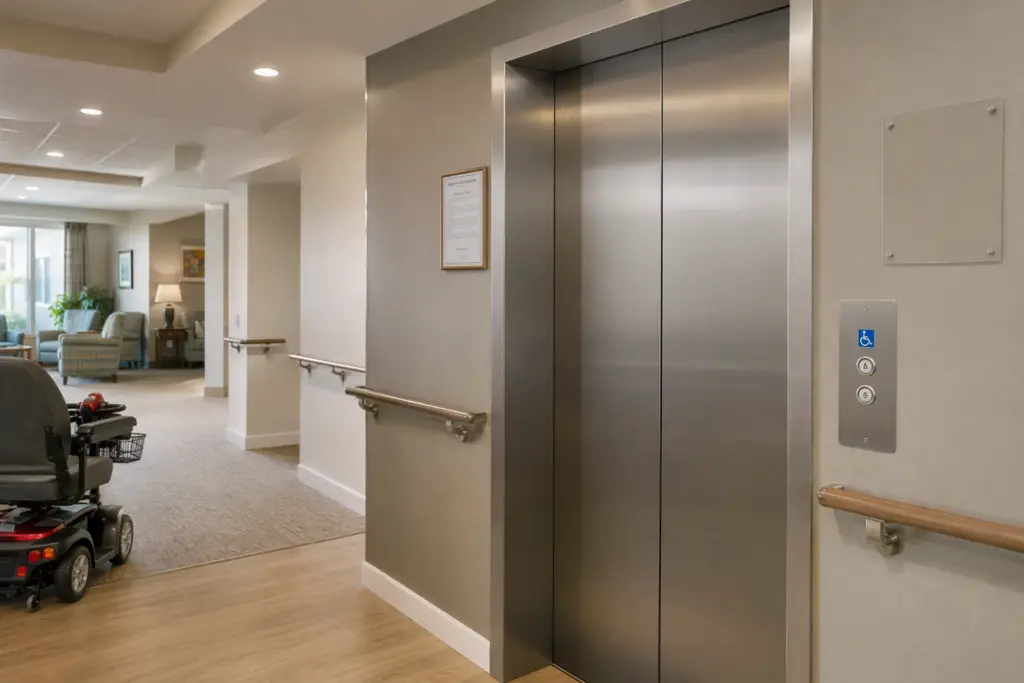
ADA compliance requirements for elevators — including cab dimensions, door width, control button standards, tactile and auditory signals, and floor designations — must be incorporated into any capital modernization project and can trigger additional compliance obligations if overlooked during planning.
Under the ADA, alterations to existing elevators that affect usability can trigger a requirement to bring additional accessibility features into compliance. This means that a controller upgrade or cab refurbishment planned purely for mechanical reasons may simultaneously create an ADA compliance obligation the facility manager was not anticipating.
Identifying ADA compliance gaps during the Q2–Q3 assessment phase allows building owners to bundle required accessibility upgrades with planned mechanical work, reducing mobilization costs and avoiding mid-project scope changes that blow capital budgets.
What steps should a facility manager follow to build an elevator capital plan from scratch?
Building an elevator capital plan from scratch requires a structured, sequential process that begins with an independent condition assessment and ends with a board-ready financial document ready for Q4 budget submission.
- Inventory all elevator assets: Document unit type (traction, hydraulic, MRL), installation year, last modernization date, current certificate of operation status, and next inspection due date for every unit in the building portfolio.
- Schedule professional condition assessments: Engage a qualified elevator service company to conduct a full mechanical, electrical, and compliance inspection of each unit. Target completion by end of Q2 or early Q3.
- Categorize findings by tier: Sort all identified deficiencies and recommendations into Tier 1 (compliance/safety), Tier 2 (capital replacement), and Tier 3 (enhancement) as described above.
- Obtain itemized quotes: Request written, line-item quotes from qualified contractors for all Tier 1 and Tier 2 items. Ensure quotes specify labor, parts, permit fees, and inspection fees separately.
- Develop a five-year rolling schedule: Map all major component replacement needs onto a five-year timeline using the life-cycle profiles identified during assessment. Spread capital expenditures to avoid budget spikes.
- Prepare the budget justification package: Assemble the condition assessment report, photographs, quotes, five-year schedule, compliance risk summary, and a one-page executive narrative into a single submission-ready document.
- Submit before the capital planning deadline: Ensure submission occurs no later than four to six weeks before the organization’s capital approval deadline to allow time for questions and revisions.
- Follow up post-approval: Once approved, schedule contracted work during periods of lower building occupancy or off-peak hours to minimize tenant disruption.
How far in advance should elevator modernization projects be planned?
Elevator modernization projects — including full drive system replacement, controller upgrades, or cab refurbishments — should be initiated at least twelve to eighteen months before the planned start of work, as lead times for equipment, permitting, and contractor scheduling are substantial in the Southern California market.
In the Los Angeles and Orange County markets specifically, permit processing through local building departments and Cal/OSHA coordination can add weeks or months to project timelines. Equipment lead times for major components such as controllers, drive machines, and hydraulic units have extended in recent years due to supply chain conditions. Initiating the planning, specification, and vendor selection process in the fiscal year preceding the intended construction year is strongly advisable.
Liftech Elevator assists property managers throughout Signal Hill, Long Beach, Los Angeles, and Orange County with project scoping and phasing plans that are designed to fit within single or multi-year capital budgets while maintaining elevator operability throughout the modernization process.
What are the consequences of deferring elevator maintenance past budget cycles?
Deferring elevator maintenance beyond planned budget cycles increases the probability of unplanned shutdowns, escalating repair costs, regulatory violations, and liability exposure — all of which are significantly more expensive and disruptive than the preventive expenditure that was deferred.
When a component fails unexpectedly rather than being replaced on a planned schedule, the costs expand in several directions simultaneously: emergency labor rates, expedited parts procurement, temporary alternative access provisions for ADA-protected building users, regulatory citation response, and potential legal exposure from tenant or visitor incidents. For multi-elevator buildings in high-occupancy environments such as healthcare, hospitality, or mixed-use residential, an unplanned outage also triggers immediate operational disruption that no budget approval can retroactively prevent.
California’s Cal/OSHA enforcement framework means that an elevator operating with known deficiencies — deficiencies documented in an inspection report but left unrepaired due to budget deferral — creates a documented record of notice that significantly affects liability outcomes in the event of an incident.
How does elevator downtime affect building value and tenant retention during budget disputes?
Recurring elevator downtime directly reduces net operating income, accelerates tenant churn, and can trigger lease termination clauses in commercial agreements — making deferred elevator maintenance a financial liability that extends well beyond the maintenance budget line itself.
For commercial building owners in the Long Beach, Los Angeles, and Orange County markets, elevator reliability is a material factor in tenant satisfaction surveys and lease renewals. Healthcare facilities and senior housing properties face even greater exposure, as elevator availability is directly tied to patient and resident safety obligations and regulatory compliance under both state and federal oversight.
Presenting this broader financial context to asset managers and ownership groups during the Q4 capital planning process often transforms elevator maintenance from a cost-center conversation into a revenue-protection and risk-management conversation — a reframing that consistently improves budget approval outcomes.
What documentation should property managers retain for elevator compliance and budget audits?
Property managers should retain all certificates of operation, inspection reports, maintenance logs, repair invoices, contractor licenses, permit approvals, and correspondence with regulatory agencies — organized by unit and year — to support both compliance audits and capital expenditure justifications.
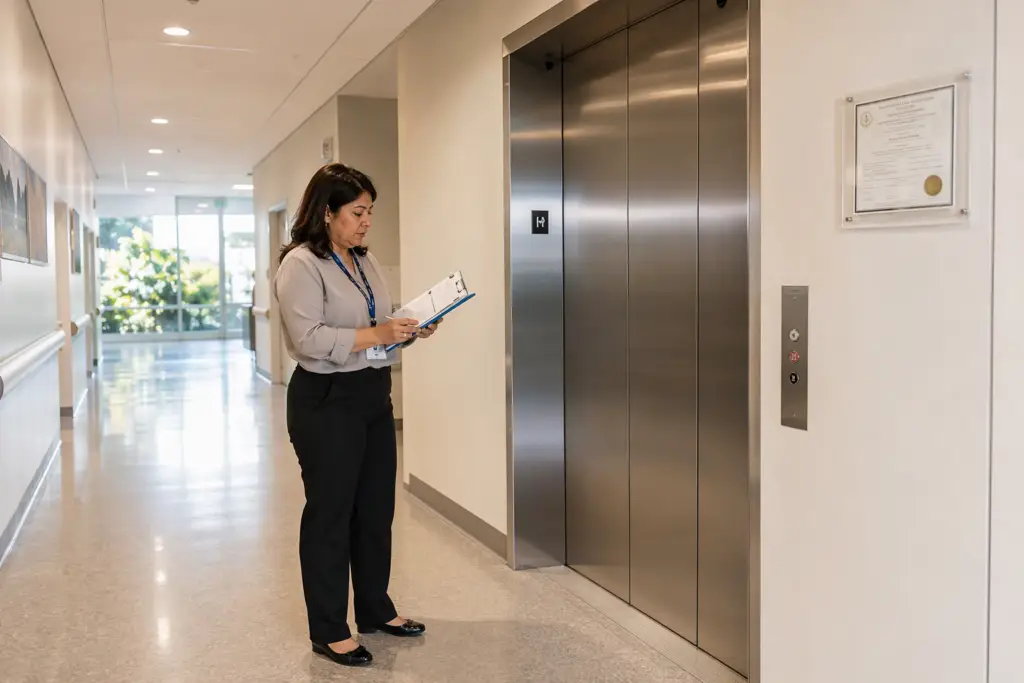
California regulations require that the current certificate of operation be posted in or near the elevator car at all times. Beyond this minimum requirement, a complete compliance file should include:
- All periodic inspection reports with deficiency lists and resolution documentation
- Maintenance visit logs with technician notes and parts replaced
- Contractor certificates of insurance and state elevator contractor registration
- All permits issued for repair or modernization work
- Correspondence with Cal/OSHA regarding any violations or notices
- ADA compliance evaluation records and any variance or equivalence documentation
- Equipment manuals and as-built drawings for modernization projects
This documentation package serves triple duty: it satisfies regulatory audit requirements, it provides the historical record that supports accurate capital planning, and it is essential during property transactions or financing events where due diligence teams review vertical transportation assets.
How should emergency elevator repairs be handled when they fall outside the approved capital budget?
Emergency elevator repairs that arise outside the approved capital budget should be addressed through a pre-established emergency expenditure protocol — typically a pre-approved emergency reserve, an authorized emergency spend threshold, or a standing service agreement that covers emergency callbacks — to avoid the approval delays that extend equipment downtime.
Best practice for facilities in regulated jurisdictions like California is to establish an elevator emergency fund or pre-approved spend authority at the beginning of each fiscal year. This fund is distinct from the planned capital budget and exists specifically to address safety-critical failures that cannot wait for a budget approval cycle. The fund size should be informed by the age and condition of the elevator fleet as documented in the most recent condition assessment.
Facilities with full-service maintenance agreements already in place with providers such as Liftech Elevator gain a structural advantage here: many emergency callback situations are covered under the agreement terms, reducing or eliminating the need to invoke emergency budget authority for routine failure modes.
What questions should facility managers ask elevator service companies before signing a maintenance contract?
Before signing a maintenance contract, facility managers should ask about exact scope of services covered, parts and labor inclusion boundaries, inspection report standards, subcontractor use, compliance documentation practices, and contract escalation terms — all of which directly affect budget predictability.
A rigorous pre-contract interview should include the following questions:
- What specific maintenance tasks are performed at each visit, and how do they map to ASME A17.1 maintenance requirements?
- Which parts are covered under the agreement and which are billed separately?
- Is inspection report generation included, and in what format are reports delivered?
- Does the company hold a current California elevator contractor registration?
- Are all technicians working on the equipment employed directly, or are subcontractors used?
- What is the escalation process if a dispute arises over whether a repair falls within or outside the contract scope?
- Does the contract include any provisions for annual cost escalation, and if so, at what rate and on what trigger?
- How is emergency callback service handled, and what documentation is provided after each callback?
How does California’s regulatory environment specifically affect elevator capital planning in Los Angeles and Orange County?
California enforces elevator safety through Title 8 of the California Code of Regulations, administered by Cal/OSHA, which incorporates and in some cases exceeds the requirements of ASME A17.1 — creating a compliance environment where capital planning must account for both the base national standard and California-specific requirements.
California-specific considerations that affect capital planning include:
- Hydraulic elevator single-bottom cylinder requirements: California has specific regulations regarding single-bottom cylinders and their environmental containment, affecting older hydraulic elevator assets.
- Seismic provisions: Buildings in Los Angeles and Orange County are subject to seismic design requirements that affect elevator equipment anchorage and may trigger compliance reviews during modernization projects.
- Cal/OSHA enforcement authority: Unlike some states that delegate to third-party inspection only, California maintains active enforcement authority, meaning that unresolved inspection deficiencies can result in operational orders that override budget timelines.
- Local permitting jurisdictions: In Los Angeles, Long Beach, Signal Hill, and municipalities throughout Orange County, elevator work requires permits from local building departments in addition to Cal/OSHA oversight — a dual-track approval process that affects project scheduling and, therefore, capital timing.
Facilities managers unfamiliar with the intersection of Title 8, ASME A17.1, and local permit requirements are strongly advised to work with elevator service providers who operate regularly in California and are familiar with the specific jurisdictional requirements of each municipality served.
What role does energy efficiency play in elevator capital planning decisions?
Energy efficiency upgrades — including variable frequency drives, regenerative drive systems, LED cab lighting, and destination dispatch technology — can reduce operating costs and may qualify for utility rebate programs in California, making them relevant to both capital and operating budget planning.
When a building owner is already undertaking a planned modernization of a drive system or controller, the incremental cost of specifying energy-efficient components is typically modest relative to the total project cost. Facilities pursuing LEED certification, energy benchmarking compliance under California’s Title 24, or participation in Southern California Edison or SoCalGas demand-response programs may find that elevator efficiency upgrades contribute meaningfully to portfolio sustainability targets.
Including energy efficiency analysis in the Q2–Q3 condition assessment ensures that opportunities are identified before the capital budget is finalized, rather than discovered mid-project when scope changes are most disruptive and costly.
How should property managers handle elevator capital planning for a multi-building portfolio?
Multi-building portfolio managers should treat elevator capital planning as a fleet management discipline — using a centralized asset register, staggered assessment schedules, and risk-ranked prioritization to allocate capital across properties based on compliance exposure, equipment age, and occupancy impact.
The practical challenge for portfolio managers is that elevator assessments, if scheduled haphazardly, produce a flood of repair requests in Q3 that cannot all be funded in a single Q4 budget cycle. A structured approach staggers assessments across the portfolio so that roughly one-third of the fleet is assessed in Q1, one-third in Q2, and one-third in Q3 — producing a continuous, manageable flow of capital planning inputs rather than a single annual crisis.
Liftech Elevator supports portfolio-level clients in the Los Angeles, Long Beach, Signal Hill, and Orange County markets with consolidated reporting formats that allow asset managers to view their entire elevator fleet’s condition status, upcoming inspection due dates, and capital requirements in a single document — significantly simplifying the budget preparation process for multi-property owners, REITs, and institutional facility management teams.
What is the minimum information needed to submit an elevator repair as a capital expenditure request?
A capital expenditure request for elevator repairs should include a written condition assessment or inspection report identifying the deficiency, at least one itemized contractor quote, a description of the compliance or safety risk if unfunded, a proposed completion timeline, and a total cost including labor, parts, permits, and inspection fees.
Finance teams and approval boards are more likely to approve capital requests that present the consequence of deferral alongside the cost of action. An effective CapEx request for elevator work frames the expenditure in terms of risk avoided — regulatory shutdown risk, liability exposure, accelerated component degradation — rather than simply requesting a dollar amount for a mechanical repair. The tiered categorization framework described earlier in this guide is directly applicable here: a Tier 1 compliance item with a Cal/OSHA deficiency notice attached carries a self-evident urgency that requires minimal additional justification.
Ready to Build Your Elevator Capital Plan Before the Q4 Deadline?
Facility managers in Signal Hill, Long Beach, Los Angeles, and Orange County can get ahead of budget season with a professional elevator condition assessment from a certified service provider. Contact Liftech Elevator for a free elevator assessment — receive a detailed inspection report, itemized repair recommendations, and a budget-ready cost schedule designed to meet your capital planning submission deadline.
Call Liftech Elevator today: 562-609-3478
Don’t let the next budget cycle pass without a documented elevator capital plan. The cost of planning is always less than the cost of an unplanned failure.
Need elevator service you can rely on? Liftech Elevator is ready to help.