What Is the Core Difference Between a Full Maintenance Contract and an Oil and Grease Contract?
A full maintenance contract bundles all routine service, labor, parts, and emergency response into one predictable monthly fee, whereas an oil and grease contract covers only scheduled lubrication, cleaning, and minor adjustments — every repair, replacement part, and after-hours callback becomes a separate out-of-pocket expense.
Building owners and facility managers in Los Angeles, Long Beach, Signal Hill, and Orange County regularly face this choice when renewing elevator service agreements. The decision is not simply a matter of price; it affects compliance risk, equipment longevity, occupant safety, and total cost of ownership over the life of the contract. Understanding what each agreement actually includes — and excludes — is the first step toward making a financially sound decision.
Full maintenance agreements are sometimes called “comprehensive” or “full-coverage” contracts. Oil and grease agreements are sometimes labeled “examination only,” “lubrication only,” or “O&G” contracts in vendor proposals. Both are legitimate service models, but they serve very different building profiles and risk tolerances.
What Does a Full Maintenance Elevator Contract Typically Include?
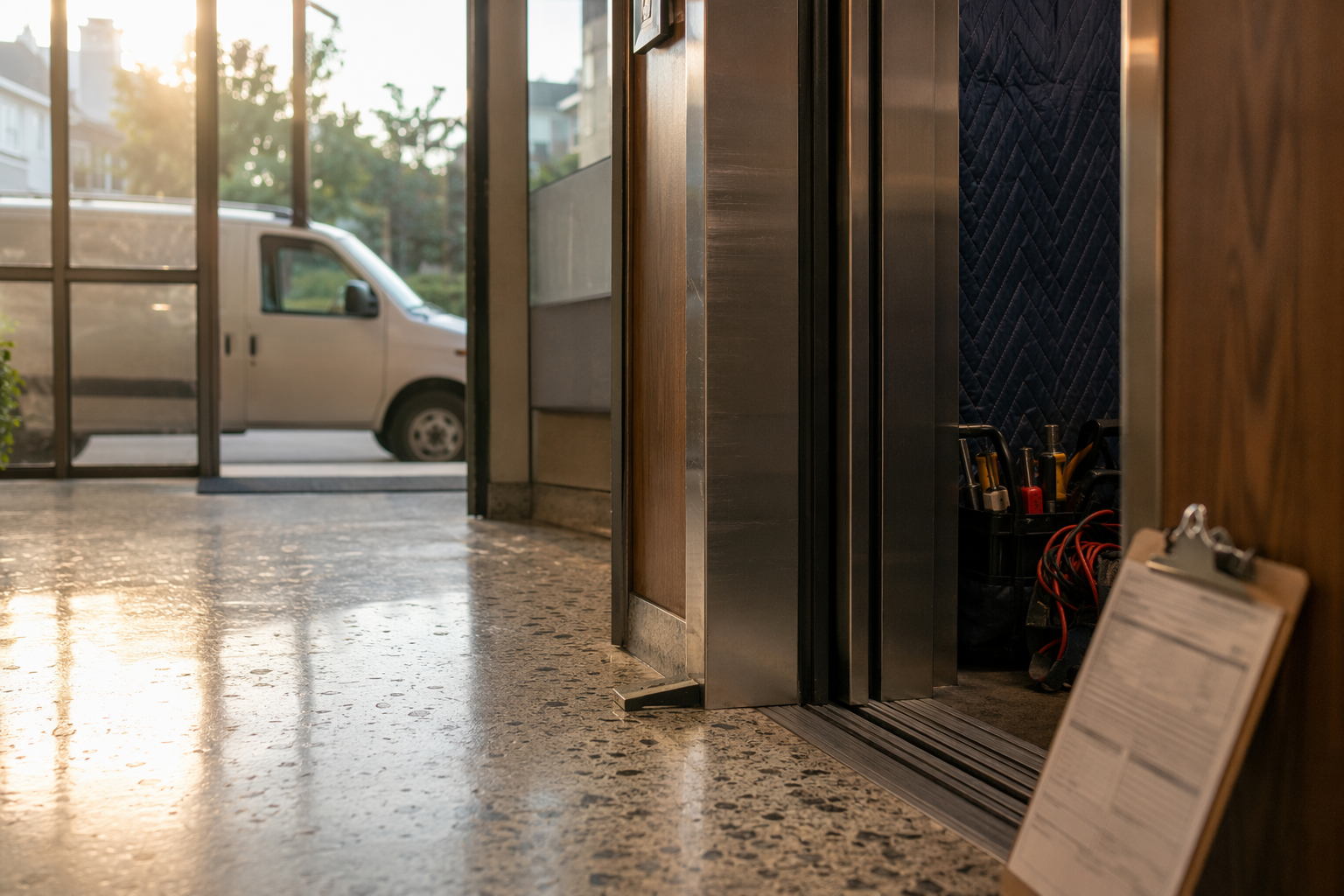
A full maintenance contract typically includes all scheduled preventive maintenance visits, lubrication, adjustments, labor for repairs, most replacement parts, and emergency callback service during the contract term.
Specific line items that a well-structured full maintenance agreement should cover include: inspection and adjustment of all mechanical and electrical components, replacement of wear parts such as brake shoes, roller guides, and door equipment, cleaning of the machine room and pit, modernization of safety devices as required by applicable codes, and 24-hour emergency callback response. Hydraulic elevator contracts should also address oil sampling and fluid replacement.
Exclusions in even the most comprehensive full maintenance contracts can include vandalism damage, cab interior refurbishment, major structural work, and certain insurance-mandated upgrades mandated by new legislation. Building owners should read the exclusions section carefully before signing.
What Does an Oil and Grease Elevator Contract Include?
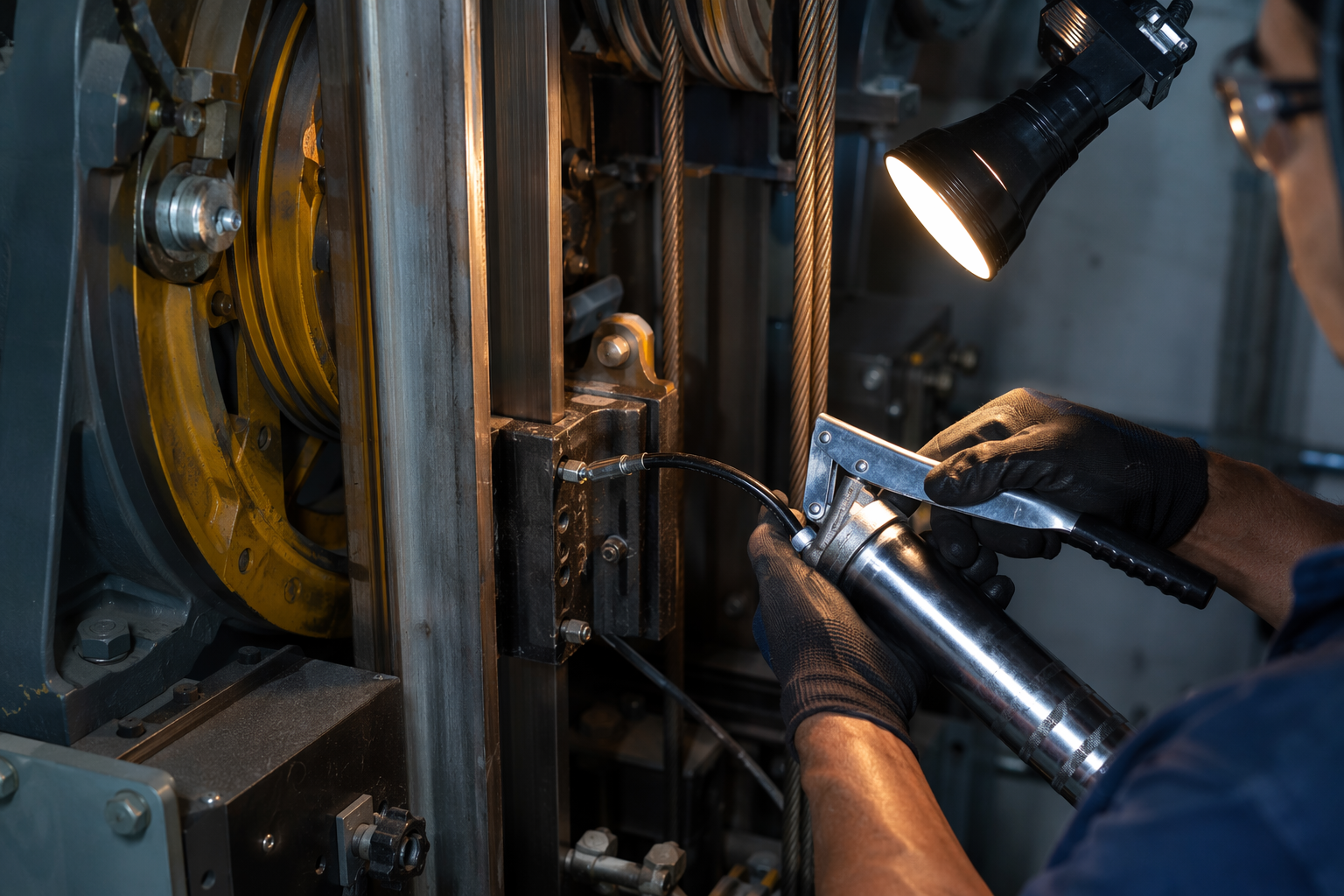
An oil and grease contract includes only scheduled visits for lubrication of moving parts, basic adjustments within the technician’s scope, and a visual inspection — all repair labor, replacement parts, and emergency callbacks are billed separately at the contractor’s prevailing rates.
O&G contracts are the most economical option on a monthly-fee basis. They make sense when a building owner has a newer elevator under a manufacturer’s warranty, carries a robust reserve fund specifically for unplanned repairs, or self-manages a property with in-house engineering staff. For older equipment — particularly traction elevators more than 15 years old or hydraulic units with aging cylinders — the accumulated cost of billable repairs can quickly exceed the premium paid for a full maintenance agreement.
O&G contracts typically do not obligate the contractor to guarantee system uptime, meet specific callback windows, or stock commonly needed parts on the service vehicle. Building owners assume the full inventory and scheduling risk.
How Do Full Maintenance and Oil and Grease Contracts Compare Side by Side?
The table below outlines the key contractual differences property managers should evaluate before signing an elevator service agreement.
| Feature | Full Maintenance Contract | Oil & Grease (O&G) Contract |
|---|---|---|
| Scheduled lubrication & adjustments | Included | Included |
| Emergency callback labor | Included | Billed separately (T&M) |
| Replacement parts (wear items) | Typically included | Billed separately |
| Major component replacement (motor, controller) | Varies by contract; often included | Billed separately |
| Annual state/local inspection support | Usually included | May be extra |
| Predictable monthly cost | Yes | Low base fee; variable total |
| Best suited for | Older equipment, high-traffic buildings, HOAs, commercial | New equipment under warranty, low-traffic, strong reserves |
| Contractor accountability for uptime | Higher | Lower |
| Risk borne by building owner | Lower | Higher |
Which Contract Type Is Required by California Law or ASME Code?
Neither California law nor the ASME A17.1 Safety Code for Elevators and Escalators mandates a specific contract type — but both impose maintenance and inspection obligations that the building owner is legally responsible for meeting regardless of contract structure.
California’s Elevator Safety Act (administered by the Division of Occupational Safety and Health — Cal/OSHA) requires that elevators be maintained in a safe condition and inspected periodically by a Certified Competent Conveyance Inspector. These obligations fall on the building owner, not the service contractor. Choosing an O&G contract does not relieve the owner of the duty to repair deficiencies identified during inspection.
The ASME A17.1/CSA B44 Safety Code establishes maintenance, testing, and inspection intervals as well as detailed maintenance control programs (MCP). The 2019 edition formalized the MCP requirement, meaning that the service contractor must document every maintenance task performed. An O&G contractor who performs only lubrication and does not maintain records of all required MCP tasks may expose the building owner to code violations. Building owners should verify that any service contractor — regardless of contract type — provides full MCP documentation.
ADA obligations also intersect with elevator maintenance. Under the Americans with Disabilities Act, elevators in public accommodations and commercial facilities must remain operational and accessible. Recurring downtime from deferred maintenance on an O&G contract can create ADA exposure for building owners.
How Does Contract Type Affect Compliance With Cal/OSHA Elevator Inspections?
Contract type directly affects inspection readiness because a full maintenance contractor is incentivized to keep the elevator in continuously compliant condition, while an O&G contractor has no financial stake in proactively correcting deficiencies before an inspection.
California requires periodic safety inspections for most elevators, with the frequency and scope governed by the type of equipment and occupancy. When an inspector issues a correction notice, the building owner must complete all items within the specified timeframe. Under an O&G contract, all labor and parts to address those corrections are billed as extras. Under a full maintenance contract, many — though not all — corrections are covered within the monthly fee.
Facilities in Los Angeles County, Long Beach, Signal Hill, and Orange County are subject to local enforcement jurisdiction as well as state oversight. Building owners should confirm with their service provider which authority having jurisdiction (AHJ) governs their property and what documentation the AHJ requires at inspection time.
What Are the Hidden Costs of an Oil and Grease Contract?
The hidden costs of an oil and grease contract include time-and-materials repair billing at premium rates, emergency callback charges, parts markups, and the cost of extended downtime when parts must be sourced without a contractor’s stocking commitment.
Building managers sometimes choose O&G contracts based solely on the lower monthly base fee, without modeling the total annualized cost of ownership. On aging equipment, a single motor starter failure, door operator replacement, or hydraulic cylinder repair can generate an invoice that exceeds many months of the differential between O&G and full maintenance pricing. Because the O&G contractor bears no risk on parts or labor, there is less incentive to perform thorough preventive adjustments that might forestall those failures.
Additional indirect costs include tenant complaints during downtime, potential liability for inaccessibility under the ADA, lost rental income in residential buildings, and the administrative burden of managing multiple repair invoices rather than a single monthly service fee.
When Does an Oil and Grease Contract Actually Make Financial Sense?
An oil and grease contract makes financial sense when the elevator is new or recently modernized, still covered by a manufacturer’s parts warranty, located in a low-traffic building, and the owner maintains a dedicated reserve fund sufficient to absorb unplanned repair costs.
Residential buildings with a single low-use elevator and a well-funded HOA reserve, or a commercial property whose elevator was fully modernized within the past few years, are realistic candidates for O&G coverage. In these scenarios, the probability of major repair events is lower, and the owner captures the savings from the reduced monthly fee during the low-risk period of the equipment’s life cycle.
Conversely, multi-elevator high-rise residential buildings, hospitals, hotels, transit facilities, and any property where elevator uptime is mission-critical should nearly always evaluate full maintenance agreements. The liability and operational consequences of unexpected outages far outweigh the monthly premium.
What Questions Should a Building Owner Ask Before Signing Either Contract?
Before signing any elevator service contract, a building owner should ask the contractor to define every inclusion and exclusion in writing, clarify parts coverage limits, specify the maintenance frequency schedule, and confirm how MCP documentation will be provided.
Key questions to request answers to in writing include:
- Which specific parts categories are included versus excluded?
- Is there a dollar cap on parts coverage per visit or per year?
- How many scheduled maintenance visits per year are included, and what tasks are performed at each?
- How is emergency callback defined, and what are the response protocols?
- Who is responsible for obtaining and tracking inspection certificates?
- Does the contract include MCP documentation as required by ASME A17.1?
- What is the contract cancellation policy and notice period?
- Are price escalation clauses included, and how are they calculated?
How Often Should Elevator Maintenance Be Performed Under Each Contract Type?
Under a full maintenance contract, most commercial elevators are serviced monthly; under an oil and grease contract, visits may occur monthly or quarterly depending on the agreement, but the scope of each visit is narrower.
The ASME A17.1 Safety Code for Elevators and Escalators establishes minimum maintenance intervals and task lists within the Maintenance Control Program framework. The code does not specify a universal visit frequency that applies to every installation — frequency is determined by equipment type, usage, and the MCP developed for that specific unit. However, the MCP must document all required tasks and the intervals at which they must be completed. An O&G contract that only provides quarterly visits may not satisfy MCP requirements for a busy commercial elevator.
Building owners should request a copy of the MCP for their equipment and verify that the proposed contract visit schedule aligns with all required task intervals. Gaps between required task intervals and actual service visits create code compliance exposure for the building owner.
What Happens During a Full Maintenance Service Visit?
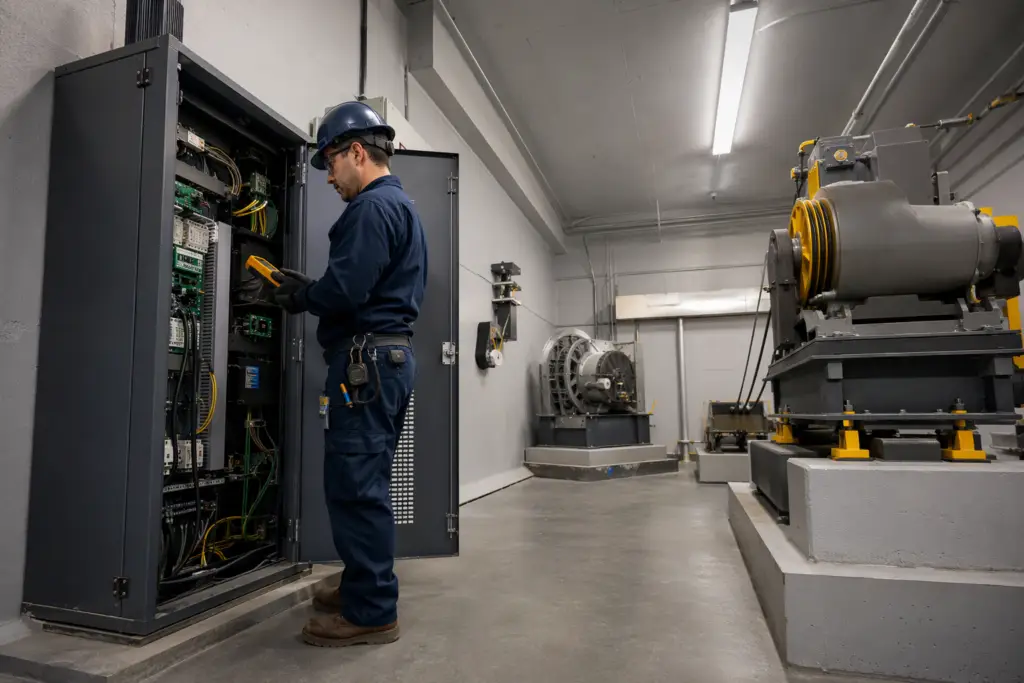
During a full maintenance service visit, a certified elevator mechanic performs lubrication of all specified points, adjusts brakes, door operators, and safety devices, tests electrical controls, cleans the machine room and pit, and documents all findings in the maintenance control program log.
A thorough full maintenance visit on a traction elevator typically covers: machine and motor bearings, wire rope lubrication, guide rail lubrication, governor and tension sheave, brake adjustment and wear inspection, door operator adjustment, door safety edge and light curtain testing, buffer inspection, pit cleanliness and sump pump function, controller and relay condition, leveling accuracy, ride quality assessment, and safety switch operability. Hydraulic elevator visits additionally address hydraulic fluid condition, pump unit, valve adjustment, and cylinder/piston integrity.
The level of documentation and task completion during a full maintenance visit is substantially greater than during an O&G visit, which is one reason full maintenance contracts command a higher monthly fee and also why they provide stronger compliance protection.
What Is a Maintenance Control Program (MCP) and Why Does It Matter?
A Maintenance Control Program (MCP) is a written document required by the ASME A17.1 Safety Code for Elevators and Escalators that specifies all maintenance tasks, intervals, and procedures for a specific elevator unit, and it matters because failure to maintain and document an MCP can result in code violations and liability exposure for the building owner.
The MCP requirement was strengthened in the 2019 edition of ASME A17.1. The program must be available at the elevator location for review by inspectors, and it must reflect actual maintenance performed. Any service contract — full maintenance or O&G — should explicitly state how MCP records will be maintained, who is responsible for them, and how the building owner can access them.
Building owners should be cautious about O&G contracts that do not address MCP documentation, as the narrower scope of O&G service may result in incomplete records that do not satisfy the ASME standard.
How Should a Building Owner Evaluate Elevator Service Contractors in Southern California?
Building owners in Southern California should evaluate elevator service contractors based on their licensure with the California Department of Industrial Relations, their familiarity with the local authority having jurisdiction, their ability to provide MCP documentation, their parts stocking capabilities, and references from similar properties in the area.
California requires elevator mechanics to hold a Certified Competent Conveyance Mechanic certification, and contractors must be properly registered. Confirming licensure before signing any contract is a non-negotiable due-diligence step. Beyond licensure, a contractor’s knowledge of the local AHJ — whether that is Los Angeles County, the City of Long Beach, the City of Signal Hill, or an Orange County municipality — can meaningfully affect how smoothly inspections and permit processes proceed.
Liftech Elevator serves building owners and property managers throughout Signal Hill, Long Beach, Los Angeles, and Orange County and is a certified elevator service company well-positioned to walk through both contract options in detail for any specific property and equipment type.
What Are the Steps to Transition From an Oil and Grease Contract to a Full Maintenance Contract?
Transitioning from an oil and grease contract to a full maintenance contract requires a condition assessment of the elevator, negotiation of pre-existing condition exclusions, and a signed agreement that defines the new scope before the prior contract’s notice period expires.
- Review the existing O&G contract for its cancellation notice requirements — typically 30 to 90 days written notice.
- Request a comprehensive condition survey of the elevator from prospective full-maintenance contractors before signing a new agreement.
- Document all known deficiencies and deferred repairs so they can be addressed in the new contract’s opening scope of work or priced separately as a pre-existing condition correction.
- Compare proposals from multiple contractors, ensuring that parts inclusions, exclusions, and MCP documentation commitments are clearly stated in each proposal.
- Confirm that the new contractor will coordinate the transfer of existing MCP records and inspection certificates.
- Issue the cancellation notice to the current O&G contractor within the required notice window to avoid automatic contract renewal.
- Schedule a joint walk-through with the new contractor before the first service visit to align on equipment condition and any priority items.
Does Building Age or Elevator Age Influence Which Contract Type Is More Appropriate?
Yes — elevator age is one of the most important factors in contract selection, because older equipment has higher failure rates, more expensive repair events, and greater compliance complexity, all of which favor a full maintenance agreement.
Elevators in older buildings throughout Los Angeles, Long Beach, Signal Hill, and Orange County often run equipment that has surpassed its design service life for key components. Hydraulic cylinders, motor generators, relay logic controllers, and original door operators on older units are prone to failure and expensive to repair. An O&G contract on this type of equipment transfers substantial financial risk to the building owner.
Newer equipment — particularly those installed with microprocessor controllers and modern door systems after a full modernization — is less prone to the types of catastrophic failures that drive large unexpected repair invoices, making O&G coverage more defensible during the early post-modernization years.
How Do Full Maintenance Contracts Address Emergency Entrapments?
Full maintenance contracts include emergency callback service as a contractual obligation of the service provider, meaning a qualified elevator mechanic is dispatched to address passenger entrapments and system failures without an additional per-call charge.
Emergency entrapment response is a life-safety function. California law and OSHA standards impose obligations on building owners to have a plan for responding to elevator entrapments. While the emergency telephone requirement is a code-mandated feature of the elevator itself, having a full maintenance contractor obligated to respond — rather than dispatching a mechanic at a billable emergency rate under an O&G contract — reduces response complexity and cost.
Building managers should confirm in writing what emergency callback protocols their contractor follows under either contract type, and how the contractor coordinates with local fire departments in the event first responders arrive at an entrapment before the elevator mechanic.
What Role Does ADA Compliance Play in Choosing an Elevator Service Contract?
ADA compliance is a continuous obligation that requires elevators to remain operational and accessible, meaning that buildings subject to the Americans with Disabilities Act face greater legal exposure from elevator downtime caused by deferred maintenance under an inadequate O&G agreement.
Public accommodations, commercial facilities, and multi-family residential buildings with elevators serving persons with disabilities are subject to ADA accessibility requirements. Extended elevator outages — particularly in buildings where the elevator is the only accessible route to upper floors — can constitute an ADA violation. Full maintenance contracts, by keeping equipment in better ongoing condition and providing prompt callback service, reduce the probability of extended downtime and the associated ADA risk.
Building owners with accessibility obligations should factor ADA exposure into the cost-benefit analysis when comparing full maintenance and O&G contract pricing.
Can a Building Owner Negotiate Custom Coverage Between Full Maintenance and Oil and Grease?
Yes — many elevator service contractors offer intermediate or “tiered” maintenance agreements that include labor coverage for repairs but exclude major components, or that provide parts coverage up to a specified annual dollar limit, allowing building owners to tailor risk allocation to their budget and risk tolerance.
Common hybrid structures include: labor-only contracts (labor for repairs included, parts billed separately), parts-and-labor contracts with a per-event deductible, or full maintenance agreements with specific high-cost components such as hydraulic cylinders or traction machine re-windings explicitly carved out. These hybrid models can offer a middle path between the comprehensive protection of full maintenance and the minimal coverage of O&G.
When evaluating hybrid proposals, building owners should model scenarios for the most probable repair events on their specific equipment and calculate whether the hybrid structure truly reduces total cost of ownership or simply shifts risk in less obvious ways. Liftech Elevator works with property managers throughout Southern California to help structure service agreements that align with their specific equipment conditions, building profiles, and budget constraints.
How Do Full Maintenance Contracts Affect Building Insurance and Liability?
Many commercial property insurers view documented full maintenance contracts favorably as evidence of proactive risk management, and some policies specifically require that elevators be maintained under a service agreement that includes regular inspections and repairs.
Insurance underwriters evaluating elevator liability exposure assess the quality of the maintenance program, the frequency of service visits, and the completeness of maintenance records. A well-documented full maintenance contract with MCP compliance provides a paper trail that demonstrates due diligence. An O&G contract with sparse records, deferred repairs, and no callback obligation may increase perceived risk and, in some cases, affect coverage terms.
Building owners should consult their insurance broker about how their elevator service contract structure interacts with their property and liability policies. In some cases, the insurance premium savings associated with a full maintenance program can offset a portion of the cost differential over an O&G contract.
How Can Building Owners in Signal Hill, Long Beach, Los Angeles, and Orange County Get the Right Contract for Their Elevator?
Building owners in Signal Hill, Long Beach, Los Angeles, and Orange County can get the right elevator service contract by scheduling a professional condition assessment of their equipment, comparing detailed written proposals from licensed contractors, and selecting an agreement whose scope matches the actual maintenance demands of their specific elevator installation.
There is no universal answer to the full maintenance versus O&G question — the right choice depends on equipment age, traffic, building type, budget, reserve funding, and the owner’s appetite for repair cost variability. The most important step is obtaining a thorough, honest assessment of the elevator’s current condition before any contract is signed. A contractor willing to walk through every system on the unit, document deficiencies, and explain how each contract option would handle those deficiencies is demonstrating the level of transparency that should define the service relationship.
Liftech Elevator provides certified elevator maintenance services throughout Signal Hill, Long Beach, Los Angeles, and Orange County and can assess any traction or hydraulic elevator installation to help property owners and managers make an informed contract decision. Liftech Elevator’s team brings knowledge of local AHJ requirements, California elevator code, and ASME A17.1 compliance to every contract evaluation.
Contact Liftech Elevator for a Free Elevator Assessment
Not sure whether your building needs a full maintenance contract or an oil and grease agreement? Liftech Elevator serves property owners and managers throughout Signal Hill CA, Long Beach CA, Los Angeles CA, and Orange County CA. Get a professional evaluation of your elevator’s condition, a plain-language explanation of both contract options, and a written proposal tailored to your building — at no cost.
Call Liftech Elevator today: 562-609-3478
Need elevator service you can rely on? Liftech Elevator is ready to help.