Who should I contact for 24-hour elevator repair service?
Building owners, property managers, and facility directors experiencing an elevator outage should immediately contact a licensed elevator service company that operates within their jurisdiction and is equipped for emergency dispatch. In Southern California — including Signal Hill, Long Beach, Los Angeles, and Orange County — Liftech Elevator provides certified elevator repair and emergency service coverage for commercial, residential, and institutional properties.
Not every elevator company that advertises emergency service has the local presence, regulatory compliance, or technical depth to handle complex failures efficiently. The following 20 frequently asked questions cover everything property professionals need to know about selecting, evaluating, and working with an emergency elevator repair provider — including code requirements, what to expect during a service call, and how to protect your liability when an elevator is out of service.
What qualifies a company to provide 24-hour emergency elevator repair in California?
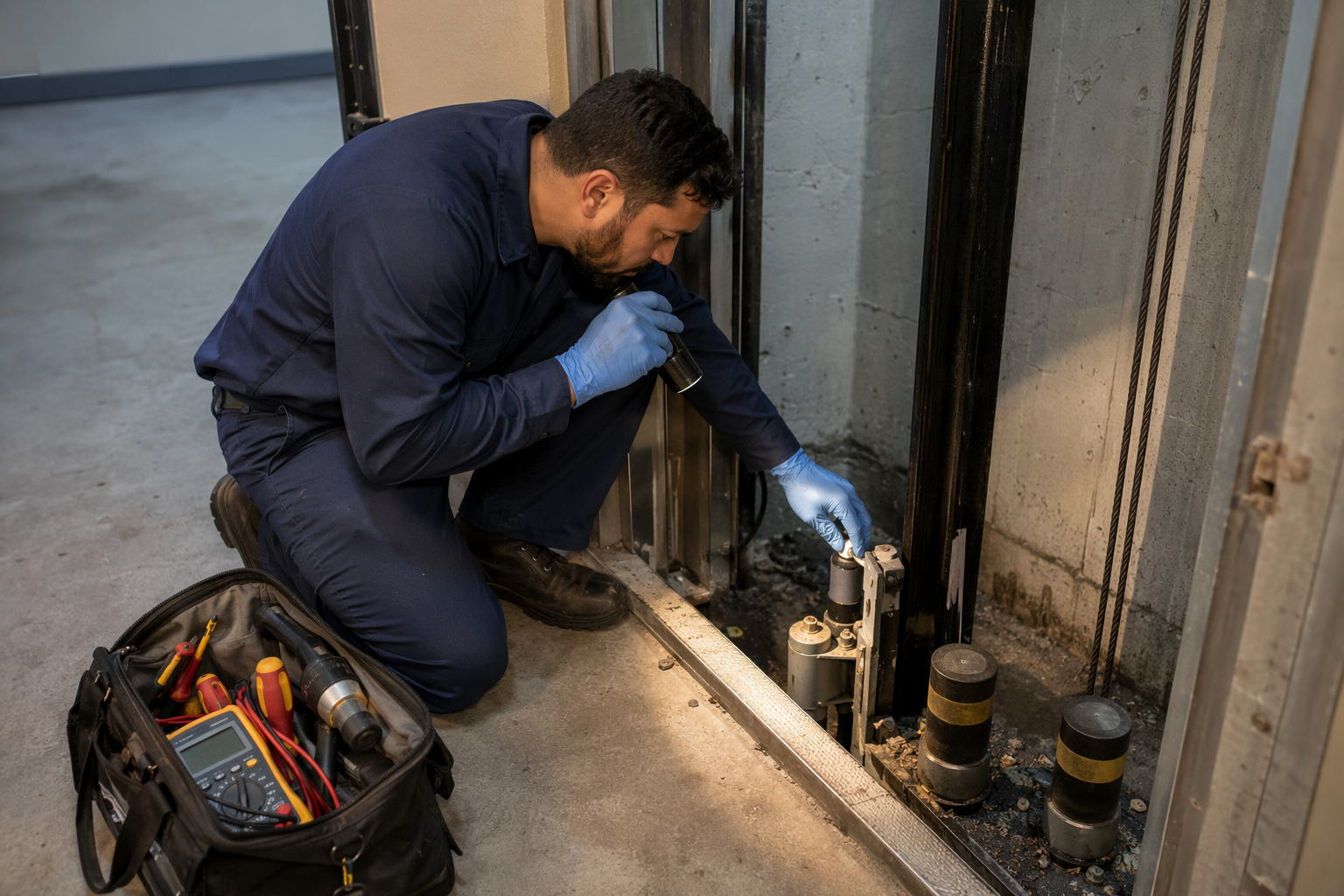
In California, elevator service contractors must hold a valid Elevator Mechanic certification and operate under a licensed Elevator Company registration regulated by the California Department of Industrial Relations (DIR), Division of Occupational Safety and Health (Cal/OSHA).
California requires that anyone who installs, repairs, maintains, or alters elevators must be certified under state law. The company itself must carry appropriate contractor licensing, general liability insurance, and workers’ compensation coverage. Emergency work performed by uncertified personnel is not only illegal but can expose building owners to significant liability. When evaluating a 24-hour emergency provider, always verify that the company’s technicians are properly certified through Cal/OSHA and that the company is registered with the state.
Technical competency is also governed by industry standards. The ASME A17.1 Safety Code for Elevators and Escalators sets the national baseline for safe elevator operation and repair practices. California adopts and enforces these standards through Cal/OSHA’s Elevator Unit. Any company performing emergency repairs should demonstrate familiarity with the current edition of this code.
What should a building owner do immediately when an elevator breaks down?
When an elevator breaks down, the building owner or property manager should follow a structured response protocol to protect passenger safety, minimize liability, and expedite professional repairs.
- Check for entrapped passengers first. Attempt verbal communication through the elevator intercom or by calling out near the cab doors. If anyone is trapped inside, call 911 immediately — do not attempt a DIY rescue.
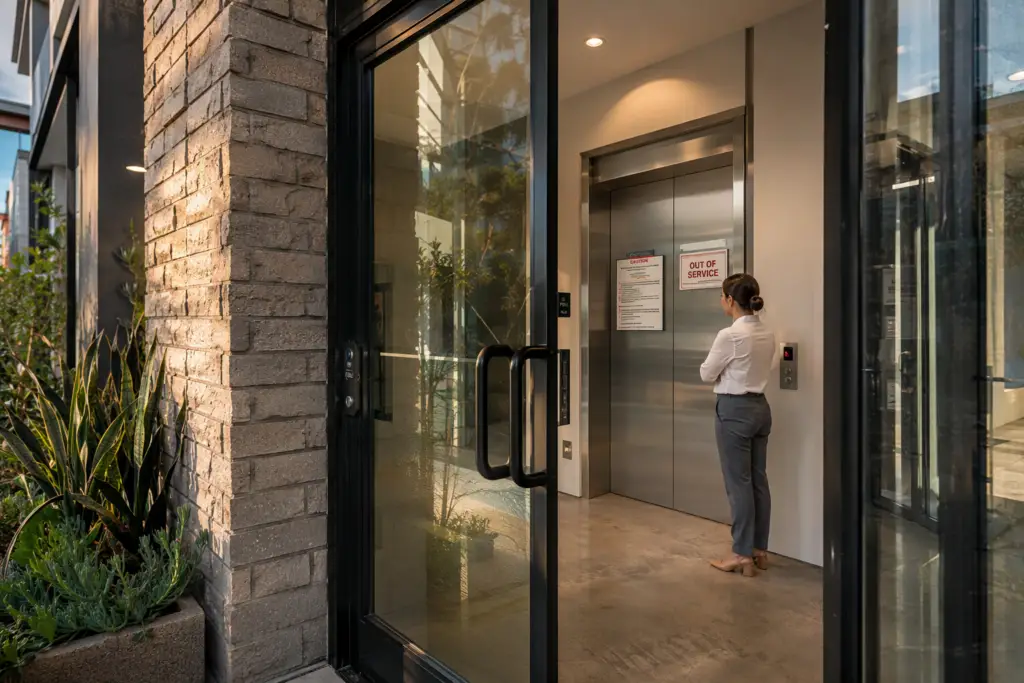
- Take the elevator out of service. Lock out the elevator using the key switch at the main lobby or machine room to prevent additional use. Post visible “Out of Service” signage on all landings.
- Contact your elevator service company. Call your contracted elevator maintenance provider or an emergency repair company licensed in California. Provide the building address, elevator model and serial number if known, and a description of the malfunction.
- Document the incident. Note the time of the outage, any error codes displayed on the control panel, unusual sounds or behaviors observed, and any passengers who were affected.
- Notify your property insurer. For commercial properties, an elevator outage affecting tenants may require prompt insurer notification depending on your policy terms.
- Ensure ADA accommodation. If your building’s sole accessible route relies on the elevator, you may have obligations under the Americans with Disabilities Act (ADA) to provide alternative accessible accommodations or to notify affected tenants promptly.
- Keep a written log. Record all communications with the elevator company, estimated repair timelines, and any follow-up inspections scheduled.
How is a 24-hour elevator emergency call handled by a qualified service company?
A qualified 24-hour elevator service company receives the emergency call through a monitored dispatch line, gathers relevant equipment information, and coordinates technician deployment to the site as efficiently as local conditions allow.
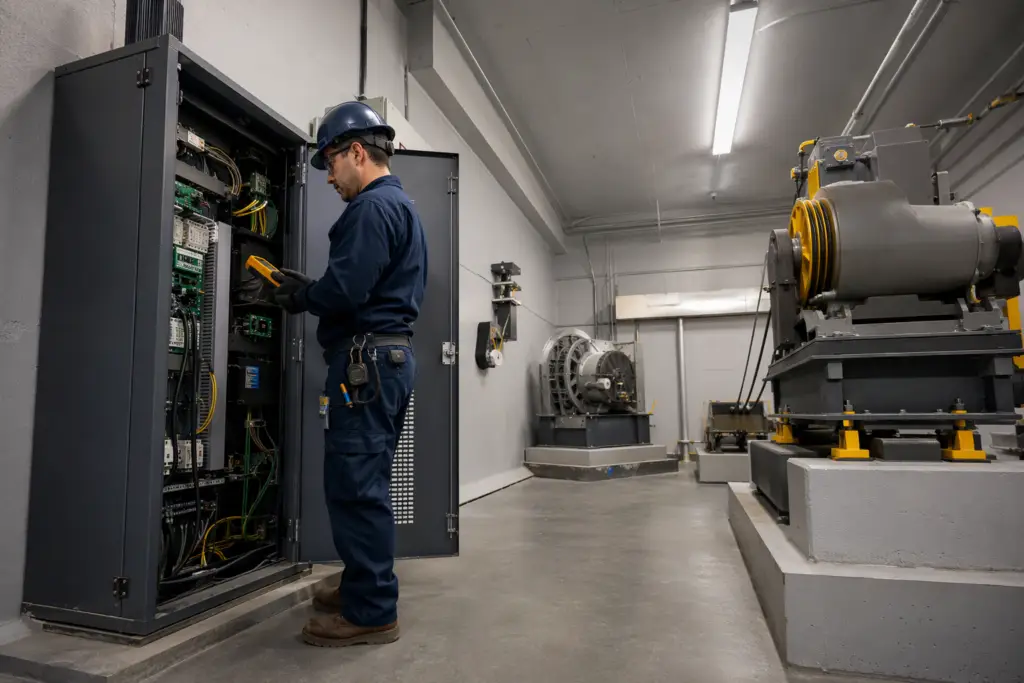
Upon arrival, the technician performs a systematic diagnostic assessment — evaluating the control system, drive unit, door operators, safety circuits, and any fault codes logged in the elevator’s controller. The technician will isolate the root cause, communicate findings and repair options to the property contact on-site, and either complete the repair in one visit or safely lock out the elevator until parts or specialized support are available.
Emergency repairs in California must comply with ASME A17.1 Safety Code for Elevators and Escalators provisions even when performed under urgent conditions. A responsible company never bypasses safety devices to restore service prematurely.
What types of elevator failures require immediate emergency repair?
Certain elevator failures demand immediate attention because they create safety hazards, entrap passengers, or expose the property to regulatory penalties.
The following failure types are generally classified as emergencies requiring urgent professional response:
- Passenger entrapment — any situation in which one or more individuals are unable to exit the elevator cab
- Door malfunctions — doors that fail to close, close on passengers, or remain open between floors
- Leveling failures — the cab stops significantly above or below the floor landing, creating a tripping hazard
- Total power failure — the elevator is completely unresponsive and may contain passengers
- Brake or safety system alerts — any indicator that a safety circuit, governor, or braking mechanism has been triggered or has failed
- Unusual sounds or movement — grinding, jerking, or sudden stops that may indicate mechanical failure in the drive system or suspension components
- Control system faults — persistent error codes that prevent safe operation
What are the legal consequences of operating a noncompliant elevator in California?
Operating an elevator that has been placed out of service, failed inspection, or is known to have a safety defect is a violation of California state law and can result in civil and criminal penalties for the property owner or operator.
Cal/OSHA’s Elevator Unit has authority to issue citations, assess fines, and mandate immediate shutdowns for noncompliant elevators. Beyond regulatory penalties, building owners who knowingly allow a defective elevator to operate face significant exposure in personal injury litigation. The Occupational Safety and Health Administration (OSHA) also enforces elevator safety standards in workplaces not covered by state plans. Ensuring prompt emergency repair is not only a safety imperative — it is a legal one.
How do I evaluate and compare 24-hour elevator repair companies in Southern California?
Selecting the right emergency elevator repair provider requires evaluating several factors beyond advertised availability, including licensing, equipment familiarity, geographic coverage, and service contract terms.
| Evaluation Criteria | What to Look For | Red Flags |
|---|---|---|
| State Licensing | Valid California DIR / Cal/OSHA registration; certified elevator mechanics | No verifiable state license; reliance on subcontractors without credentials |
| ASME Code Familiarity | Technicians trained on current ASME A17.1 edition | Unable to cite applicable code requirements when asked |
| Geographic Service Area | Proven local presence in your city or county | Vague coverage claims; long estimated travel distances |
| Equipment Compatibility | Experience with your elevator brand and drive type (hydraulic, traction, MRL) | Only services one manufacturer or unfamiliar with your system |
| Emergency Dispatch Process | Monitored emergency line; clear escalation protocol | Voicemail-only after hours; no dispatch confirmation process |
| Parts Availability | Access to common replacement parts or established supply chain | No parts inventory; relies solely on manufacturer lead times |
| Insurance & Liability Coverage | General liability and workers’ comp certificates available on request | Unable or unwilling to provide insurance documentation |
| Inspection & Compliance Support | Familiarity with Cal/OSHA inspection process; can assist with permit filings | No experience navigating local AHJ (Authority Having Jurisdiction) processes |
Liftech Elevator serves building owners and property managers across Signal Hill, Long Beach, Los Angeles, and Orange County, CA, and is structured to meet each of these evaluation criteria for emergency and ongoing maintenance engagements.
Does the ADA require buildings to maintain elevator accessibility during outages?
Under the Americans with Disabilities Act (ADA), covered entities are required to ensure that their programs, services, and facilities remain accessible to individuals with disabilities — and a prolonged elevator outage in a multi-story building can constitute a barrier to access that triggers accommodation obligations.
While the ADA recognizes that temporary outages can occur, building operators are expected to have a plan for maintaining accessible service and to restore elevator operation promptly. For buildings where the elevator is the sole accessible means of vertical travel, an extended outage may require the owner to provide alternative accessible programming or relocation of services to accessible floors while repairs are completed. Failure to address accessibility during an outage can result in ADA complaints or civil rights investigations.
What elevator types does a full-service emergency repair company need to service?
A capable 24-hour emergency repair company should be technically proficient across all major elevator drive systems and configurations commonly found in commercial and residential buildings.
- Hydraulic elevators — common in low-rise buildings; failures often involve the pump unit, fluid leaks, or valve malfunctions
- Electric traction elevators (geared and gearless) — used in mid- and high-rise applications; failures may involve motors, sheaves, control systems, or rope/belt assemblies
- Machine-Room-Less (MRL) traction elevators — increasingly common in modern construction; require technicians familiar with compact drive and control configurations
- Freight elevators — industrial and commercial applications with higher load capacities and different regulatory considerations under ASME A17.1
- Residential elevators and platform lifts — governed by ASME A17.1 and A18.1; typically found in single-family homes and low-rise residential buildings
How often should elevators be inspected to reduce the likelihood of emergency breakdowns?
California requires periodic elevator inspections by Cal/OSHA-approved inspectors, with frequency generally tied to elevator type and usage — and adherence to these schedules is the most effective way to catch developing problems before they become emergency failures.
Under California’s elevator safety regulations, which adopt and enforce standards derived from the ASME A17.1 Safety Code for Elevators and Escalators, elevators must undergo routine periodic inspections. The specific intervals are set by the authority having jurisdiction (AHJ) — in California, this is Cal/OSHA’s Elevator Unit. In addition to state-mandated inspections, industry best practice calls for a qualified elevator company to perform regular preventive maintenance visits throughout the year. Preventive maintenance is the single most reliable way to reduce unplanned outages and the need for emergency repair calls.
What information should I have ready when calling for emergency elevator repair?
Having key information prepared before calling your elevator service company allows dispatch to deploy the right technician with the right tools and parts, reducing overall repair time.
- Building address and floor count
- Elevator manufacturer name and model (usually found on a data plate inside the cab or in the machine room)
- Serial number or unit identification number
- Type of drive system (hydraulic, traction, MRL) if known
- Description of the malfunction: error codes displayed, unusual sounds, behavior observed
- Whether any passengers are currently entrapped
- Name and direct contact number for the on-site person who will receive the technician
- Access information: machine room location, key box codes, building security requirements
Can building owners perform any temporary measures while waiting for a repair technician?
Building owners and property managers have a limited and clearly defined role during an elevator outage — safety isolation and communication — and should not attempt any mechanical intervention themselves.
The only appropriate actions for a non-certified person during an elevator emergency are: securing the elevator out of service (using the key switch), posting out-of-service signage, communicating with any entrapped passengers to reassure them while emergency services respond, and notifying relevant building contacts and tenants. Attempting to manually move a stalled cab, override safety devices, or access the machine room without proper certification is dangerous and may be unlawful under California regulations and OSHA standards. All mechanical work must be performed by a certified elevator mechanic.
How does preventive maintenance reduce the need for 24-hour emergency repairs?
A structured preventive maintenance program, performed by a certified elevator service company on a regular schedule, is the most cost-effective strategy for reducing the frequency and severity of elevator failures that require emergency response.
Preventive maintenance typically includes lubrication of moving components, adjustment of door operators and safety edges, inspection of ropes or hydraulic systems, testing of safety devices including governors and buffers, and review of control system diagnostics. When developing problems are identified during scheduled visits — worn components, out-of-tolerance adjustments, fluid degradation in hydraulic systems — they can be corrected during planned service rather than during a crisis. Buildings that maintain consistent preventive maintenance contracts with a reputable provider tend to experience fewer emergency outages and lower lifetime repair costs.
What is the difference between a maintenance contract and an emergency service call?
A maintenance contract is a proactive, scheduled agreement between a building owner and an elevator service company to perform regular inspections and upkeep; an emergency service call is a reactive response to an unexpected failure outside of scheduled visits.
Most full-service elevator companies offer tiered maintenance contracts ranging from basic lubrication-and-inspection agreements to comprehensive full-coverage plans that may include parts and labor for repairs discovered during routine service. Emergency service calls — also called callback calls — may or may not be covered under a maintenance contract depending on the contract tier. Building owners should carefully review contract terms to understand what emergency response coverage, if any, is included, and what the terms are for after-hours dispatch under their specific agreement.
Are there specific Southern California or local jurisdictional rules that affect elevator emergency response?
Yes — in addition to California state regulations enforced by Cal/OSHA, elevators in cities such as Los Angeles, Long Beach, and jurisdictions within Orange County may be subject to additional local permitting and inspection requirements administered by the local Authority Having Jurisdiction (AHJ).
Some municipalities within Los Angeles County and Orange County maintain their own elevator inspection programs that operate in parallel or in coordination with Cal/OSHA’s Elevator Unit. Emergency repairs that result in significant alterations to elevator systems may require a permit filing with the local AHJ before the elevator is returned to service. A qualified local service provider — such as Liftech Elevator, which operates specifically within these jurisdictions — will be familiar with the applicable local requirements and can coordinate the necessary documentation as part of the repair process.
What should a property manager look for in a service agreement with a 24-hour elevator company?
A well-structured service agreement with a 24-hour elevator repair company should clearly define the scope of covered services, the process for emergency dispatch, responsibilities for parts procurement, and terms governing work outside the contract scope.
Key provisions to review in any elevator service agreement include: the specific list of services included in routine maintenance visits, whether emergency callback calls are included or billed separately, how after-hours calls are handled, which parties are responsible for procuring replacement parts and at what markup, liability and indemnification terms, and contract termination and renewal provisions. Property managers should also confirm that the service company’s technicians are covered by current workers’ compensation insurance, as uninsured work on the property can create liability exposure for the building owner.
How do hydraulic elevator emergencies differ from traction elevator emergencies?
Hydraulic and traction elevators have fundamentally different mechanical systems, and the nature of their emergency failures — and the specialized knowledge required to address them — differs accordingly.
Hydraulic elevator emergencies frequently involve fluid leaks (which can create environmental and fire hazards), pump or valve failures that cause the cab to sink or become unresponsive, or cylinder seal failures in older in-ground hydraulic systems. Traction elevator emergencies are more likely to involve issues with the drive motor or controller, rope or belt wear, brake malfunctions, or door operator failures. Machine-Room-Less (MRL) traction systems add complexity because the drive machinery is integrated into the hoistway rather than housed in a separate machine room, requiring technicians to work in confined conditions with specialized tooling. An emergency repair company should clearly articulate its experience with the specific drive type installed in the building before being engaged.
What role does ASME A17.1 play in guiding emergency elevator repairs?
The ASME A17.1 Safety Code for Elevators and Escalators is the foundational technical standard governing all aspects of elevator design, installation, maintenance, and repair in the United States, including emergency repair practices.
Even during an emergency, certified technicians are required to adhere to ASME A17.1 provisions regarding safety device testing, acceptable repair methods, and conditions under which an elevator may be returned to service. For example, the code establishes requirements for what tests must be performed after certain types of repairs before the unit is placed back in operation. California’s adoption and enforcement of these standards through Cal/OSHA means that shortcuts taken during emergency repairs — such as bypassing safety circuits to restore service — can result in citations, fines, or more serious consequences if an injury subsequently occurs. Reputable emergency repair companies maintain their practices in strict alignment with the current edition of this code.
How should a property manager communicate an elevator outage to building tenants?
Clear, timely, and factually accurate communication to building tenants during an elevator outage is a professional obligation that also reduces liability and prevents unnecessary complaints or escalations.
As soon as an outage is confirmed, property management should post physical notices at all elevator landings and building entrances, noting that the elevator is out of service and that repair has been initiated. For residential buildings, direct communication via email, text notification systems, or building management software is advisable. For commercial buildings, notify tenant contacts and building security. Where tenants with disabilities may be directly impacted, proactive direct communication is particularly important given ADA considerations. Provide updates as information becomes available — even a brief notice that the repair technician is on-site and assessing the issue is valuable to tenants. Avoid speculating about timelines if parts or additional assessment are required.
What should building owners expect after an emergency repair is completed?
After a qualified technician completes an emergency elevator repair, the building owner should expect a documented summary of the findings and work performed, confirmation that the elevator has been tested and is safe to return to service, and guidance on any follow-up actions required.
The repair documentation should include a description of the identified failure, the corrective action taken, any parts replaced, and whether additional repairs or inspections are recommended. If the emergency repair involved a significant alteration to the elevator system, a follow-up inspection by the local AHJ or Cal/OSHA may be required before the unit is legally returned to service. The technician should also advise whether the root cause of the failure suggests a need for changes to the preventive maintenance program or an upcoming modernization evaluation. Liftech Elevator provides property managers with clear post-repair documentation to support record-keeping and regulatory compliance.
When should a building owner consider elevator modernization instead of repeated emergency repairs?
When an elevator requires frequent emergency repairs, experiences recurring failures of the same components, or is approaching the end of its useful service life, modernization — the systematic replacement of key systems — often becomes more cost-effective than continued reactive repair.
Indicators that modernization may be appropriate include: aging relay-logic control systems that are difficult to troubleshoot or for which replacement parts are no longer readily available; recurring hydraulic cylinder or packing failures in older in-ground systems; door operator systems that repeatedly malfunction; or elevator equipment that no longer meets current ASME A17.1 Safety Code for Elevators and Escalators requirements for safety devices. Modernization projects typically address the controller, drive system, door operators, and cab interior, and may also incorporate upgrades to meet current ADA requirements. A full-service elevator company can conduct a comprehensive assessment to determine whether continued repair or a phased modernization strategy is the more appropriate path for a specific installation.
Why should building owners in Signal Hill, Long Beach, Los Angeles, and Orange County choose a locally based elevator repair company?
A locally based elevator service company brings critical advantages in an emergency: knowledge of local jurisdictional requirements, established relationships with local AHJ officials, and the ability to deploy technicians efficiently within the specific geography of the service area.
Companies operating far from the service location may face extended travel times in emergency situations and may lack direct familiarity with the local permitting and inspection processes administered by municipalities within Los Angeles County and Orange County. Local providers are also more likely to have established supply chain relationships with regional parts distributors, which can reduce lead times for replacement components. For building owners and property managers in Signal Hill, Long Beach, Los Angeles, and Orange County, partnering with a locally rooted company like Liftech Elevator means that emergency response is grounded in direct knowledge of the area’s regulatory environment and physical geography.
Ready to Protect Your Property with Reliable Emergency Elevator Service?
Whether a building is experiencing an active elevator outage or a property manager wants to evaluate current maintenance coverage before an emergency occurs, expert guidance is available now. Contact Liftech Elevator for a free elevator assessment and speak directly with a certified elevator service professional serving Signal Hill, Long Beach, Los Angeles, and Orange County, CA.
Call Liftech Elevator: 562-609-3478
Need elevator service you can rely on? Liftech Elevator is ready to help.