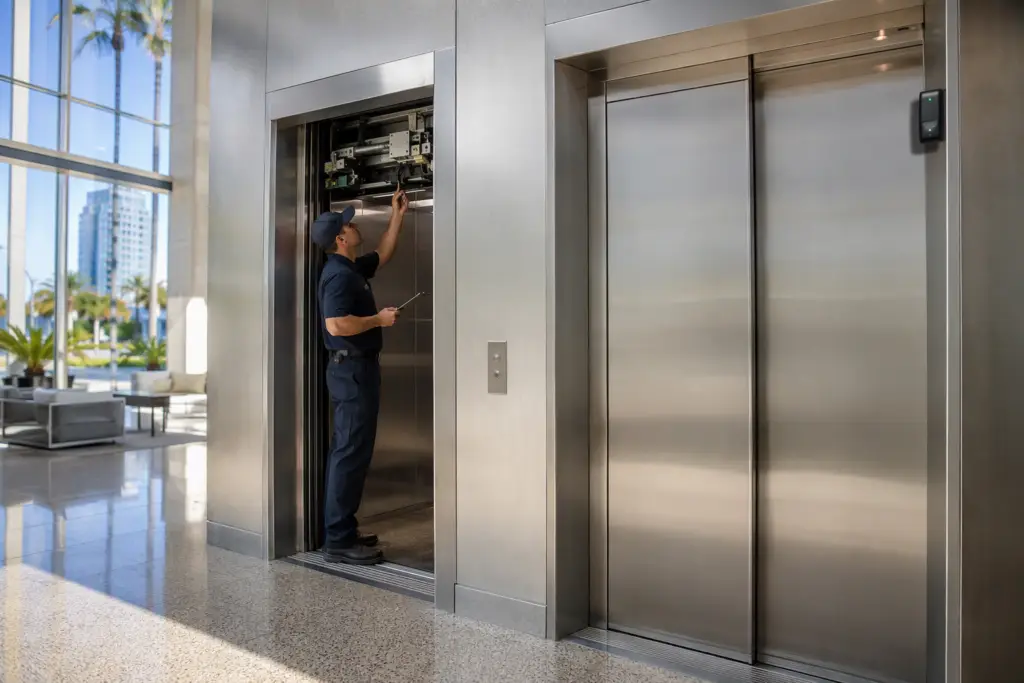
How to Get Your Hospital or Clinic Elevator Back in Service Fast After an Unplanned Shutdown in Los Angeles or Orange County
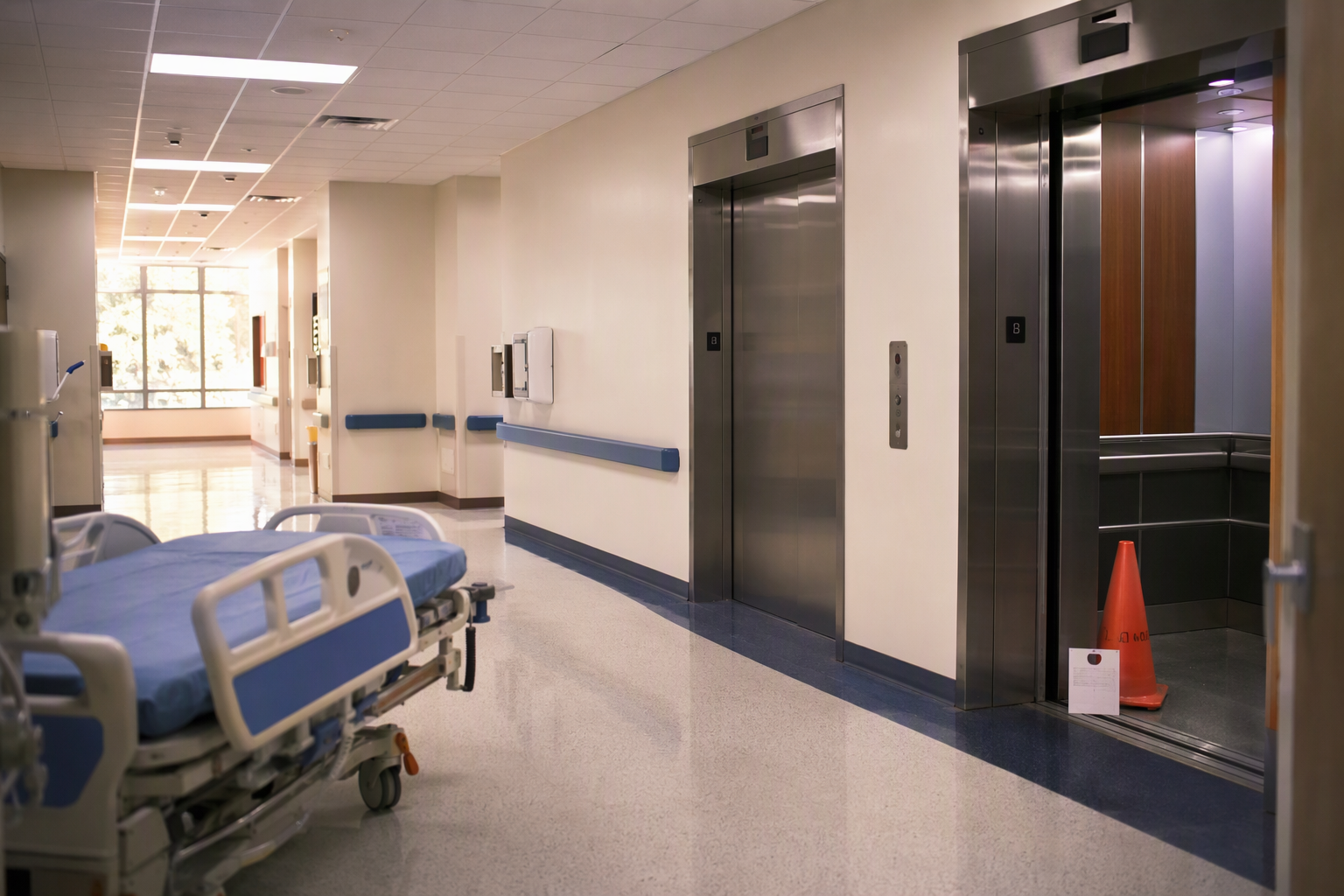
In a hospital, surgical center, skilled nursing facility, or outpatient clinic, elevators are not a convenience — they are clinical infrastructure. A gurney, a medication cart, or a patient in a wheelchair cannot use the stairs. Every hour an elevator sits idle in a healthcare setting has direct consequences for patient flow, staff efficiency, and regulatory standing. The steps below explain exactly what California law requires, what your inspector will look for, and how working with a qualified elevator service company can compress the timeline from shutdown to restored permit.
What Triggers an Unplanned Elevator Shutdown in a Healthcare Facility?
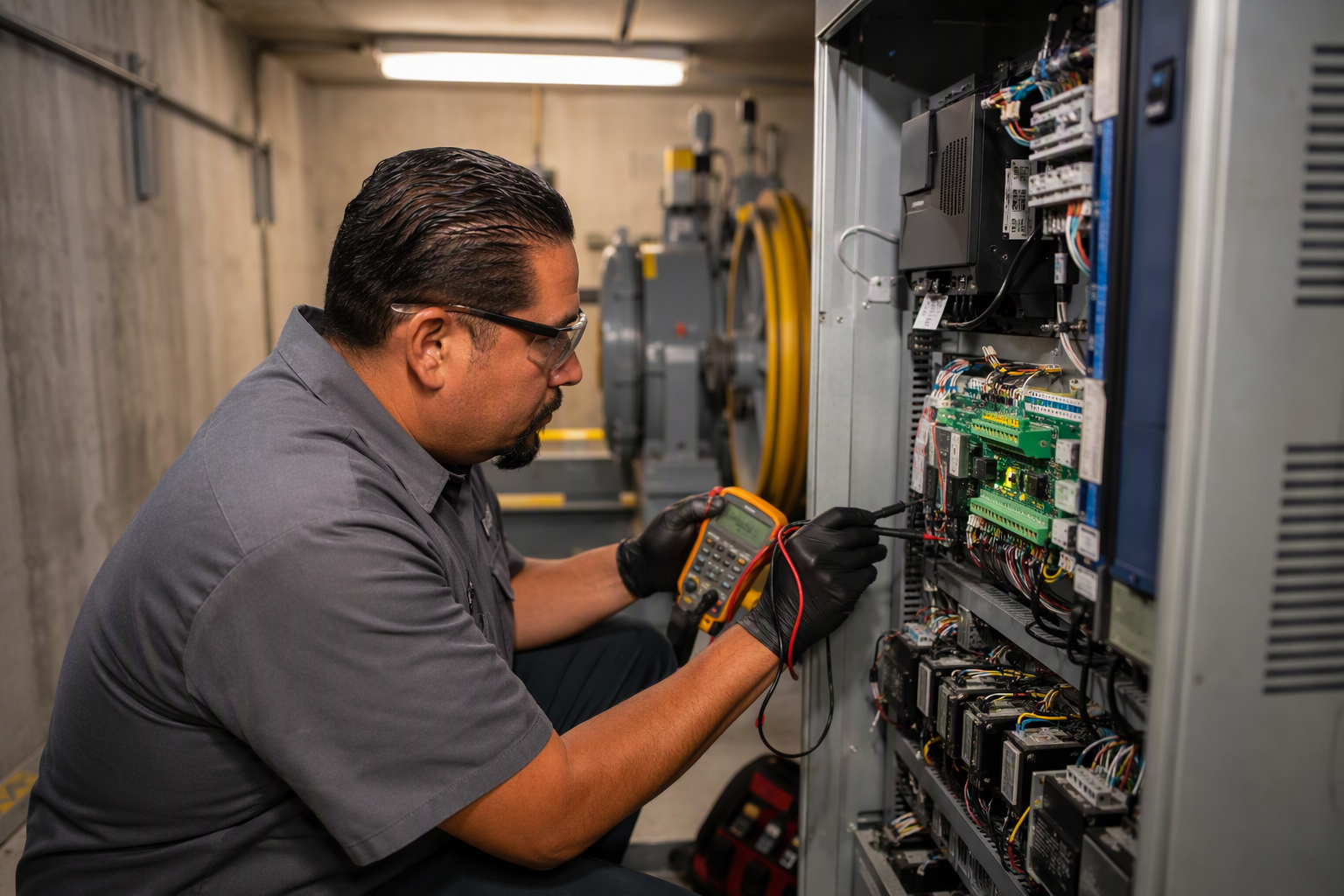
Unplanned shutdowns in healthcare settings typically fall into one of three categories:
- Mechanical or electrical failure — drive system faults, door operator failures, brake component issues, or control board errors that cause the elevator to fault out and lock down automatically.
- Safety device activation — governor overspeed trips, pit flooding, seismic sensors, or door safety edge malfunctions that place the unit into a protected stop.
- Cal/OSHA or LADBS enforcement action — an inspection that reveals a deficiency serious enough to require removal from service until corrected and reinspected.
Each scenario follows a slightly different restoration path, but all of them end at the same gate: a valid permit to operate issued or reinstated by the authority having jurisdiction before the elevator may carry passengers again.
What Does California Law Actually Require Before an Elevator Can Return to Service?

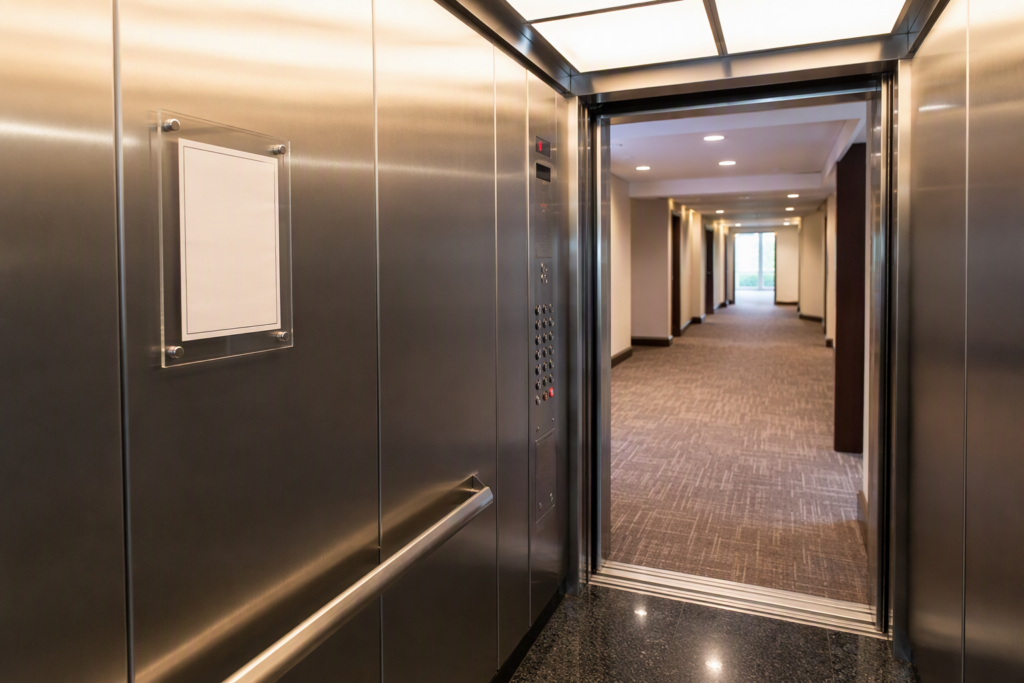
Under California Labor Code Sections 7300–7324.2 and the California Code of Regulations, Title 8, Elevator Safety Orders, no elevator may be operated in California without a valid, current permit to operate issued by Cal/OSHA. That permit must be posted conspicuously inside the elevator car. If an unplanned shutdown results from a condition that voided or suspended the permit, the elevator cannot legally be returned to service until:
- The underlying deficiency is corrected by a Certified Competent Conveyance Mechanic (CCCM) employed by a Certified Qualified Conveyance Company (CQCC).
- A reinspection is performed by either a Cal/OSHA State Safety Engineer or a Certified Competent Conveyance Inspector (CCCI).
- Cal/OSHA issues a new or reinstated permit to operate.
In the City of Los Angeles specifically, the Department of Building and Safety (LADBS) runs its own elevator and conveyance inspection program, so coordination with LADBS may be required in addition to or in place of the Cal/OSHA Elevator Unit depending on the circumstances. Liftech Elevator’s team understands which authority governs your specific facility location and can help ownership navigate that coordination without delay.
California has adopted the ASME A17.1/CSA B44 Safety Code for Elevators and Escalators, 2004 edition, for installation contracts signed on or after May 1, 2008. All repair and restoration work must be consistent with those safety orders. California is also in the process of proposing a Group V update that would incorporate portions of ASME A17.1-2019; as of 2026, no effective date has been posted, but facilities planning capital work should monitor the California Standards Board for updates.
What Should a Healthcare Facility Do Immediately After an Elevator Shuts Down?
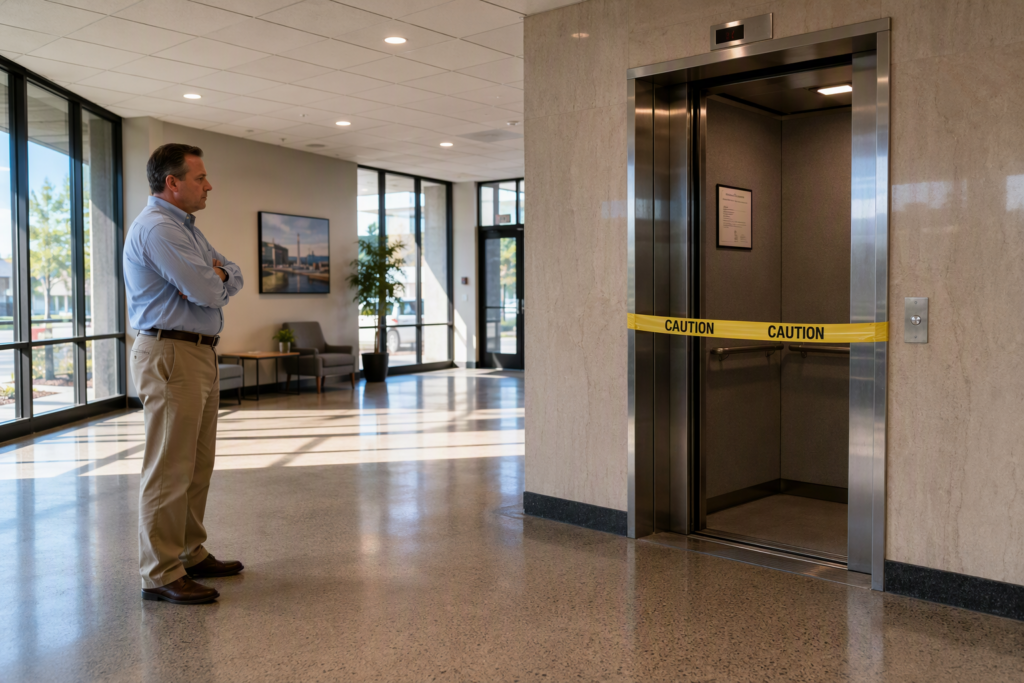
- Secure the elevator. Lock out the cab at each landing, post clear out-of-service signage, and prevent any unauthorized access or restart attempts.
- Activate your continuity plan. Notify nursing supervisors, patient transport, and facilities management. Identify which alternative vertical access routes exist and whether any patients require immediate elevator-dependent care transitions.
- Document the failure. Note the exact time, the error code or observed symptom, any unusual sounds or movements, and the names of staff who witnessed the shutdown. This documentation speeds the diagnostic phase significantly.
- Contact a CQCC-certified elevator company. Only a Certified Qualified Conveyance Company employing Certified Competent Conveyance Mechanics may legally perform repairs on California elevators. Liftech Elevator holds the certifications required under California law to respond, diagnose, and correct conveyance deficiencies in Los Angeles and Orange County.
- Notify the authority having jurisdiction. Depending on your location and the nature of the shutdown, this may be the Cal/OSHA Elevator Unit, LADBS, or both. Your elevator service company can help you determine the correct notification path and required documentation.
- Do not attempt a bypass or manual restart without qualified oversight. An unauthorized restart that results in injury or a failed reinspection can extend the shutdown period significantly and may expose the facility to enforcement action.
- Confirm the permit status. Before the elevator is returned to service, verify that a valid permit to operate is posted in the cab as required by California law.
How Does ADA Compliance Affect an Elevator Shutdown in a Healthcare Setting?
Healthcare facilities subject to the Americans with Disabilities Act (ADA) have a legal obligation to provide accessible routes for patients, visitors, and employees with disabilities. When an elevator that serves as part of an accessible route goes out of service, the facility must assess whether an equivalent accessible alternative exists. If it does not, the facility may face ADA exposure independent of the elevator code violation. This is particularly acute in multi-story hospitals and clinics where elevator access is the only code-compliant route for wheelchair users. Restoring service quickly is not only a patient care priority — it is an accessibility compliance obligation.
What Are the Compliance Considerations Specific to Healthcare Elevators?
Healthcare elevators carry unique operational demands that affect both the restoration process and ongoing maintenance strategy:
- Gurney and bed-size cab requirements — Many hospital elevators are designed to ASME A17.1 provisions for larger cab dimensions to accommodate medical transport equipment. Any repair or alteration work must preserve those dimensions and load ratings.
- Fireman’s Emergency Operation — Elevators in California healthcare facilities must comply with the firefighter recall and emergency operation provisions of the adopted ASME A17.1 code. These systems are verified during inspection.
- Emergency power provisions — Hospitals are required under state and federal healthcare facility regulations to maintain elevator service on emergency power for patient evacuation. Any shutdown that affects emergency power connectivity must be addressed as a priority item.
- Infection control during repair — Technicians working in an active clinical environment should follow the facility’s infection control and construction/maintenance protocols, including barrier requirements in clinical zones.
- The Joint Commission and CMS readiness — Facilities subject to The Joint Commission accreditation or Centers for Medicare & Medicaid Services (CMS) conditions of participation must maintain documented evidence of elevator maintenance and permit currency. A lapse in permit status during a survey can affect accreditation standing.
What Is the Role of the Cal/OSHA Elevator Unit in Restoring Permit Status?
The Cal/OSHA Elevator Unit under the California Department of Industrial Relations is the primary state-level authority for elevator permits, inspections, and company certification outside of jurisdictions with their own programs. When a shutdown involves a safety deficiency that affects permit validity, the Elevator Unit must be engaged to schedule a reinspection. California law allows Cal/OSHA to issue a permit to operate for up to two years for an elevator in safe condition that is covered by a full maintenance contract with a C-11 licensed elevator company — an arrangement that can reduce future disruptions by extending the permit interval.
Arranging the annual reinspection and maintaining permit currency is the elevator owner’s responsibility under California law — not the elevator company’s and not the building management company’s unless contractually assigned. Facility management teams should ensure this responsibility is explicitly addressed in their service contracts.
What Factors Determine How Quickly Service Can Be Restored?
Several variables affect the timeline between shutdown and restored service:
- Parts availability — Common components for widely deployed drive systems and door operators may be available locally. Proprietary or legacy components for older healthcare elevators may require longer lead times.
- Nature of the deficiency — A failed door safety edge that can be replaced in a single visit differs substantially from a drive motor failure or a structural issue in the pit or machine room.
- Inspector scheduling — Reinspection must be performed by a Cal/OSHA Safety Engineer or CCCI, and scheduling depends on Cal/OSHA’s current queue and the local authority’s calendar.
- Permit documentation completeness — Having accurate maintenance records, equipment specifications, and prior inspection reports readily accessible accelerates the reinspection process.
- Jurisdictional requirements — Facilities in the City of Los Angeles must coordinate with LADBS in addition to or in lieu of the Cal/OSHA Elevator Unit, which can affect the process.
Liftech Elevator prioritizes healthcare facilities in Los Angeles County and Orange County because elevator downtime in a clinical setting is categorically different from a commercial office building outage. The team focuses on accurate first-visit diagnostics, rapid parts sourcing, and proactive communication with inspectors to move reinspections forward as quickly as the authority’s schedule allows.
What Should Be in a Healthcare Facility’s Elevator Emergency Response Plan?
California healthcare facilities are advised to maintain a written elevator emergency response plan as part of their broader Environment of Care program. A well-structured plan addresses:
- Immediate notification chain (facilities management, nursing leadership, patient transport, security)
- Alternative accessible route identification for each elevator bank
- Preferred CQCC-certified elevator service vendor contact information
- Current permit to operate location and copy on file in facilities records
- Documentation protocol for failure events
- Communication script for patients, staff, and visitors
- Escalation contacts at Cal/OSHA Elevator Unit and, for Los Angeles facilities, LADBS
How Does a Full Maintenance Contract Help Prevent Future Unplanned Shutdowns?
A full maintenance contract with a C-11 licensed elevator company serves two purposes in California. First, it qualifies the facility for a permit to operate of up to two years rather than the standard one-year period under California law, reducing the administrative burden on the facility. Second, a well-structured maintenance program emphasizes condition-based monitoring, lubrication, component adjustment, and early fault detection — all of which reduce the probability of an unplanned shutdown. For healthcare facilities where elevator uptime is directly tied to patient care continuity, preventive maintenance is a risk-management tool, not merely a compliance checkbox.
Does OSHA Have Any Role in a Hospital Elevator Shutdown?
Federal OSHA occupational safety regulations may apply to conditions that endangered workers during or prior to the shutdown — for example, if a mechanical failure created a hazardous condition for elevator mechanics or hospital staff. However, elevator-specific permitting, inspection, and certification in California is governed by Cal/OSHA’s Elevator Unit under the California Labor Code, not directly by federal OSHA. If a worker injury or near-miss is involved, facilities should consult their safety and legal counsel regarding OSHA recordkeeping and reporting obligations independently of the elevator permit restoration process.
Questions Your Inspector Will Ask
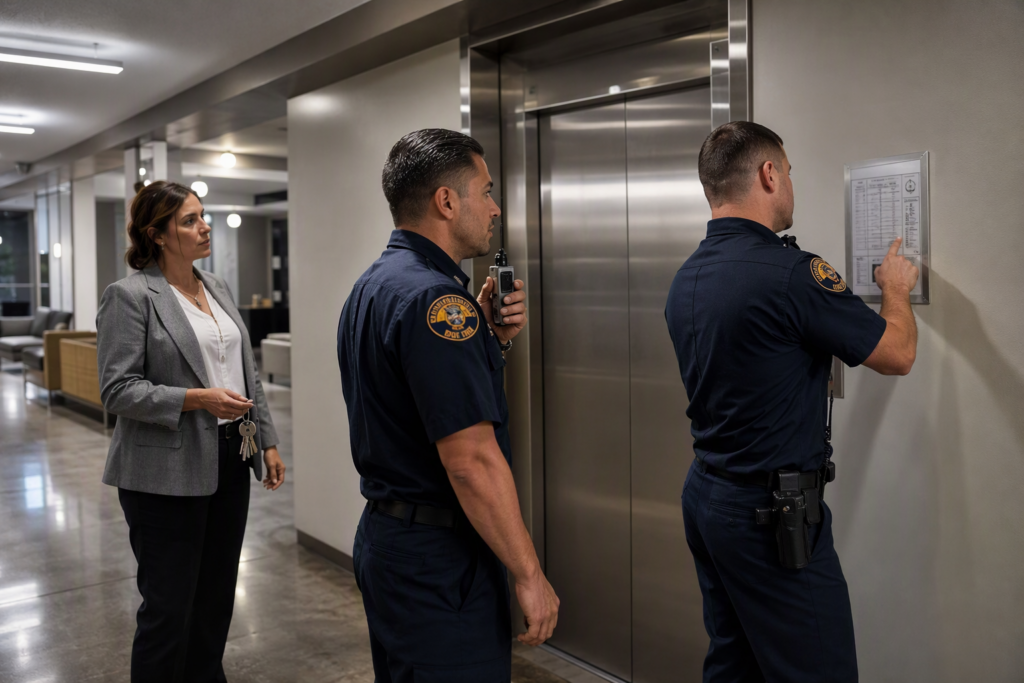
When a Cal/OSHA Safety Engineer or Certified Competent Conveyance Inspector arrives for a reinspection following an unplanned shutdown, healthcare facility managers should be prepared to address the following:
- What is the current permit to operate status, and where is it posted? The inspector will verify that the permit is or was conspicuously posted in the elevator car as required by California law.
- What maintenance contract is in place, and with which CQCC-certified company? Documentation of the maintenance relationship affects permit duration and demonstrates the facility’s compliance posture.
- What are the maintenance logs showing for the past inspection period? Inspectors review maintenance records to determine whether the failure resulted from deferred maintenance or was genuinely unforeseen.
- What was the specific cause of the shutdown, and what corrective action was taken? The inspector will want a written or verbal description of the deficiency and the CCCM-performed repair, including any parts replaced.
- Has any alteration been made to the elevator since the last permit was issued? Any material alteration requires a separate Cal/OSHA permit before the work is performed. The inspector will ask whether the repair crossed into alteration territory.
- Is Fireman’s Emergency Operation functional? This is a standard test item during reinspection, particularly critical in healthcare facilities.
- Is the machine room secure, clean, and free of storage or unauthorized materials? Code requires machine rooms to be kept in a condition that allows safe access and operation.
- Are all required safety devices — pit ladder, lighting, stop switch, and sump pump where applicable — in working order? These are standard inspection verification items under the California Elevator Safety Orders.
Why Do Los Angeles and Orange County Healthcare Facilities Work with Liftech Elevator?
Liftech Elevator is a certified elevator service company operating across Signal Hill, Long Beach, Los Angeles, and Orange County. The company holds the California CQCC certification and employs Certified Competent Conveyance Mechanics as required by state law — meaning every technician dispatched to a healthcare facility is legally authorized to perform the repair and restoration work the facility needs. Liftech Elevator understands the dual-authority environment that Los Angeles facilities navigate between Cal/OSHA and LADBS, and the team is familiar with the documentation and communication requirements that move reinspections forward efficiently.
For healthcare facility managers focused on minimizing patient care disruption, working with a company that knows California regulatory requirements — not a generalist contractor who will need to look them up — makes a measurable difference in how quickly an elevator is back in service.
Get Your Healthcare Elevator Back in Service
An elevator shutdown in a hospital, clinic, or skilled nursing facility cannot wait. Contact Liftech Elevator for a free elevator assessment and to discuss how a full maintenance program and proper permit management can protect your facility’s clinical operations and compliance standing across Los Angeles and Orange County.
Contact Liftech Elevator for a free elevator assessment: 562-609-3478
Need elevator service you can rely on? Liftech Elevator is ready to help.