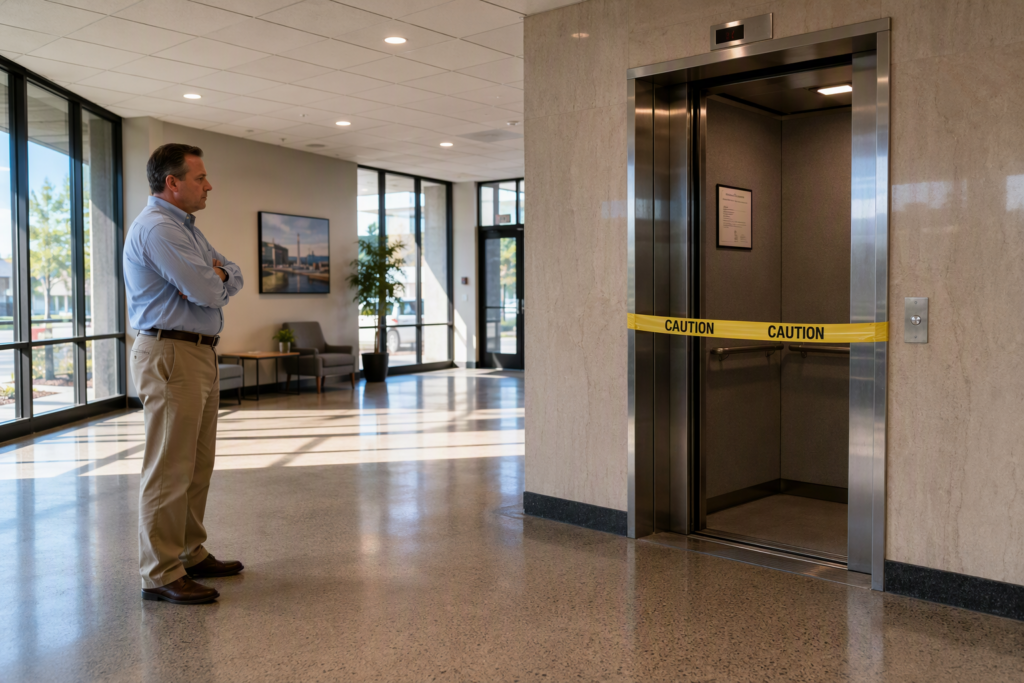

Selecting the right elevator maintenance contract is one of the most consequential facility decisions a California building owner or property manager makes. The wrong coverage type can mean either overpaying for services you rarely need or facing unexpected five-figure repair invoices that drain capital reserves. This guide breaks down both contract structures, compares them across the criteria that matter most, and helps owners identify which approach aligns with their building’s risk profile.
What Is a Full-Service Elevator Maintenance Contract?
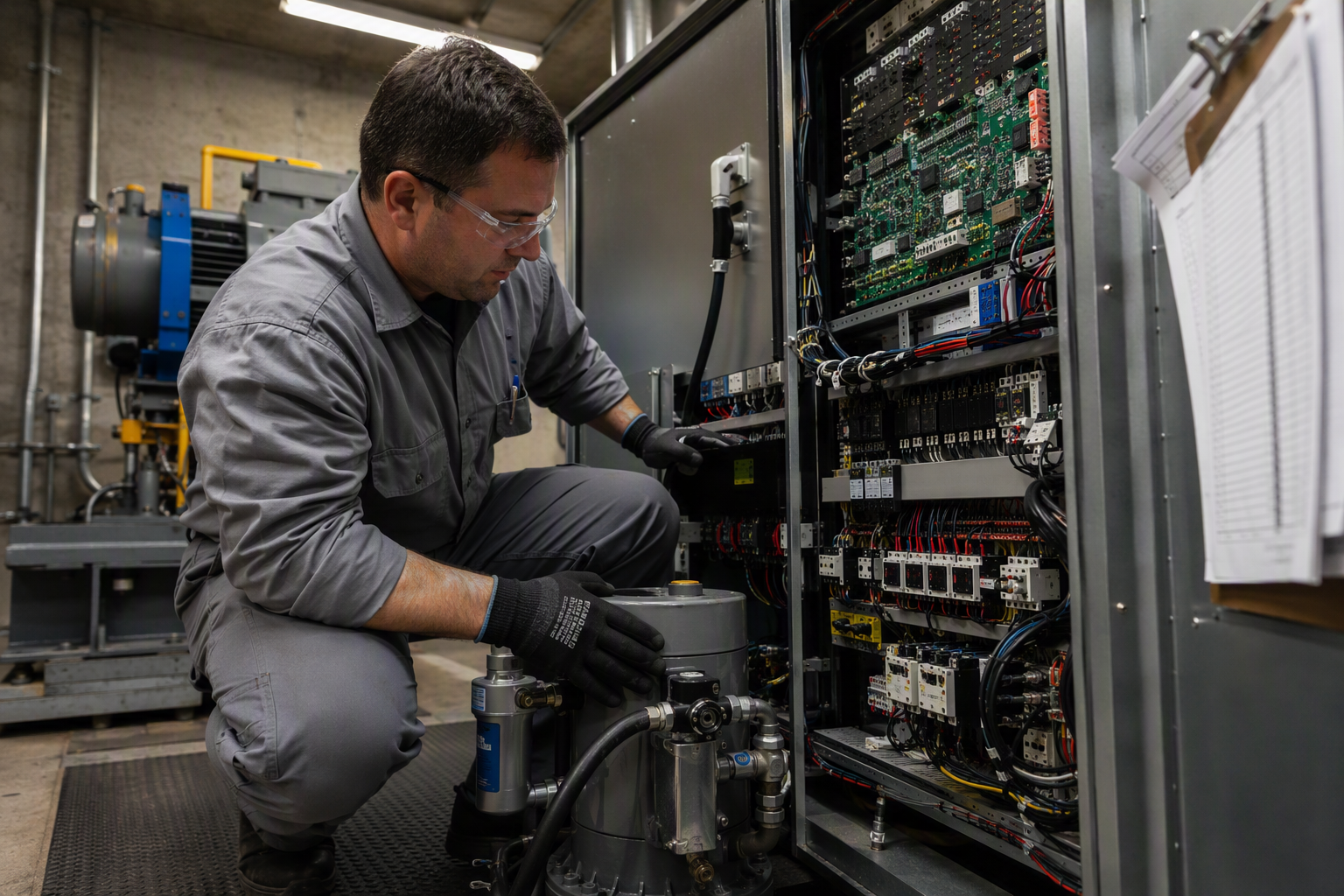
A full-service elevator maintenance contract—sometimes called an “all-inclusive” or “comprehensive” contract—covers routine preventive maintenance, labor for repairs, and parts replacement under a single recurring fee. When a component fails, the vendor handles replacement at no additional charge beyond the contract premium. Coverage typically extends to hydraulic fluid, cables, controller boards, door operators, and other wear items, though contracts vary in what they exclude (major modernization work and vandalism damage are common exclusions, so owners should read every exclusion clause carefully).
This structure transfers most of the financial risk of equipment failure to the service provider. In exchange, the provider charges a higher monthly or annual premium to account for that risk assumption.
What Is a Parts-and-Labor Elevator Maintenance Contract?
A parts-and-labor contract—also called a “basic” or “examine, lubricate, and adjust” (ELA) contract—covers the technician’s time for scheduled maintenance visits and labor for covered repairs, but bills parts and components separately at time of failure. The building owner effectively self-insures against parts costs. Monthly premiums are lower, but each repair event generates a separate invoice for materials.
This structure keeps baseline costs down and can be cost-effective for newer equipment with low failure rates. The trade-off is budget unpredictability: a single motor controller replacement or hydraulic pump failure can represent a significant unplanned expense.
Side-by-Side Comparison: Full-Service vs. Parts-and-Labor
| Factor | Full-Service Contract | Parts-and-Labor Contract |
|---|---|---|
| Monthly Premium | Higher fixed cost | Lower fixed cost |
| Parts Coverage | Included (subject to exclusions) | Billed separately at failure |
| Budget Predictability | High — one line item per period | Low — variable depending on failures |
| Best Equipment Age | Older or aging equipment | Newer equipment (under ~5 years) |
| Best Traffic Level | High-traffic buildings | Low- to moderate-traffic buildings |
| Owner Risk Exposure | Low — provider absorbs parts risk | High — owner absorbs parts costs |
| Provider Incentive | Incentivized to prevent failures proactively | Revenue-neutral on parts; less urgency to prevent failures |
| Ideal Owner Profile | HOAs, commercial landlords, healthcare, senior living | Owner-occupied low-rise, new construction, light-use facilities |
| Compliance Support | Usually included; provider tracks inspection schedules | Maintenance visits included; additional inspection fees may apply |
| Modernization | Typically excluded in both contract types | Typically excluded in both contract types |
Pros and Cons at a Glance
| Full-Service — Pros | Full-Service — Cons | |
|---|---|---|
|
|
| Parts-and-Labor — Pros | Parts-and-Labor — Cons | |
|---|---|---|
|
|
How Do California Compliance Requirements Affect My Contract Choice?
California elevator owners must comply with federal safety standards and are subject to state inspection and permitting requirements administered through local jurisdictions and the California Department of Industrial Relations. Elevators in California are generally required to undergo periodic safety inspections, and those inspections must be performed or overseen by a certified QEI (Qualified Elevator Inspector) under criteria established by ASME A17.1 Safety Code for Elevators and Escalators and the companion standard ASME A17.3 Safety Code for Existing Elevators and Escalators.
Non-compliant elevators can face shutdown orders, which in a high-occupancy residential or commercial building translates directly into tenant disruption, liability exposure, and potential ADA access violations under the Americans with Disabilities Act. Full-service contracts often include inspection scheduling and compliance documentation as part of the service package, reducing the administrative burden on the building owner. Parts-and-labor contracts may or may not include this support—owners should confirm in writing what compliance-related services are covered.
What Factors Should I Evaluate Before Signing Either Contract?
Before committing to either coverage type, building owners and property managers should systematically assess the following factors:
- Equipment age and condition: Request a current condition assessment that documents the remaining service life of major components such as the hydraulic pump, controller, drive machine, and door operators. Older or deteriorating components dramatically shift the financial math toward full-service coverage.
- Traffic volume: Count average daily trips or consult your existing service records. Elevators in high-traffic environments accumulate wear faster, increasing the probability of component failure within any contract period.
- Building type and tenant sensitivity: Healthcare facilities, senior living communities, and residential high-rises face disproportionate disruption from elevator outages. The cost of tenant dissatisfaction, accessibility complaints, or emergency service calls should factor into the coverage decision.
- Capital reserve availability: If the building’s reserve fund cannot comfortably absorb a mid-year five-figure repair without triggering a special assessment, full-service coverage provides a meaningful financial buffer.
- Exclusion language: Read every contract’s exclusion clause. Common exclusions across both contract types include cab interior finishes, lighting fixtures, vandalism damage, and full modernization. Some full-service contracts also exclude older proprietary components that are no longer manufactured.
- Parts sourcing transparency: Under a parts-and-labor contract, ask whether the provider discloses parts cost at cost or applies a markup, and whether you have the right to source parts independently.
- Contract term and exit provisions: Multi-year agreements may include early termination fees. Evaluate whether the savings offset the reduced flexibility.
- OSHA obligations: Elevator maintenance work in California must comply with applicable OSHA safety standards. Confirm that any contracted service provider’s technicians meet applicable safety training requirements.
Is a Full-Service Contract Always More Expensive Over Time?
Not necessarily. On newer equipment with low failure rates, a parts-and-labor contract will often cost less in aggregate over a three-to-five-year horizon. However, as equipment ages and component failure rates increase, the cumulative cost of individually invoiced parts can exceed what a full-service premium would have totaled for the same period. The break-even point depends on the specific equipment, usage intensity, and the particular vendor’s parts pricing. Building owners should request a multi-year cost projection from any prospective service provider before signing, using realistic failure probability assumptions for the equipment’s age and condition.
What Should I Look for in a Contract’s Exclusion List?
Exclusion lists are where full-service contracts vary most significantly from one provider to the next. Before signing, request a written list of every excluded item and ask the provider to clarify the following categories:
- Proprietary components: If your elevator uses a manufacturer’s proprietary controller or drive system, confirm whether those parts are covered or excluded. Some providers exclude proprietary parts they cannot source at competitive pricing.
- Hydraulic fluid and oil: Some contracts treat these as consumables and exclude them; others include them. For hydraulic elevators, fluid replacement can be a recurring cost.
- Modernization versus repair: The line between a major repair and a modernization project can be blurry. Ask for written definitions of each term as the provider uses them in the contract.
- Vandalism and misuse: Nearly all contracts exclude damage resulting from vandalism, misuse, or third-party modifications. Understand what documentation is required to invoke this exclusion so you are not surprised at claim time.
- Environmental damage: Water intrusion, seismic damage, and power surge damage are commonly excluded. Review your property insurance policy alongside the elevator contract to identify any coverage gaps.
How Does Equipment Age Affect the Decision?
Equipment age is one of the clearest decision signals. Elevator components have finite service lives, and the probability of failure increases meaningfully as equipment passes the midpoint of its expected operational life. Controllers, hydraulic systems, wire rope, and guide rail systems all degrade over time and with use. On equipment that is well past its initial installation era, the risk of multiple component failures within a single contract year is substantially higher than on recently installed or modernized equipment. Building owners with aging elevators who choose a parts-and-labor contract to reduce monthly premiums frequently find that a single major failure eliminates any savings realized over the prior years of lower payments.
Can I Switch Contract Types Mid-Term?
Switching is possible but requires attention to several practical issues:
- Review the existing contract for early termination clauses and any associated fees before initiating a change.
- Request a fresh condition assessment from the incoming provider before the new contract begins, so both parties have a documented baseline of equipment condition at contract start.
- Ensure that all maintenance records, inspection reports, and parts histories are transferred to the new provider. California inspection authorities may request historical records during periodic audits.
- Confirm that the transition does not create a lapse in coverage during any upcoming inspection period required under applicable ASME standards.
- Negotiate the new contract start date to align with the expiration of the prior agreement wherever possible.
What Questions Should I Ask a Prospective Elevator Service Provider?
When evaluating any elevator service provider in California, owners should ask the following questions directly and request written responses:
- Are your technicians trained and qualified under the requirements of ASME A17.1?
- Does your company carry appropriate general liability and workers’ compensation insurance in California?
- Who bears the cost if a required inspection reveals a deficiency that needs immediate repair — is that covered under this contract or billed separately?
- Do you use original equipment manufacturer (OEM) parts, aftermarket parts, or both, and how are parts priced under a parts-and-labor arrangement?
- What is your escalation procedure if a safety-critical component fails?
- Can you provide references from California buildings of similar type and equipment age to mine?
- What documentation do you provide after each service visit, and how is that documentation stored and made accessible for inspection purposes?
How Does Contract Choice Affect ADA Compliance?
Under the Americans with Disabilities Act, building owners have an ongoing obligation to maintain accessible features — including elevators — in operable condition. An elevator that is out of service due to deferred maintenance or a delayed parts repair can create an ADA compliance exposure, particularly in commercial facilities and places of public accommodation. Full-service contracts that prioritize rapid restoration of service following failures provide a stronger operational framework for meeting this ongoing obligation than arrangements where parts procurement delays extend downtime.
Why Choose Liftech Elevator as Your Independent Service Provider in California?
Liftech Elevator is a certified, independent elevator service company serving California building owners and property managers. As an independent provider, Liftech Elevator is not tied to a single elevator manufacturer, which means technicians can service a broad range of equipment brands and are not incentivized to steer owners toward a particular manufacturer’s modernization packages. Liftech Elevator offers both full-service and parts-and-labor contract structures, and the team conducts thorough equipment assessments to help building owners determine which coverage type genuinely aligns with their equipment condition, usage profile, and financial risk tolerance — rather than defaulting to whichever option generates higher contract revenue. For California building owners navigating the compliance requirements associated with ASME A17.1 and A17.3 and applicable ADA obligations, working with an experienced independent provider that understands the California regulatory environment is a meaningful operational advantage.
Decision Framework: A Step-by-Step Process for Choosing Your Contract Type
Use this structured process to reach a defensible, well-documented contract decision for your building:
- Commission a current condition assessment. Before evaluating any contract, have a qualified technician inspect and document the condition of every major elevator component. This report becomes the foundation of your decision.
- Categorize your equipment as new, mid-life, or aging. Use the condition assessment to place your equipment on a rough service-life timeline. Equipment in early service life favors parts-and-labor; equipment in mid-to-late service life favors full-service.
- Assess your building’s traffic intensity. Classify daily usage as light, moderate, or heavy based on occupancy type and observed usage patterns. Higher traffic accelerates wear and shifts the decision toward full-service coverage.
- Review your capital reserve position. Determine whether the reserve fund can absorb a major unplanned repair without triggering a special assessment or borrowing. If not, full-service coverage provides meaningful financial protection.
- Obtain itemized proposals from at least two providers for each contract type. Compare line-by-line coverage, exclusion lists, escalation procedures, and term lengths — not just headline monthly premiums.
- Request a multi-year total cost of ownership projection. Ask each provider to model the expected total cost under both contract types over a three-to-five-year horizon, using realistic failure probability assumptions for your specific equipment.
- Review exclusion lists with legal or facilities counsel. Have someone familiar with contract language review every exclusion clause before signing. Misunderstood exclusions are the leading cause of contract disputes in elevator service agreements.
- Confirm compliance coverage. Verify in writing that the selected contract structure includes or explicitly excludes the inspection scheduling and documentation support needed to meet California inspection requirements under applicable ASME standards.
- Execute and document. Retain all signed agreements, condition assessment reports, and correspondence in a dedicated facility file accessible to future property management teams.
Ready to Make the Right Contract Decision for Your Building?
Liftech Elevator provides free elevator assessments to help California building owners determine which maintenance contract structure — full-service or parts-and-labor — genuinely fits their equipment condition, usage profile, and budget. An informed contract decision starts with an honest assessment of what your elevator actually needs.
Contact Liftech Elevator for a free elevator assessment: 562-609-3478
Need elevator service you can rely on? Liftech Elevator is ready to help.