How to Evaluate and Switch Elevator Service Vendors in Healthcare Facilities
By the Liftech Elevator Team
Elevator reliability in a hospital, surgical center, or long-term care facility is not a facilities-management convenience — it is a patient-safety imperative. When a vertical-transport system fails during a code response or a gurney transfer, the consequences extend well beyond a service ticket. Healthcare operators across Southern California are increasingly reviewing whether their current elevator contractor is meeting the regulatory, mechanical, and documentation standards the industry demands. The guidance below walks facility managers through every stage of that evaluation and transition process.
What compliance standards govern hospital elevators in California?
Healthcare elevator installations and maintenance in California must satisfy a layered set of requirements:
- ASME A17.1 Safety Code for Elevators and Escalators — the foundational North American standard covering design, installation, inspection, and maintenance of elevator equipment. California enforces this code through the Division of Occupational Safety and Health (Cal/OSHA).
- California Code of Regulations, Title 8, Group 1 — the state-level elevator safety order that references ASME A17.1 and specifies periodic inspection intervals for conveyances in public-use buildings, including healthcare facilities.
- Americans with Disabilities Act (ADA) — mandates accessible cab dimensions, door timing, floor call buttons, and Braille signage that directly affect patient and visitor mobility in healthcare settings.
- FGI Guidelines for Design and Construction of Hospitals — while not a building code, these guidelines are adopted by the California Office of Statewide Health Planning and Development (OSHPD/HCAI) and specify elevator capacities and quantities for patient-care occupancies.
- The Joint Commission (TJC) Environment of Care Standards — accredited hospitals must demonstrate that life-safety equipment, including elevators, is properly maintained and that documentation is current and accessible during surveys.
- OSHA General Industry Standards — applicable to service personnel accessing machine rooms and elevator pits.
When Liftech Elevator performs assessments for healthcare clients in Long Beach, Signal Hill, Los Angeles, and Orange County, documentation readiness for all of these layers is reviewed as part of the evaluation process.
What are the warning signs that a healthcare facility should consider switching elevator vendors?
- Inspection certificates are expired or not posted in the cab as required by California law.
- Recurring callbacks for the same mechanical issue without a documented root-cause repair.
- The vendor cannot produce a complete maintenance log on demand — a direct liability risk during a Joint Commission survey.
- Door-timing adjustments have not been verified against ADA-compliant dwell times for patient transport.
- The contractor is unfamiliar with hospital-specific requirements such as firefighter service (Phase I and Phase II), hospital emergency power (HEPS) integration, or stretcher-capacity cab dimensions.
- Communication breakdowns — facility managers receive no advance notice before scheduled maintenance windows, disrupting patient-transport schedules.
- Equipment reaching end-of-life without a modernization roadmap or capital planning conversation.
How do you audit your current elevator service contractor before switching?
A structured audit before initiating a vendor change protects the facility from inheriting undisclosed deficiencies and establishes a clean baseline for the incoming contractor. Follow these steps:
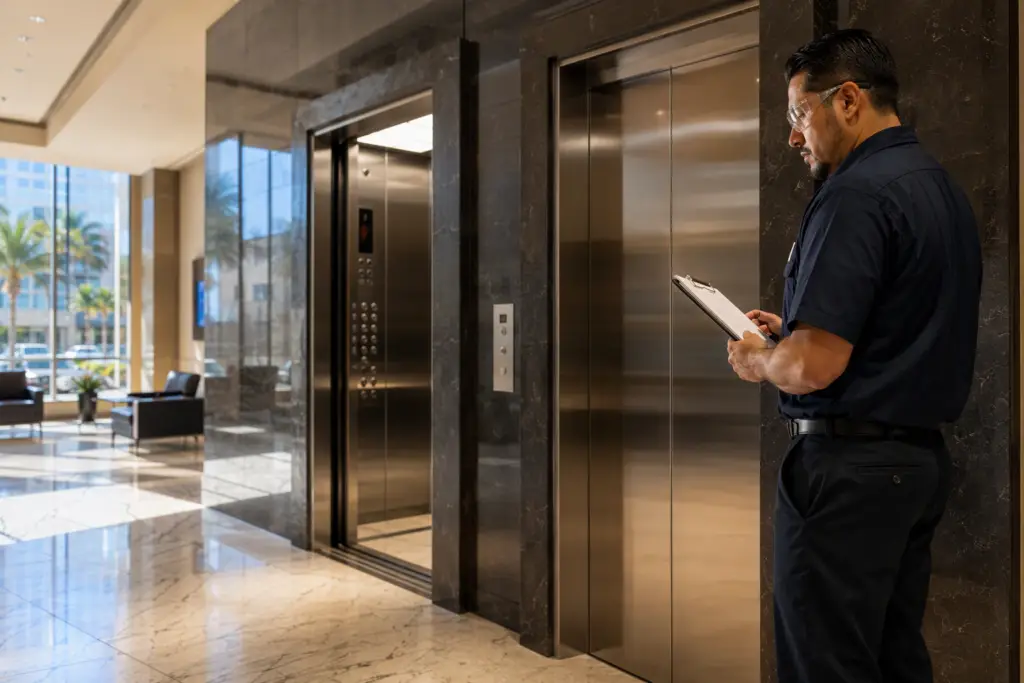
- Collect all current inspection certificates. Verify that each conveyance has a valid annual inspection certificate posted in the cab and that periodic Category 1 and Category 5 tests required under ASME A17.1 are current and documented.
- Request the full maintenance log. Every service visit, oil change, adjustment, and callback should be recorded with date, technician identification, and work performed. Gaps in this log represent regulatory exposure.
- Review outstanding violation notices. Contact Cal/OSHA’s Elevator, Ride, and Tramway Unit or check the facility’s permit records for any open violations or orders-to-comply issued against existing equipment.
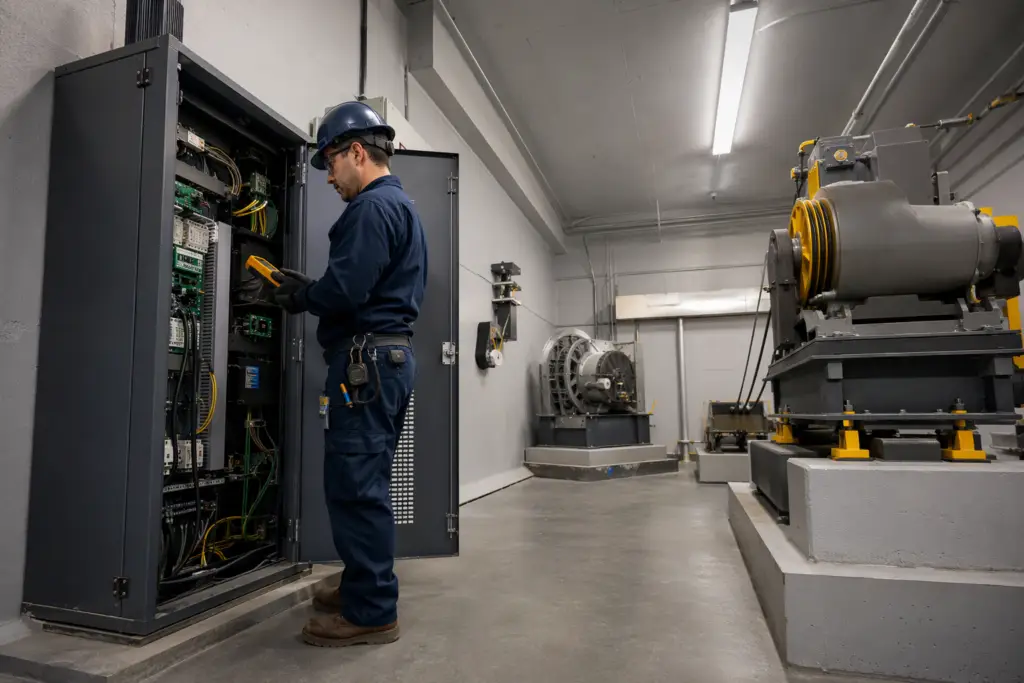
- Inspect machine room and pit conditions. Evaluate lighting, housekeeping, fire protection, and equipment labeling against California Title 8 requirements and OSHA standards.
- Assess ADA compliance. Measure cab dimensions, verify audible signals, check Braille plate condition, and confirm door-sensor sensitivity meets ADA specifications for healthcare use.
- Document all deferred maintenance items. List every known mechanical issue that the current vendor has deferred or failed to resolve. This list becomes part of the scope-of-work issued to prospective vendors.
- Obtain equipment inventory and wiring diagrams. These documents belong to the facility, not the contractor. Ensure they are transferred before the outgoing vendor’s contract ends.
What should a healthcare facility include in an elevator service RFP?
A well-constructed request for proposal reduces the risk of selecting an under-qualified vendor and creates accountability from day one. Key elements include:
- Full equipment inventory — make, model, year installed, and current condition notes for each unit.
- Specific California elevator contractor license requirement (California requires a C-11 Electrical or appropriate specialty contractor classification for elevator work).
- Compliance scope: ASME A17.1, ADA, Title 8, and TJC documentation requirements.
- Maintenance task schedule aligned to manufacturer recommendations and code-required test intervals.
- Documentation requirements — format and frequency of maintenance logs, inspection reports, and deficiency notices.
- Communication protocol for planned outages — hospitals cannot accept unplanned elevator downtime without advance coordination with nursing and transport teams.
- Modernization consultation capacity — prospective vendors should demonstrate familiarity with healthcare capital planning cycles.
- References from comparable healthcare facilities in Southern California.
How long does a healthcare elevator vendor transition typically take?
The timeline varies by facility size and the number of conveyances involved, but a structured transition generally unfolds across three phases:
- Evaluation and award (four to eight weeks): Audit completion, RFP issuance, vendor interviews, reference checks, and contract negotiation.
- Onboarding and equipment familiarization (two to four weeks): The incoming contractor conducts a comprehensive initial inspection of every unit, reviews all inherited documentation, and meets with facilities leadership to establish communication protocols. Liftech Elevator performs this initial inspection as part of its healthcare onboarding process in the Long Beach and Orange County service area.
- First service cycle and compliance verification (thirty to sixty days): Any deficiencies identified during onboarding are prioritized and addressed; all inspection documentation is brought into current standing.
Rushing the transition to save a billing cycle often results in undisclosed deficiencies being inherited without a clear chain of accountability. A deliberate handoff protects the facility.
What elevator features are specific to hospital and healthcare environments?
- Firefighter Emergency Operation (Phase I and Phase II): Required by ASME A17.1 and California code on all new installations, and expected on modernized equipment serving patient-occupied floors.
- Oversized cab capacity: Hospital elevators serving patient floors must accommodate stretchers, wheelchairs, and accompanying medical staff — FGI guidelines specify minimum cab dimensions for these applications.
- Hospital Emergency Power System (HEPS) integration: California’s Office of Statewide Health Planning (HCAI) requires that at least one elevator per bank in licensed general acute care hospitals be connected to the emergency power system to support patient evacuation.
- Slow door-close timing: ADA-compliant door dwell time is critical in healthcare settings where patients may use mobility aids or IV poles.
- Infection-control cab materials: Antimicrobial wall panels and seamless flooring reduce pathogen transmission — a maintenance contractor should understand how to service these surfaces without voiding warranties.
- Priority dispatch systems: Some acute care facilities use destination dispatch or dedicated service elevators to prevent delays during emergencies.
How does switching vendors affect ongoing inspection and permitting obligations?
California requires a permit to operate each conveyance, issued by Cal/OSHA’s Elevator, Ride, and Tramway Unit. A vendor change does not reset or pause this obligation. The facility remains responsible for ensuring that:
- The annual inspection is completed on schedule, regardless of which contractor is currently under contract.
- Any violations noted by the state inspector are remediated before the operating permit is renewed.
- The incoming contractor is added to the permit file as the responsible maintenance entity.
- Wiring diagrams, test records, and Category 5 load test documentation are transferred to the new contractor and remain available for inspector review.
Facilities in Los Angeles and Orange County that have worked with Liftech Elevator report that having a structured document-transfer checklist significantly reduces the risk of a permit gap during the transition period.
Questions Your Inspector Will Ask
California elevator inspectors and Joint Commission surveyors focus on documentation, equipment condition, and operational readiness. Expect questions and document requests along these lines:
- “Where is the current operating permit and inspection certificate for each unit?”
- “Can you produce the complete maintenance log for the past twelve months?”
- “When was the last Category 1 annual test and Category 5 five-year test performed, and where is the signed test record?”
- “Are there any open violation notices from the state elevator inspection unit? What is the remediation status?”
- “How is firefighter emergency operation tested and documented?”
- “Is the elevator connected to the emergency power system, and has that integration been tested under load?”
- “Do cab dimensions meet FGI and ADA requirements for stretcher transport?”
- “What is the process for notifying clinical staff when an elevator will be taken out of service for maintenance?”
- “Who is the responsible maintenance contractor, and what is the current contract term?”
Facilities that cannot answer these questions on demand are at risk of a deficiency citation. Liftech Elevator helps healthcare clients in Signal Hill, Long Beach, Los Angeles, and Orange County build an inspection-ready documentation package as a standard deliverable.
What questions should a healthcare facility ask prospective elevator vendors?
- Is your company licensed to perform elevator work in California, and can you provide documentation?
- Do your technicians have specific experience servicing equipment in licensed healthcare facilities?
- How do you document each service visit, and in what format will records be provided to the facility?
- How do you coordinate planned maintenance outages with hospital operations teams?
- What is your process for identifying and escalating safety-related deficiencies?
- Can you provide references from comparable healthcare facilities in Southern California?
- How do you handle code-compliance updates when a new edition of ASME A17.1 takes effect?
- What modernization consulting services do you provide, and how do you integrate with a facility’s capital planning cycle?
How does elevator modernization fit into a healthcare vendor evaluation?
A vendor evaluation is an appropriate trigger for a broader capital planning conversation. Aging elevator equipment in healthcare facilities creates compounding risk: parts availability decreases, energy consumption increases, and the cost of maintaining outdated controls often exceeds the cost of modernization over a multi-year horizon. Prospective vendors should be able to present a condition assessment that distinguishes between equipment requiring only improved maintenance and equipment that has reached an economic end-of-life threshold.
In the 2026 regulatory environment, modernization projects in California healthcare facilities must also account for HCAI (formerly OSHPD) permitting for any alteration to a licensed facility’s vertical transportation systems. A qualified contractor will be familiar with this permitting pathway and able to assist the facility in scoping a compliant modernization project.
Why do healthcare facilities in Southern California choose Liftech Elevator?
Liftech Elevator serves healthcare and commercial facility operators across Signal Hill, Long Beach, Los Angeles, and Orange County with elevator maintenance, repair, and modernization services. Healthcare clients value a contractor that understands the documentation discipline required by Joint Commission surveys and California state inspections, communicates proactively about planned service windows, and brings familiarity with the specific operational demands of patient-care environments — from stretcher-capacity cab requirements to emergency power integration.
Start Your Elevator Vendor Assessment Today
If your healthcare facility is overdue for an elevator vendor review, or if recurring maintenance issues, documentation gaps, or upcoming Joint Commission surveys have raised concerns, the process starts with an objective equipment assessment.
Contact Liftech Elevator for a free elevator assessment — call 562-609-3478 today. Liftech Elevator serves healthcare facilities throughout Signal Hill, Long Beach, Los Angeles, and Orange County, CA.
Need elevator service you can rely on? Liftech Elevator is ready to help.