Elevator Code Violation Penalties: A Complete Comparison and Decision Guide
Understanding elevator code violation penalties is essential for building owners, property managers, and facility directors. Violations can trigger equipment shutdowns, compounding fines, and civil liability exposure. This guide compares violation types, likely consequences, timelines, and what steps to take immediately after receiving a notice — so decision-makers can act with confidence rather than guess.
What Are Elevator Code Violations?
Elevator code violations occur when an elevator or escalator fails to meet the safety, maintenance, or inspection requirements set by applicable codes and standards. In the United States, the primary technical standard is the ASME A17.1 Safety Code for Elevators and Escalators, which establishes design, construction, operation, and maintenance requirements. Most state and local authorities having jurisdiction (AHJ) adopt ASME A17.1 by reference, meaning violations of the ASME standard become violations of local law.
Separately, any elevator serving the public or a place of employment must meet accessibility requirements under the Americans with Disabilities Act (ADA), and workplaces where elevator mechanics perform service must comply with OSHA standards for general industry and construction. Violations of any of these frameworks can generate independent penalty tracks.
How Are Elevator Violations Classified?
Jurisdictions typically classify violations into tiers. While exact tier names vary by state and city, the following categories reflect how most AHJs structure their enforcement:
| Violation Class | Description | Typical AHJ Response | Shutdown Risk |
|---|---|---|---|
| Immediately Hazardous | Broken safety devices, failed buffers, inoperative emergency stop, broken cab enclosure | Mandatory immediate shutdown order | Certain |
| Major / Class I | Worn wire ropes not yet at removal threshold, door reopening device deficiencies, lighting failures | Notice with short correction window (often 30 days or less) | High if uncorrected |
| Minor / Class II | Cosmetic or administrative issues, missing signage, documentation gaps | Notice with standard correction window (30–90 days) | Low |
| Administrative | Lapsed inspection certificate, missing maintenance logs, unpermitted modifications | Fines and/or certificate suspension | Moderate |
Elevator Code Violation Penalties: Cost and Consequence Comparison
Penalty structures vary significantly by jurisdiction. The table below compares the general consequence categories building owners face — without inventing specific dollar figures that differ by city and state law:
| Penalty Type | When It Applies | Duration / Recurrence | Mitigation Path |
|---|---|---|---|
| Shutdown Order | Immediately hazardous violations | Until repair is verified by AHJ | Emergency repair + re-inspection |
| Daily Recurring Fines | Uncorrected violations past deadline | Accrue each day until corrective action is documented | Prompt repair + written compliance proof |
| Certificate Suspension | Lapsed or failed inspection | Until successful re-inspection | Remediation + scheduled re-inspection |
| Civil Liability | Injury or property damage linked to violation | Ongoing; increases if willful neglect is demonstrated | Documented maintenance program; legal counsel |
| Criminal Charges | Gross negligence or repeated willful violations | Prosecution timeline varies | Legal representation; proactive compliance history |
| Insurance Consequences | Violation history disclosed to insurer | Premium increases or policy cancellation | Compliance documentation shared with underwriter |
What Should a Building Owner Do Immediately After Receiving a Violation Notice?
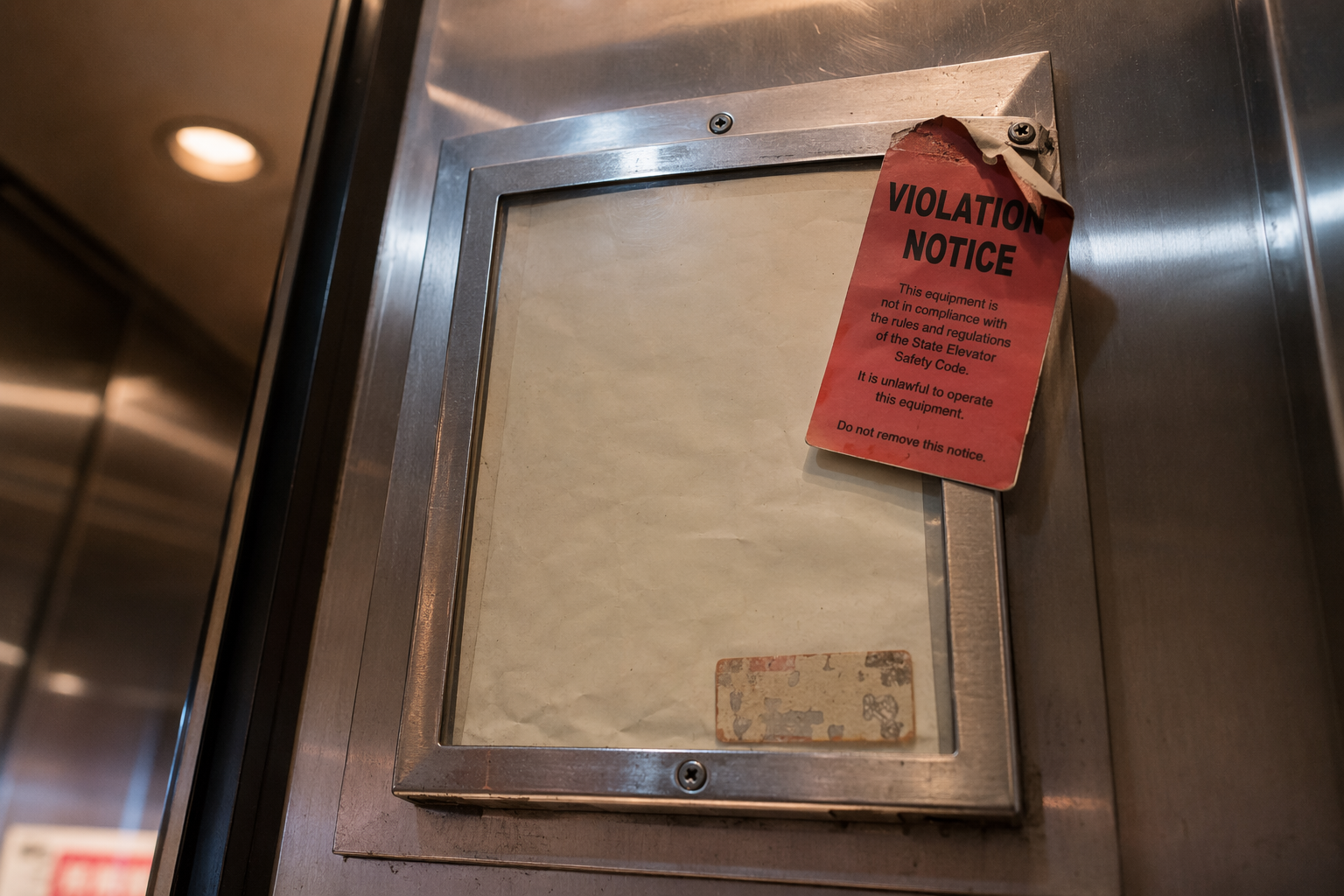
- Read the notice completely. Identify the violation class, the specific code section cited, the correction deadline, and any shutdown orders that are already in effect.
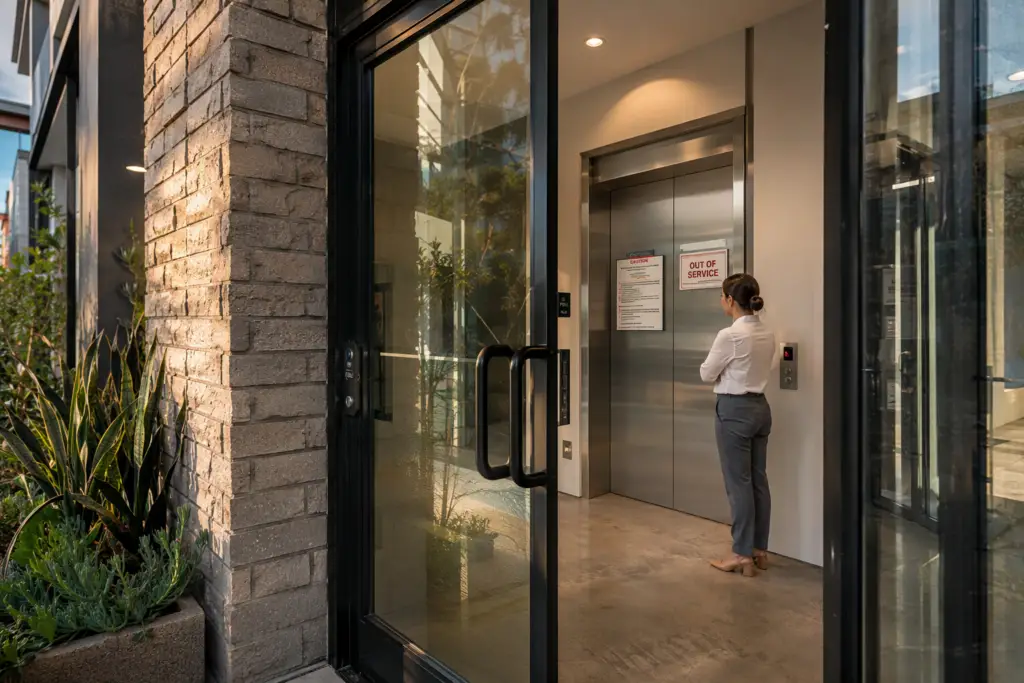
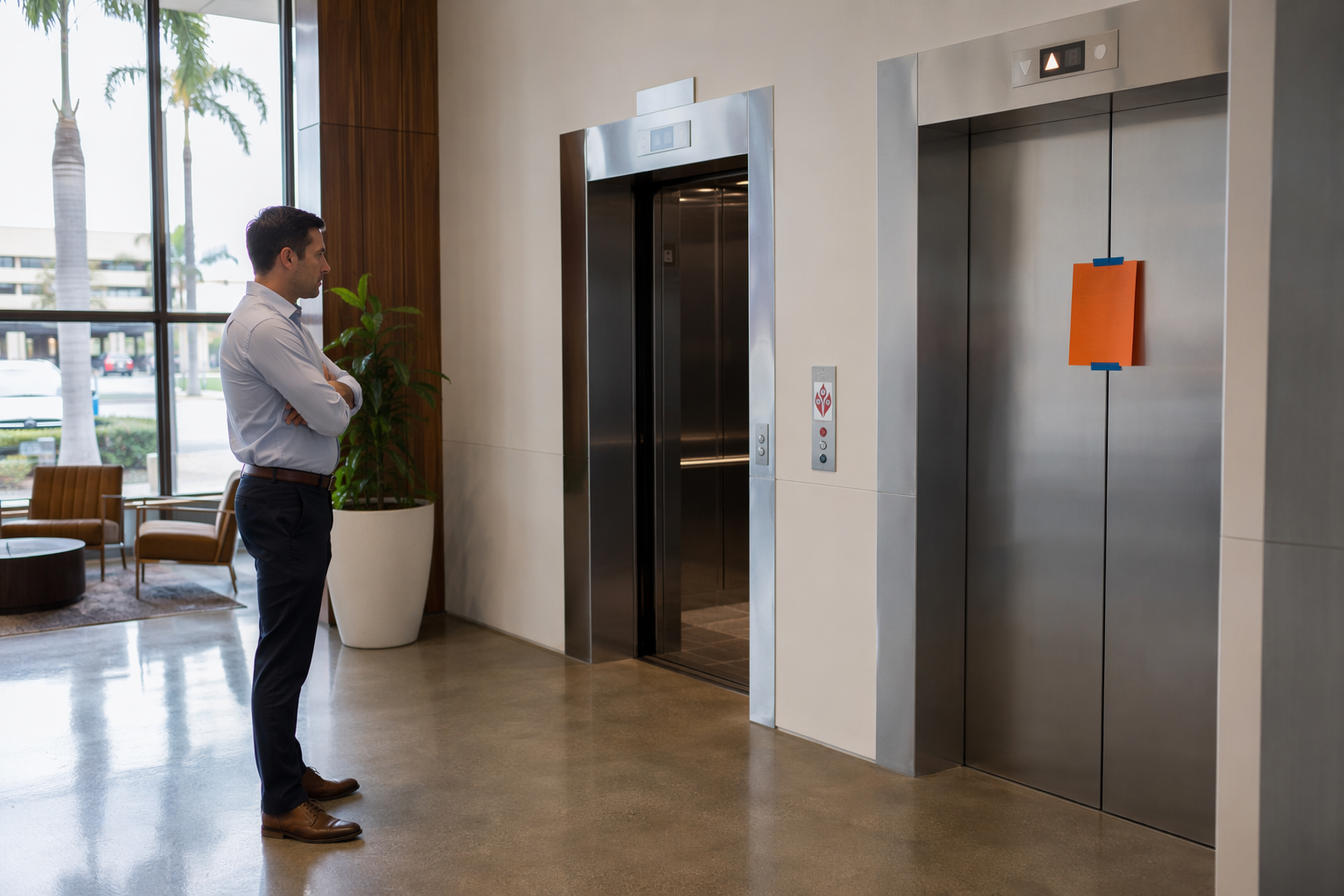
- Secure the elevator if required. If the notice includes a shutdown order or the violation is immediately hazardous, take the unit out of service and post required out-of-service signage before anyone else enters the cab.
- Contact a licensed elevator service company. A qualified contractor must assess the violation, confirm its scope, and provide a written repair plan — this documentation protects the building owner throughout the enforcement process.
- Notify your insurance carrier. Most commercial liability policies require prompt notification of regulatory actions. Failure to notify can jeopardize coverage.
- Request an extension in writing if needed. If parts must be sourced or structural modifications are required, contact the AHJ in writing before the deadline and request a documented extension. Most jurisdictions grant extensions when good-faith efforts are demonstrated.
- Complete all repairs and obtain documentation. Ensure the elevator contractor provides a signed work order and any required test certificates upon completion.
- Schedule the re-inspection. Contact the AHJ to schedule the compliance inspection. Do not simply reopen the elevator without written clearance where a shutdown order was issued.
- Retain all records. Store violation notices, repair invoices, test reports, and correspondence with the AHJ for a minimum period consistent with local requirements and your insurance policy terms.
How Do ADA Violations Differ From ASME Violations?
ASME A17.1 violations are enforced by state or local elevator inspection authorities and primarily address mechanical safety. ADA violations are enforced through a separate federal framework: the U.S. Department of Justice, private lawsuits under Title II or Title III, and in some cases by the U.S. Access Board. The two enforcement tracks are independent — a building can be mechanically compliant under ASME while still facing ADA enforcement for inaccessible controls, insufficient cab dimensions, or missing auditory signals. Both compliance tracks must be addressed simultaneously.
What Is the Difference Between a Violation and a Deficiency?
Many AHJs distinguish between a violation — a condition that directly contravenes a code requirement — and a deficiency or advisory item, which is a condition the inspector recommends addressing but that does not yet trigger formal penalty proceedings. Deficiencies, if left unaddressed, often escalate to violations at the next inspection cycle. Proactive maintenance addresses deficiencies before they become enforceable violations, reducing long-term exposure and unplanned downtime.
How Long Does It Typically Take to Resolve an Elevator Code Violation?
| Violation Type | Repair Complexity | Typical Resolution Timeline | Key Delay Factors |
|---|---|---|---|
| Administrative (paperwork) | Low | Days to 2 weeks | AHJ scheduling |
| Minor mechanical | Low–Medium | 1–4 weeks | Parts availability |
| Major mechanical / safety device | Medium–High | 2–8 weeks | Parts lead time, permit processing |
| Modernization required | High | 2–6 months or longer | Engineering, permitting, contractor availability |
What Are the Pros and Cons of Reactive vs. Proactive Compliance?
| Approach | Pros | Cons | Best For |
|---|---|---|---|
| Reactive (respond only after violation) |
Lower immediate cost outlay; no action until required | Shutdown risk; accruing daily fines; emergency repair premiums; civil liability exposure; reputational damage | Nobody — this approach consistently costs more over time |
| Proactive (ongoing maintenance + pre-inspection) |
Prevents violations; avoids shutdowns; supports insurance rates; protects occupants; creates defensible record | Requires budgeting for scheduled service; requires tracking inspection cycles | All building owners and property managers |
Which Elevator Code Standards Apply in 2026?
As of 2026, most U.S. jurisdictions base their elevator safety rules on an adopted edition of the ASME A17.1 Safety Code for Elevators and Escalators. ASME periodically revises the standard, and states adopt new editions on their own legislative schedules — meaning the edition in force varies by state. Building owners should confirm with their local AHJ which edition is currently adopted in their jurisdiction. Using an outdated edition as the compliance reference is itself an administrative risk. ADA accessibility standards are governed at the federal level by the ADA Standards for Accessible Design, which apply nationwide regardless of state adoption.
Can a Building Owner Contest an Elevator Violation?
Yes. Most jurisdictions provide a formal appeal or variance process. Common grounds for appeal include:
- The cited condition does not actually violate the adopted code edition
- The violation was corrected before the notice was issued but the inspector was unaware
- The prescribed remedy is technically infeasible for the specific installation, warranting an equivalent safety alternative
- The notice contains procedural errors (wrong unit, wrong address, incorrect code citation)
Appeals must typically be filed within a short window — often 15 to 30 days from the notice date — and must be submitted in writing with supporting documentation. Filing an appeal does not automatically stay a shutdown order; the building owner should confirm with the AHJ whether the unit may remain in service during the appeal period.
What OSHA Requirements Apply to Elevator Maintenance Work?
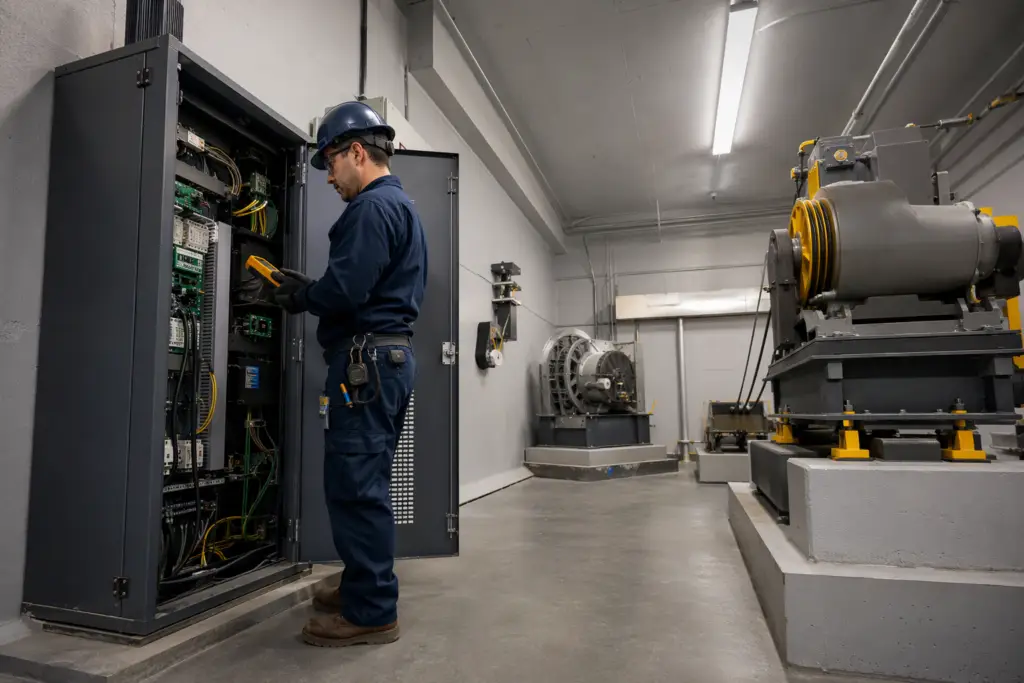
When elevator technicians perform maintenance, repair, or testing work, the worksite is subject to OSHA standards covering lockout/tagout procedures, confined space entry, fall protection, and electrical safety. Building owners have a duty to provide safe access to mechanical rooms and pit areas. Failure to maintain these conditions can generate separate OSHA citations that run concurrently with elevator code violations — compounding the penalty exposure for a single deficient installation.
How Does an Independent Elevator Service Company Compare to a Large OEM Service Contract?
| Factor | OEM / Large National Provider | Independent Provider (e.g., Liftech Elevator) |
|---|---|---|
| Parts sourcing | Proprietary parts often required; may restrict third-party sourcing | Broader parts sourcing options; can service multi-brand installations |
| Contract flexibility | Long-term contracts common; early termination fees apply | Typically more flexible contract structures |
| Code compliance focus | Varies; large portfolios can reduce individual attention | Dedicated compliance guidance per property |
| Violation response | Routed through regional dispatch; variable timelines | Direct relationship with local technicians and AHJ familiarity |
| Documentation support | Standardized reporting; may not customize for local AHJ formats | Can tailor documentation to specific AHJ requirements |
Liftech Elevator is a certified independent elevator service company. Building owners and property managers working with Liftech gain a partner focused specifically on their property’s compliance standing, rather than being managed as one unit in a large national portfolio.
What Documentation Should a Building Owner Maintain to Defend Against Penalties?
- Current inspection certificate posted in the cab as required by the AHJ
- Maintenance logs showing dates, technician identification, and work performed, aligned with the ASME A17.1 maintenance requirements for the specific equipment type
- Signed work orders for all repairs, adjustments, and replacements
- Test certificates for periodic tests required under the adopted code edition (e.g., safety tests, brake tests, pressure relief tests for hydraulic units)
- Correspondence with the AHJ including any extension requests and approvals
- Violation notices and proof of correction for any prior enforcement actions
- ADA accessibility documentation where applicable under ADA Standards for Accessible Design
What Is the ROI of Proactive Elevator Compliance?
The financial case for proactive compliance rests on avoiding the compounding costs of the reactive path. Building owners who defer maintenance until a violation is issued typically face some combination of emergency repair premiums, daily fines that accrue before correction is complete, lost tenant revenue during shutdown periods, increased insurance premiums following a violation history, and legal costs if an incident occurs. Proactive maintenance and scheduled inspections address developing deficiencies before they reach enforcement — converting a potential penalty scenario into a predictable, budgetable operating cost. The avoided downtime alone typically justifies the investment for any elevator serving a revenue-generating property or serving occupants who depend on it for accessibility.
Summary: Key Decision Factors for Building Owners
| Decision Factor | Recommended Action |
|---|---|
| Violation notice received | Act immediately; engage licensed elevator contractor; notify insurer |
| Shutdown order issued | Take unit out of service; pursue emergency repair; do not reinstate without written AHJ clearance |
| Inspection certificate lapsing | Schedule inspection before expiration; confirm current adopted code edition with AHJ |
| No current violation but aging equipment | Commission a proactive assessment; identify deficiencies before next inspection |
| ADA accessibility concerns | Consult ADA Standards independently of state elevator code compliance |
| Changing service provider | Request full compliance documentation from outgoing provider before transition |
Take Action Before a Violation Becomes a Penalty
Liftech Elevator helps building owners and property managers stay ahead of code enforcement — with thorough assessments, documented maintenance programs, and hands-on support through the AHJ process.
Contact Liftech Elevator for a free elevator assessment: 562-609-3478
Need elevator service you can rely on? Liftech Elevator is ready to help.