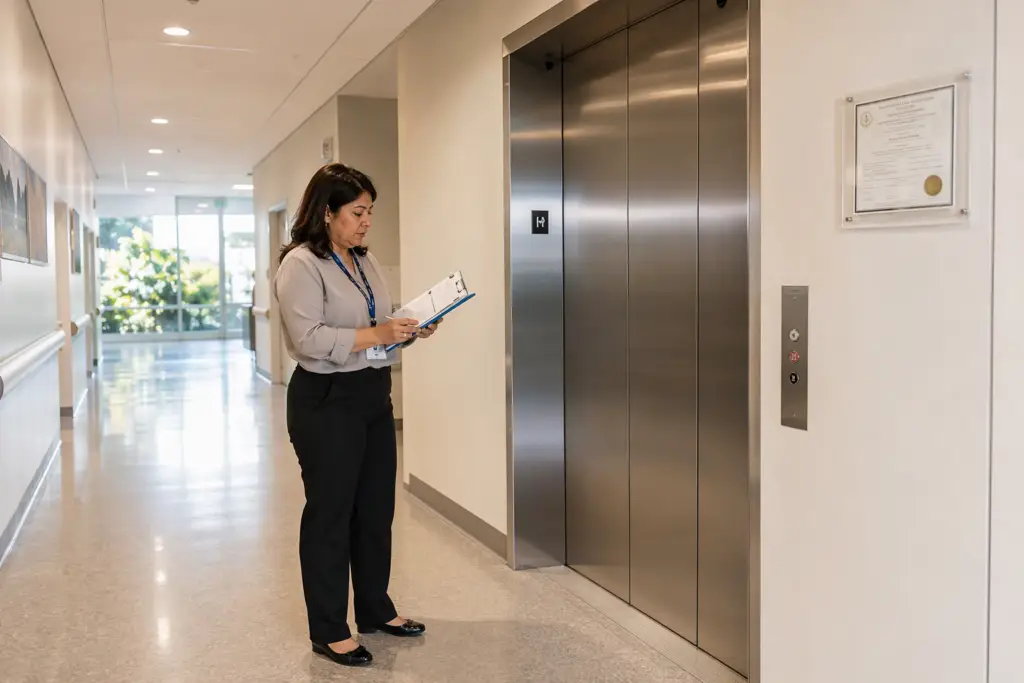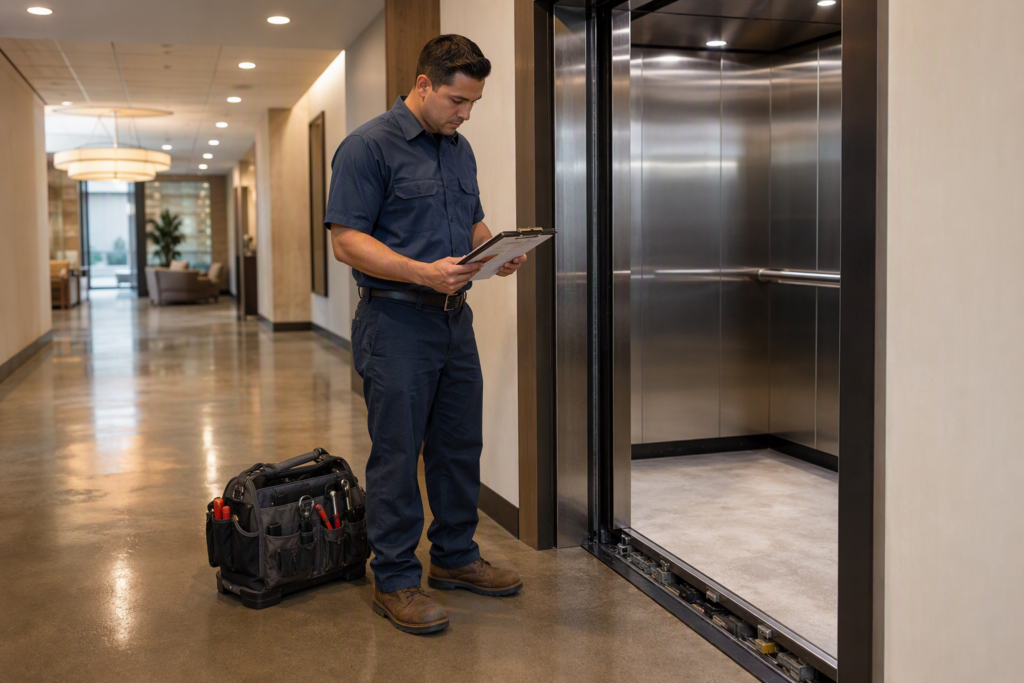
Elevator Certificate of Compliance: Complete Comparison & Decision Guide
Choosing the right path to obtain, renew, or maintain an elevator certificate of compliance depends on your building type, local jurisdiction requirements, current elevator condition, and whether you manage compliance in-house or through an independent service provider. This guide covers every angle — from what the certificate actually certifies to cost factors, timelines, vendor options, and the questions building managers ask most.
What Is an Elevator Certificate of Compliance?
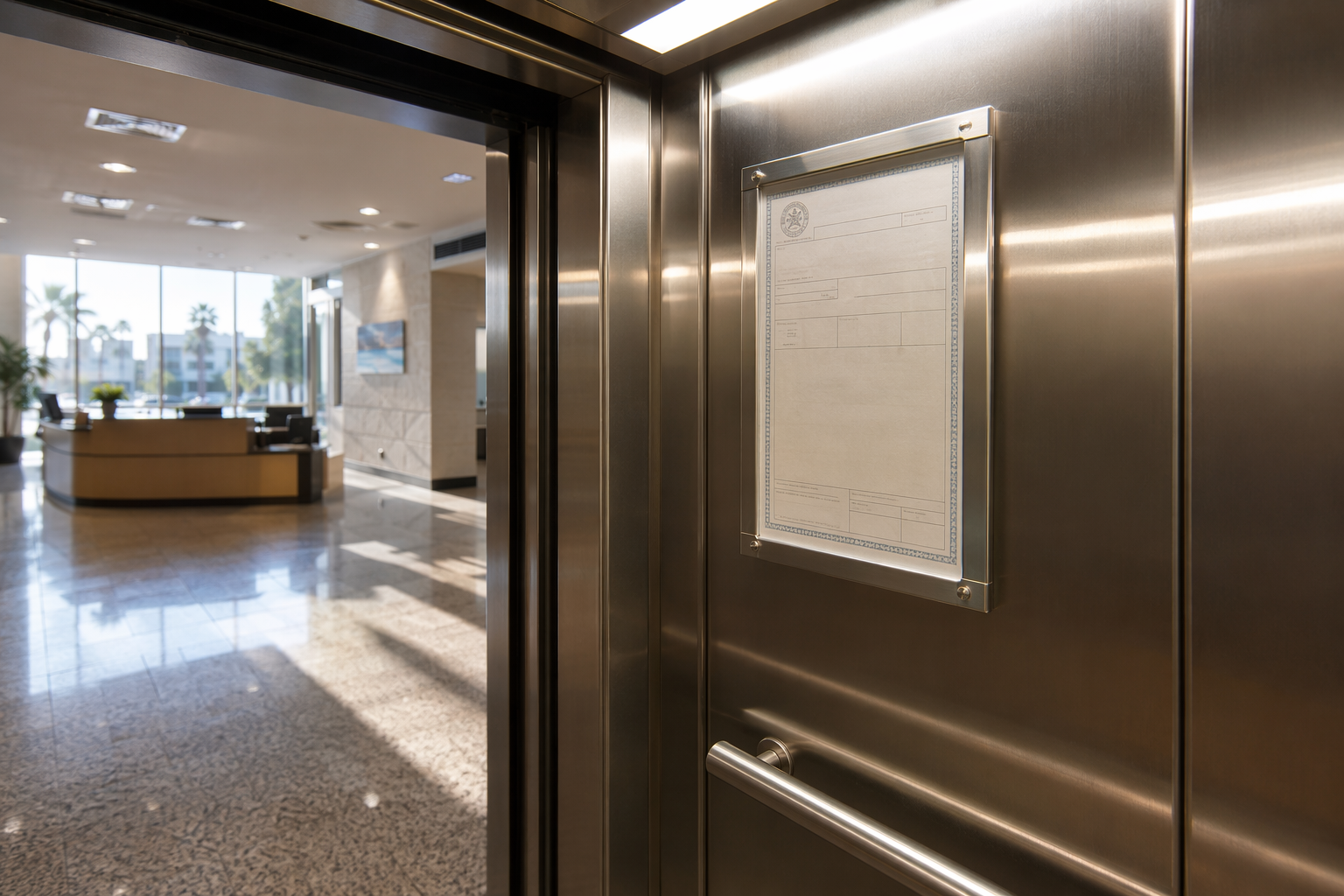
An elevator certificate of compliance (sometimes called a certificate of inspection or operating permit) is a jurisdiction-issued document confirming that a licensed elevator inspector has examined the elevator, found it meets the applicable safety code, and authorized its continued operation. The certificate typically must be posted inside the elevator car or in a publicly visible location near the elevator entrance.
Most jurisdictions base their inspection requirements on the ASME A17.1 Safety Code for Elevators and Escalators, which establishes minimum safety requirements for the design, construction, operation, inspection, testing, and maintenance of elevators. The 2025/2026 edition of this code continues to serve as the primary reference document adopted — sometimes with local amendments — by states, counties, and municipalities across the United States.
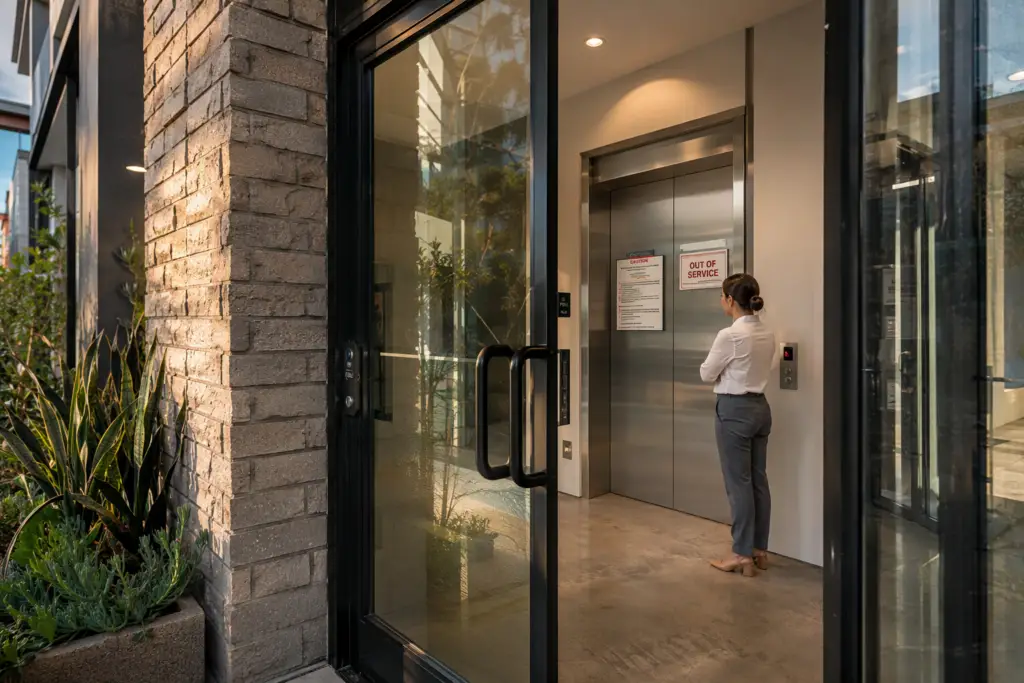
Failure to display a valid certificate can result in mandatory shutdown orders, fines, and significant liability exposure if an incident occurs while the certificate is lapsed.
Certificate of Compliance vs. Related Documents: What Is the Difference?

| Document | Issued By | Purpose | Display Required? | Renewal Frequency |
|---|---|---|---|---|
| Certificate of Compliance / Operating Permit | State or local authority having jurisdiction (AHJ) | Authorizes ongoing operation after passed inspection | Yes — inside cab or near entrance | Typically annual (varies by jurisdiction) |
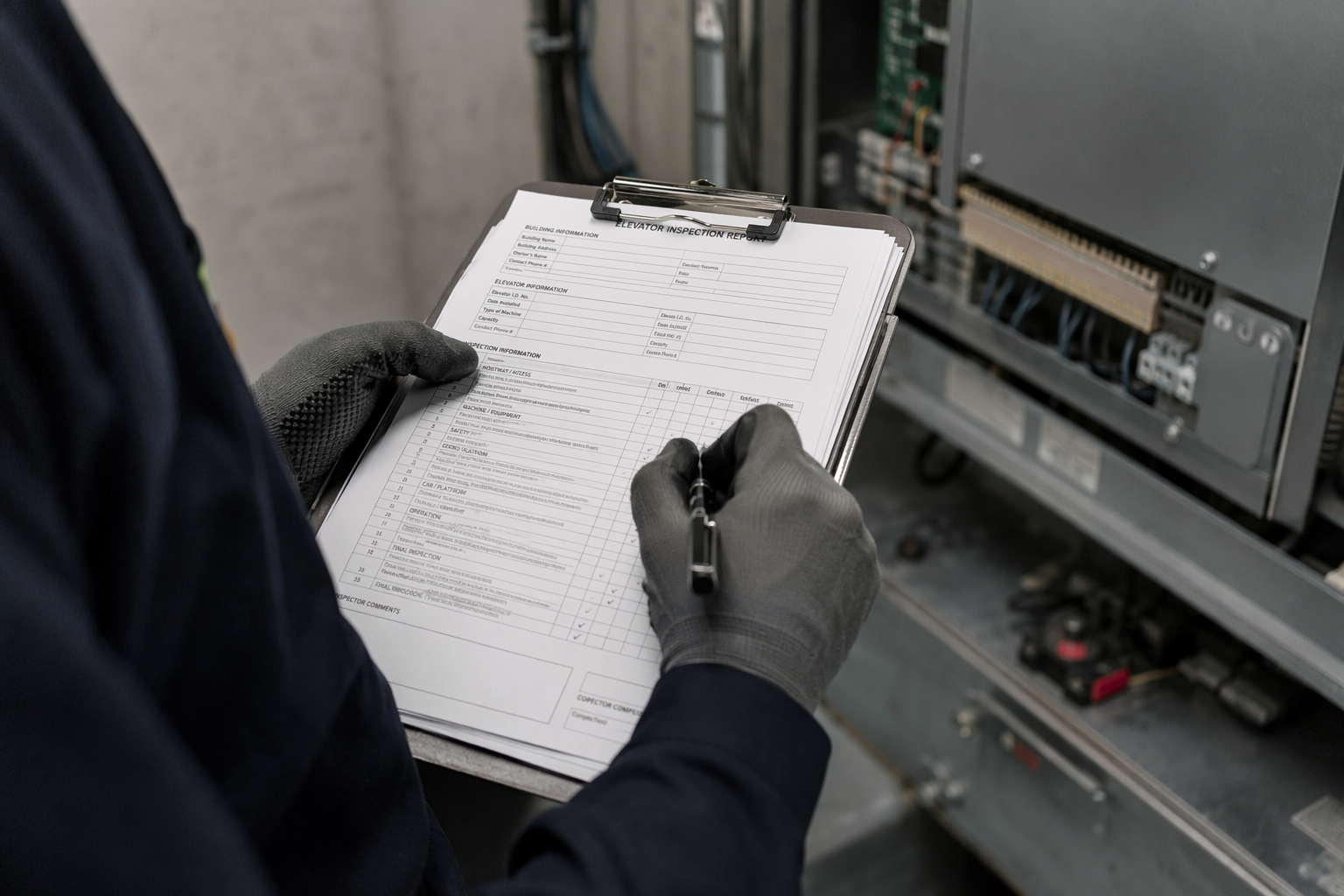
| Inspection Report / Test Report | Licensed elevator inspector or third-party agency | Documents inspection findings, deficiencies, and required corrections | No — retained in building records | Tied to each inspection event |
| Maintenance Log / Service Record | Elevator service company | Tracks all maintenance, repairs, and parts replacements | No — on-site retention required | Updated after every service visit |
| ADA Accessibility Compliance Documentation | Building owner / accessibility consultant | Confirms elevator meets ADA Standards for Accessible Design | No — retained for legal defense | Updated upon modification or renovation |
| New Installation / Alteration Permit | Local building department | Permits new elevator installation or major modification work | Posted at job site during work | Project-based; leads to initial certificate |
Who Can Perform the Inspection Required to Obtain the Certificate?
The inspection must be conducted by a qualified elevator inspector as defined by the authority having jurisdiction. Many jurisdictions require inspectors to hold a Qualified Elevator Inspector (QEI) certification issued under ASME QEI-1 Standard for the Qualification of Elevator Inspectors. Inspections may be performed by:
- State or local government inspectors — employed directly by the AHJ; some jurisdictions handle all inspections in-house.
- Third-party inspection agencies — private firms authorized by the AHJ to conduct and certify inspections on the jurisdiction’s behalf.
- Insurance carrier inspectors — some states allow or require inspection through the building’s insurance provider.
Importantly, the elevator maintenance company typically does not issue the certificate itself — they prepare the elevator to pass inspection. Liftech Elevator provides pre-inspection maintenance, deficiency correction, and compliance support so that the inspection proceeds without fail-items that would delay certificate issuance.
Compliance Pathway Comparison: In-House vs. Independent Service Provider
| Factor | Managing Compliance In-House | OEM / Manufacturer Service | Independent Provider (e.g., Liftech Elevator) |
|---|---|---|---|
| Code Knowledge | Depends on staff expertise; risk of gaps | Strong for own equipment; limited cross-brand knowledge | Broad multi-brand expertise; up to date on current ASME and local amendments |
| Inspection Preparation | No structured pre-inspection process | Available but typically premium-priced | Pre-inspection walkthrough and deficiency remediation |
| Documentation Management | Manual tracking; prone to lapses | Proprietary portal; limited owner access | Transparent record-keeping accessible to building owner |
| Deficiency Repair Turnaround | Dependent on contractor availability | Can be slow due to proprietary parts lead times | Multi-brand parts sourcing; faster resolution |
| Contract Flexibility | N/A | Long-term contracts common; exit fees apply | Flexible agreement terms |
| ADA / Accessibility Guidance | Owner must source separately | Limited to equipment scope | Holistic assessment including ADA considerations |
| Best For | Large in-house facilities teams with elevator expertise | Buildings under original manufacturer warranty | Most commercial, residential, and institutional buildings |
What Is the Step-by-Step Process to Obtain an Elevator Certificate of Compliance?
- Confirm your jurisdiction’s requirements. Contact your state or local elevator authority to identify the applicable code edition, inspection frequency, and approved inspection providers in your area.
- Schedule preventive maintenance. Arrange a maintenance visit with a qualified elevator service company — such as Liftech Elevator — to ensure all mechanical, electrical, and safety components are functioning per code before the official inspection.
- Address outstanding deficiencies. Review any open items from the previous inspection report or maintenance log. Repair or replace components that may cause a fail finding.
- Gather required documentation. Assemble the elevator’s maintenance log, previous inspection reports, equipment specifications, and any permits for past alterations.
- Engage an authorized inspector. Contact your AHJ or an approved third-party inspection agency to schedule the formal inspection. Provide all required documentation in advance.
- Be present during the inspection. Have a building representative or service technician available to accompany the inspector and answer questions about recent work.
- Receive the inspection report. The inspector will issue a written report noting pass/fail status and any deficiencies requiring correction within a specified timeframe.
- Correct any cited deficiencies. If deficiencies are noted, engage your service provider promptly. Re-inspection may be required before the certificate is issued.
- Obtain and post the certificate. Once the elevator passes, the AHJ or inspection agency issues the certificate. Post it immediately inside the elevator cab or as required by local regulation.
- Set your renewal reminder. Mark the certificate expiration date and schedule your next maintenance and inspection cycle well in advance to avoid lapses.
What Are the Pros and Cons of Different Compliance Strategies?
| Strategy | Pros | Cons |
|---|---|---|
| Reactive (fix only when cited) | Lower upfront spend | Risk of shutdown orders; emergency repair costs; certificate delays; liability exposure |
| Annual maintenance contract | Predictable scheduling; consistent technician familiarity with equipment | Contract lock-in; quality varies by provider |
| Full-service compliance program with independent provider | Pre-inspection prep included; documentation managed; multi-brand expertise; faster deficiency resolution | Requires selecting a qualified independent provider; ongoing relationship management |
| OEM manufacturer service plan | Deep knowledge of proprietary systems; factory-trained technicians | Higher cost; proprietary parts delays; less flexibility; not suitable for multi-brand portfolios |
What Happens If an Elevator Operates Without a Valid Certificate?
Operating an elevator without a current, valid certificate of compliance exposes building owners to serious consequences, which vary by jurisdiction but commonly include:
- Mandatory shutdown orders — the AHJ has authority to lock or seal the elevator out of service until a valid certificate is obtained.
- Fines and penalties — jurisdictions impose per-day fines for operating without a valid certificate or for failing to correct cited deficiencies within the required timeframe.
- Increased liability — if an injury occurs while the certificate is lapsed, building owners face significantly heightened legal exposure, as the absence of a valid certificate demonstrates a failure to meet the standard of care.
- Insurance complications — some property and liability insurers may deny claims or increase premiums upon discovering a lapsed compliance certificate.
- Occupancy impact — in some jurisdictions, a lapsed elevator certificate can trigger broader building code enforcement actions.
OSHA also maintains jurisdiction over elevator safety in general industry and construction workplaces, adding another layer of regulatory exposure in commercial and industrial settings.
How Does ADA Compliance Relate to the Certificate of Compliance?
The elevator certificate of compliance confirms safety code adherence — it does not certify ADA compliance. However, the two are closely linked during elevator alterations. Under the ADA Standards for Accessible Design, when an elevator undergoes a qualifying alteration, accessibility requirements are triggered for the altered elements and, in some circumstances, for the path of travel to the elevator.
Building owners undergoing modernization projects should consult with a knowledgeable service provider — such as Liftech Elevator — to ensure that alteration work is scoped in a way that satisfies both the safety code inspection requirements leading to certificate issuance and the applicable ADA accessibility standards simultaneously, avoiding costly after-the-fact corrections.
What Is the Typical Timeline to Obtain or Renew a Certificate?
Timeline varies by jurisdiction, elevator condition, and inspector availability. A general framework:
| Scenario | Typical Timeline | Key Variables |
|---|---|---|
| Routine annual renewal — no deficiencies | Days to a few weeks after inspection | AHJ processing time; inspector backlog |
| Routine renewal with minor deficiencies | Several weeks to 1–2 months | Parts availability; re-inspection scheduling |
| Post-modernization or alteration | 1–3 months after project completion | Permit closeout; acceptance test scheduling |
| Lapsed certificate — major deficiencies | Highly variable; elevator may be out of service | Scope of repairs; parts lead times; re-inspection queue |
| New installation — initial certificate | Tied to permit and construction schedule | Acceptance test; AHJ final sign-off |
What Factors Affect the Cost of Obtaining or Maintaining a Certificate?
Because inspection fees, permit costs, and labor rates vary widely by state and municipality — and because Liftech Elevator does not publish pricing in this guide — cost figures are omitted here to avoid inaccuracy. However, the primary cost drivers are:
- Jurisdiction fees — some AHJs charge flat permit/inspection fees; others assess fees based on elevator type, age, or number of floors.
- Scope of deficiencies — elevators with extensive deferred maintenance require more repair work before passing inspection, increasing pre-certification costs.
- Modernization triggers — some jurisdictions require upgrades to current code upon reaching certain age or alteration thresholds per ASME A17.3 Safety Code for Existing Elevators and Escalators, which can significantly expand project scope.
- Re-inspection fees — failed inspections typically incur additional inspection fees for the follow-up visit.
- Maintenance contract terms — a comprehensive maintenance agreement typically includes pre-inspection preparation, which can reduce unexpected costs near renewal time.
- Portfolio size — buildings with multiple elevator units may negotiate volume-based service arrangements.
Liftech Elevator recommends requesting a detailed scope-of-work and fee estimate before committing to any compliance-related service engagement.
How Often Must an Elevator Be Inspected to Maintain Compliance?
Inspection frequency is set by the authority having jurisdiction, which typically adopts or adapts the ASME A17.1 Safety Code for Elevators and Escalators inspection and test intervals. Requirements generally include:
- Periodic inspections — most commonly annual, though some jurisdictions require semi-annual inspections for high-use elevators.
- Periodic tests — full-load, safety device, and hydraulic tests are typically required on a defined multi-year cycle as specified by the applicable code edition.
- Acceptance inspections — required after new installation or major alteration before the elevator is placed into service.
- Category tests — ASME A17.1 defines Category 1 and Category 5 tests for various safety devices, each with its own interval schedule.
Building owners should verify their specific jurisdiction’s adopted code edition and any local amendments, as these directly determine compliance obligations in 2026 and beyond.
What Should Building Owners Look for When Selecting an Elevator Service Company for Compliance Support?
Selecting the right service partner directly affects whether certificates are obtained on time and without costly re-inspections. Key evaluation criteria include:
- Technician licensing and inspector familiarity — confirm that technicians are licensed per state requirements and experienced with the inspection process in your specific jurisdiction.
- Multi-brand capability — buildings with mixed elevator makes and models benefit from a provider capable of servicing all units under one agreement.
- Pre-inspection preparation process — ask whether the provider conducts a formal pre-inspection walkthrough and provides a deficiency report before the official inspection date.
- Documentation transparency — the building owner should have full access to all maintenance logs and inspection records, not just a summary.
- Responsiveness on deficiencies — delays in correcting deficiencies directly delay certificate issuance and may trigger ongoing fines; evaluate the provider’s typical parts sourcing and repair turnaround.
- Code currency — the service company should be current on the 2025/2026 ASME code editions and aware of local amendments specific to your jurisdiction.
Liftech Elevator is an independent certified elevator service provider offering compliance support, pre-inspection preparation, deficiency remediation, and documentation management for commercial, residential, and institutional elevator owners.
Can a Lapsed Certificate Be Reinstated Without Full Modernization?
In many cases, yes — if the elevator’s deficiencies are limited to maintenance items or component replacements that do not constitute a major alteration under the applicable code. However, if the AHJ has classified the elevator as requiring upgrade under ASME A17.3 Safety Code for Existing Elevators and Escalators, or if the building has undergone a qualifying change of occupancy, broader modernization may be required before the certificate can be reinstated.
A qualified elevator service company should assess the elevator’s current condition against both the maintenance deficiency list and any applicable retroactive code requirements before advising the building owner on the reinstatement path and associated scope of work.
Summary: Key Decision Factors at a Glance
| Decision Factor | What to Do |
|---|---|
| Certificate is current and no deficiencies | Schedule next annual maintenance cycle and set renewal reminder |
| Upcoming inspection with known maintenance gaps | Engage Liftech Elevator for pre-inspection preparation and deficiency correction |
| Certificate lapsed or near expiration | Contact service provider immediately; do not wait for AHJ enforcement action |
| Planning a modernization or alteration | Coordinate scope to satisfy both safety code and ADA requirements simultaneously |
| Managing multiple elevators across a portfolio | Consolidate under an independent provider with multi-brand capability and centralized documentation |
| Unsure of jurisdiction requirements | Consult with a service provider familiar with your local AHJ and current ASME code adoption |
Ready to Ensure Your Elevator Is Fully Compliant?
Don’t wait for a shutdown order or an expired certificate to disrupt your building operations. Liftech Elevator provides a free elevator assessment to help building owners understand their current compliance status, outstanding deficiencies, and the steps needed to obtain or renew their elevator certificate of compliance.
Contact Liftech Elevator for a free elevator assessment: 562-609-3478
Need elevator service you can rely on? Liftech Elevator is ready to help.