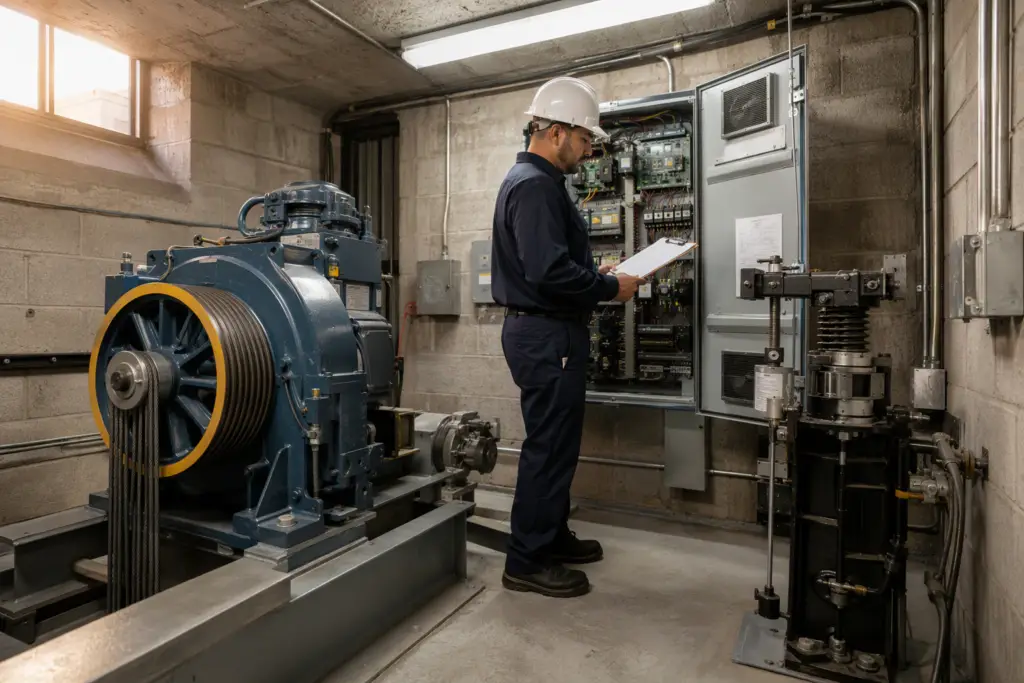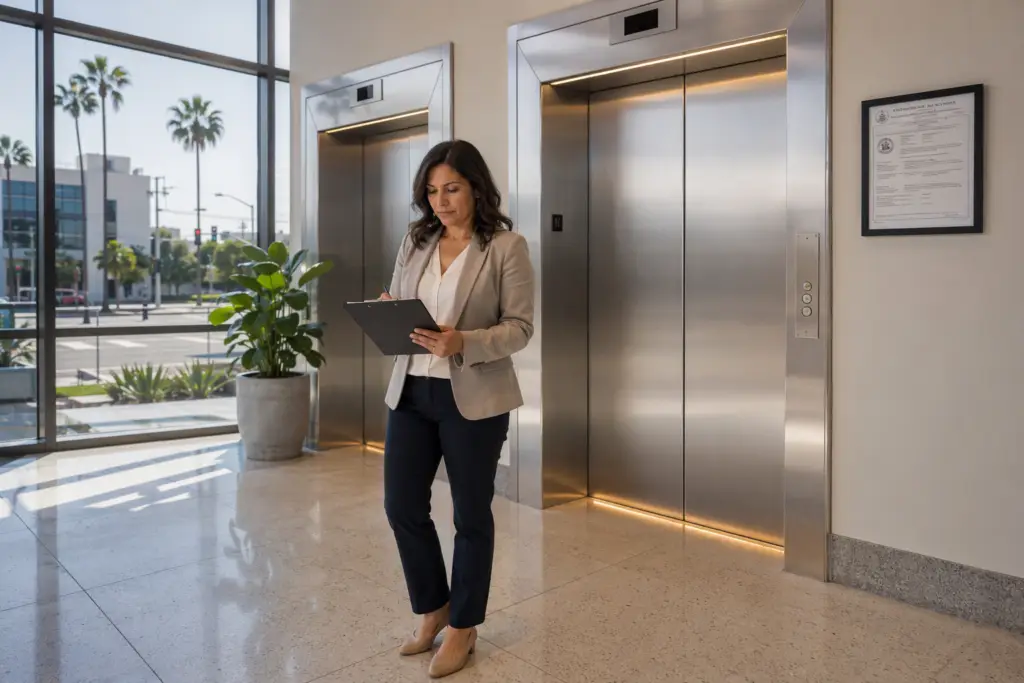
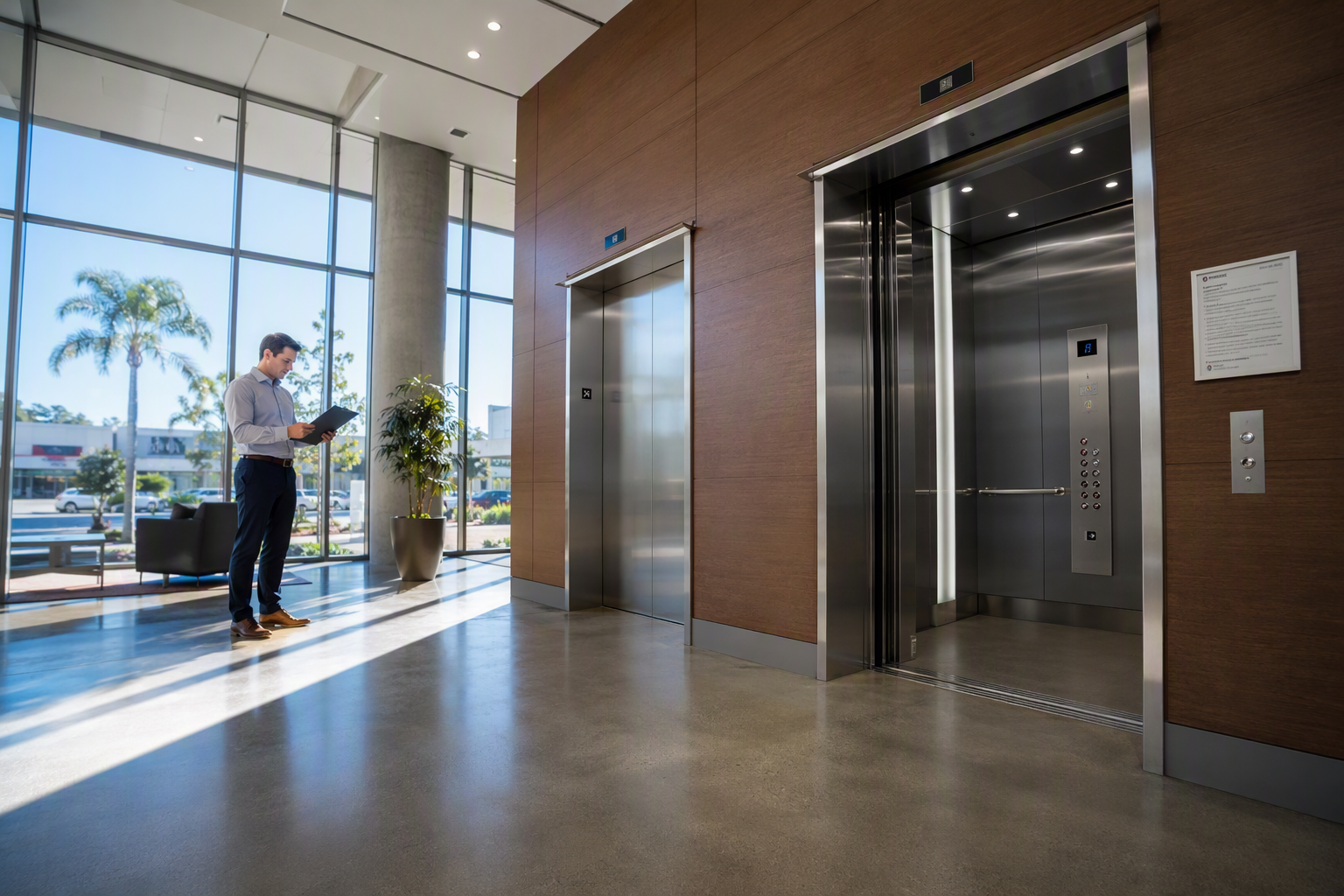
Office buildings and schools subject to ADA and California accessibility law must comply with overlapping federal and state elevator standards. The key decision factors are: whether the building triggers new construction or alteration rules, whether a path-of-travel obligation applies, the elevator’s current compliance status against both federal ADA Standards for Accessible Design and California’s Title 24 accessibility provisions, and the enforcement consequences of non-compliance. Facility directors who understand both frameworks avoid costly retrofits and legal exposure.
What Federal ADA Requirements Apply to Elevators in Office Buildings and Schools?
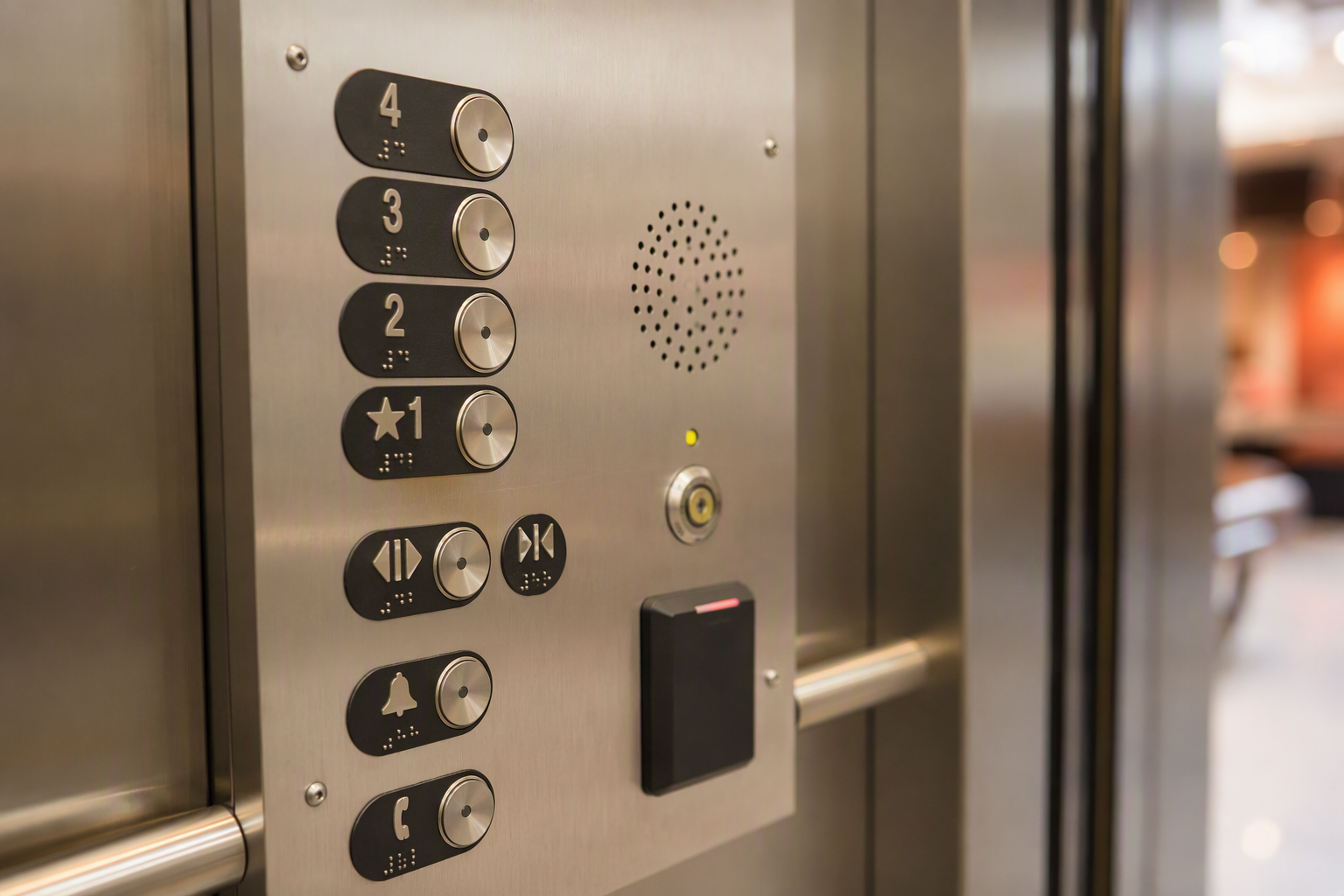
The Americans with Disabilities Act (ADA) requires that elevators in multi-story facilities be accessible when a building has more than two stories or has more than a specified floor area per story — unless a small-building or shopping-center exemption applies. The ADA Standards for Accessible Design (ADASAD), adopted by the Department of Justice, set the baseline for:
- Cab interior dimensions: Minimum clear floor space requirements to accommodate wheelchair users and mobility devices.
- Door clear width: A minimum clear opening width to ensure passage for mobility aids.
- Control panel height: Operable controls must be reachable from a seated position, within reach-range limits defined in the ADASAD.
- Raised and Braille characters: Floor designations and control labels must include tactile and Braille markings.
- Door timing: Doors must remain open long enough for a person using a mobility aid to enter and exit without injury.
- Floor leveling (landing accuracy): The cab must level within a tolerance that prevents tripping or rolling hazards at the threshold.
- Two-way communication: Emergency communication systems inside the cab must be accessible to people who are deaf or hard of hearing, typically requiring visual indicators alongside audible signals.
Public schools operated by state or local government are also covered by Title II of the ADA, which applies to government entities regardless of building size. Private schools that operate as places of public accommodation fall under Title III. Both titles require program accessibility, meaning barrier removal or an accessible alternative must exist.
How Does California’s Title 24 Differ From the Federal ADA Standard?
California enforces accessibility through the California Building Code (CBC), Part 2, which incorporates and frequently exceeds the federal ADASAD. Under California law, the Division of the State Architect (DSA) has authority over publicly funded K–12 schools, community colleges, and state buildings. Key areas where California requirements are more stringent include:
- Cab dimensions: California’s CBC may require larger minimum interior dimensions than the federal standard, particularly for passenger elevators installed in new construction.
- Two-way communication: California specifies visual and tactile requirements for emergency communication panels that align with but may extend beyond federal minimums.
- Door reopening devices: California requires sensitive edge devices that detect obstructions and reopen doors without requiring contact force that could injure a user.
- Signage and way-finding: CBC accessibility provisions include floor designation signage placement rules that may be more specific than federal guidance.
- Path of travel: California’s trigger for path-of-travel upgrades when a primary function area is altered can result in broader remediation obligations than federal law alone.
When California and federal requirements conflict, the more restrictive standard governs. Facility directors must always check both frameworks simultaneously rather than treating federal compliance as sufficient.
Comparison Table: ADA vs. California CBC Elevator Accessibility Requirements
| Requirement Area | Federal ADA (ADASAD) | California CBC / Title 24 | Which Controls in CA? |
|---|---|---|---|
| Applicability trigger (offices) | Buildings >2 stories or above floor-area threshold | Applies broadly; DSA oversight for public buildings | CBC (more inclusive) |
| Applicability trigger (schools) | Title II (public) / Title III (private) | DSA mandatory for publicly funded K–12 and community colleges | CBC / DSA |
| Minimum cab clear floor area | Defined in ADASAD Section 407 | CBC may require larger dimensions for new construction | CBC (where more stringent) |
| Door clear width | Minimum clear opening per ADASAD | Matches or exceeds federal minimum | CBC (where more stringent) |
| Control reach range | Forward and side reach limits per ADASAD | Consistent with federal; CBC adds mounting-height specifics | CBC |
| Braille / tactile controls | Required per ADASAD | Required; CBC may specify additional placement rules | CBC |
| Door reopening device | Required; must not require contact | Sensitive edge required; explicit force limits | CBC |
| Two-way emergency communication | Visual + audible required | Visual + audible + tactile elements specified | CBC |
| Leveling tolerance | Defined in ADASAD (threshold tolerance) | CBC references ASME A17.1 leveling standards | CBC / ASME |
| Path-of-travel obligation on alteration | Triggered when primary function area altered | Triggered; may require broader scope of remediation | CBC (broader) |
| Enforcement body | DOJ / private right of action | DSA (schools/state), local building departments (offices) | Both |
What Are the ASME Safety Code Requirements That Overlap With Accessibility?
Elevator safety and accessibility intersect at the technical level through the ASME A17.1 Safety Code for Elevators and Escalators. California adopts ASME A17.1 as the baseline safety standard, enforced by the California Department of Industrial Relations, Division of Occupational Safety and Health (Cal/OSHA). Accessibility-relevant provisions in ASME A17.1 include:
- Leveling accuracy requirements that directly affect wheelchair accessibility at thresholds.
- Door operation force limits that align with ADA’s requirement that doors not injure users.
- Emergency lighting and communication system requirements.
- Inspection intervals — California requires periodic inspections by a licensed QEI (Qualified Elevator Inspector), and a non-compliant elevator will fail inspection, creating both a safety and accessibility enforcement event simultaneously.
Facility directors should understand that an elevator failing its annual safety inspection under ASME A17.1 / Cal/OSHA may also be failing its ADA and CBC accessibility obligations, since the issues often overlap.
Do the ADA Elevator Requirements Apply to Existing Buildings or Only New Construction?
Both new construction and alterations trigger full compliance with current standards. For existing buildings that have not been altered, the ADA requires “barrier removal” to the extent readily achievable — meaning technically feasible without much difficulty or expense. California’s CBC applies a stricter alteration trigger: when work is done on a primary function area, path-of-travel upgrades (which can include elevator accessibility) are required up to a percentage of the overall project cost.
Practically, this means:
- A school adding a new wing must make the entire path of travel to that wing accessible, which typically includes elevator compliance.
- An office building undergoing tenant improvements may trigger elevator accessibility upgrades if the elevator serves the altered primary function area.
- Elevators in buildings constructed before ADA took effect are not automatically grandfathered — barrier removal obligations apply on an ongoing basis.
What Is the Step-by-Step Process for Bringing an Elevator Into ADA and CBC Compliance?
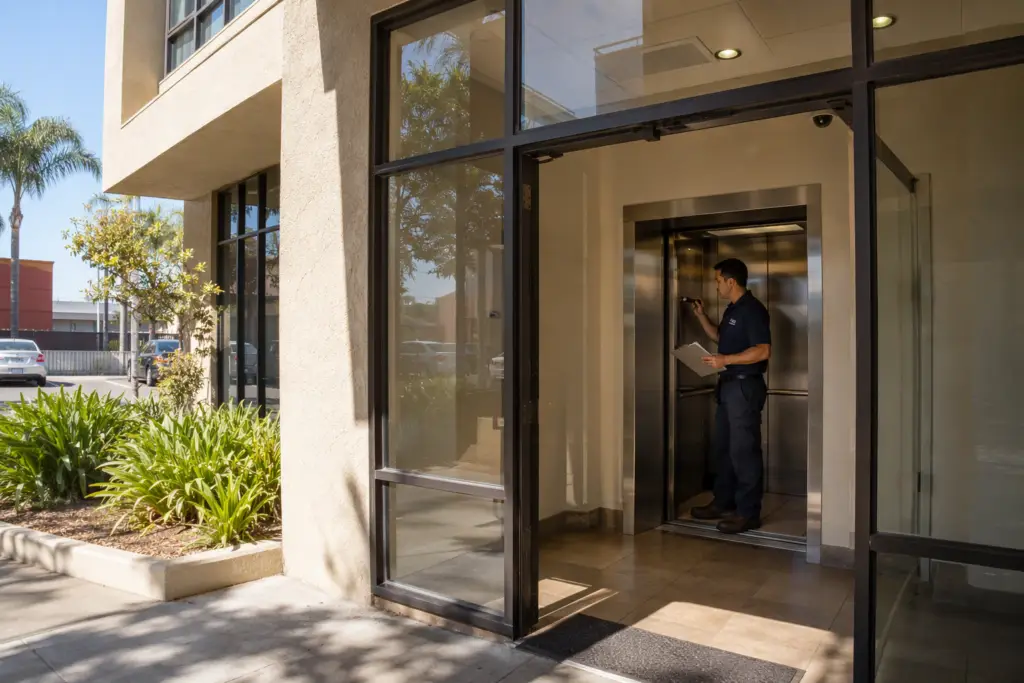
- Conduct a baseline accessibility audit. Have a qualified accessibility consultant or certified elevator technician evaluate the existing elevator against both ADASAD and current CBC requirements. Document all deficiencies in writing.
- Review ASME A17.1 inspection records. Obtain the most recent Cal/OSHA inspection certificate. Identify any open violations that overlap with accessibility deficiencies.
- Determine the applicable code edition. Confirm which edition of the CBC and ADASAD is enforced by your local jurisdiction as of 2026, since code adoption cycles vary by municipality.
- Classify the scope of work. Distinguish between barrier removal (existing buildings, no current alteration), alteration-triggered compliance, and new construction compliance — each carries different standards and timelines.
- Obtain required permits. Elevator accessibility modifications in California require building and elevator permits. For DSA-regulated schools, DSA plan approval is mandatory before work begins.
- Engage a licensed elevator contractor. Only contractors licensed by the California Contractors State License Board (CSLB) in the appropriate classification may perform elevator work in California.
- Schedule modernization or retrofit work. Work with your contractor to sequence the work to minimize building disruption, particularly in schools where student scheduling creates access constraints.
- Schedule final inspection and certification. After work is complete, Cal/OSHA and the local building department must inspect and approve the elevator before it returns to service.
- Document and retain records. Maintain all permits, inspection certificates, and compliance documentation. These records are critical in the event of an ADA complaint or DOJ investigation.
Pros and Cons Comparison: Phased Compliance vs. Full Modernization
| Approach | Pros | Cons | Best Suited For |
|---|---|---|---|
| Targeted Barrier Removal (address specific deficiencies only) | Lower immediate cost; faster to implement; can be prioritized by severity | May require repeated visits; does not address underlying equipment age; may not satisfy CBC alteration triggers | Existing buildings with no current alteration project; budget-constrained facilities |
| Full Cab and Control Modernization | Addresses all ADA and CBC deficiencies in one project; improves reliability; resets maintenance cycle; satisfies alteration-triggered compliance | Higher upfront cost; longer out-of-service period; requires DSA approval for schools | Buildings undergoing renovation; older equipment with multiple deficiencies; schools with DSA oversight |
| New Elevator Installation | Full compliance with current code from day one; longest service life; maximum reliability | Highest cost; longest project timeline; significant structural and permitting requirements | New construction; buildings adding vertical access where none existed |
What Are the Consequences of Non-Compliance With ADA Elevator Requirements?
Non-compliance exposes facility owners and operators to several categories of risk:
- Federal enforcement: The Department of Justice can investigate complaints filed under the ADA and may require remediation, civil penalties, and monitoring agreements.
- Private litigation: Individuals with disabilities have a private right of action under the ADA and under California’s Unruh Civil Rights Act, which provides for statutory damages per violation — making California litigation exposure particularly significant.
- Cal/OSHA shutdown: An elevator that fails its periodic safety inspection under OSHA-equivalent California standards can be ordered out of service, creating an immediate accessibility barrier and operational disruption.
- DSA enforcement (schools): For publicly funded schools, DSA can issue stop-work orders and withhold project approvals until compliance is achieved.
- Reputational and operational impact: An inaccessible elevator in a school or office building can trigger complaints from students, parents, employees, and visitors — with impacts that extend beyond legal liability.
Are There Exemptions to ADA Elevator Requirements for Small Office Buildings or Schools?
The ADA includes a limited exemption for facilities that have fewer than three stories or fewer than a specified square footage per story, provided the building is not a shopping center, shopping mall, professional office of a healthcare provider, or a transit facility. However, this exemption does not apply to Title II entities — meaning public schools and government offices must provide elevator access regardless of building size if an elevator is the only means of achieving program accessibility across floors.
Private schools and private-sector offices in small buildings may qualify for the structural exemption, but only if they can demonstrate that an accessible route using a ramp or other means is genuinely provided to all programs and services offered on upper floors. Relying on this exemption without a qualified accessibility review is risky, as conditions that appear to qualify can fail legal scrutiny.
How Does the Path-of-Travel Requirement Affect School Renovation Projects?
When a California school undertakes alterations to a “primary function area” — any space that is part of the core educational mission, including classrooms, libraries, laboratories, gymnasiums, and administrative offices — the CBC requires that the path of travel to that area be made accessible. The path of travel includes the route from the exterior entrance to the altered area, which typically passes through lobbies, corridors, and vertical access points such as elevators.
Path-of-travel expenditure is not unlimited: California allows the path-of-travel obligation to be capped at a percentage of the primary alteration cost, as specified in the CBC. However, the cap must be calculated correctly, and the priority of remediation items is defined — elevators serving an inaccessible floor are typically among the highest-priority items to address before less critical path-of-travel elements.
School facility directors planning any renovation project should conduct an accessibility pre-design review to understand the full path-of-travel scope before finalizing project budgets.
What Elevator Features Are Required for Accessibility in Multi-Story Office Buildings?
Beyond the structural cab and door requirements, ADA-compliant elevators in office buildings must include:
- Audible floor announcements: An automatic voice announcing each floor designation as the cab passes or stops.
- Visual floor indicators: A visible indicator showing the current floor, accessible to users who are deaf or hard of hearing.
- Hall call buttons: Accessible call buttons on each landing, mounted within reach ranges and operable with a closed fist.
- Handrails: Graspable handrails on the rear and side walls of the cab where required by applicable standards.
- Illumination levels: Adequate lighting inside the cab to allow users with low vision to read controls and floor indicators.
- Emergency phone accessibility: The two-way communication device must be usable without voice, with a visual signal confirming that help has been summoned.
How Should Facility Directors Choose an Elevator Service Provider for Compliance Work?
Compliance-related elevator work requires a service provider who understands both the technical safety requirements under ASME A17.1 and the accessibility requirements under the ADA and California CBC. Key selection criteria include:
- CSLB licensure in the appropriate elevator contractor classification.
- Demonstrated experience with DSA-regulated school projects, including plan review and inspection coordination.
- Familiarity with both new construction and alteration/modernization compliance pathways.
- Ability to provide documented compliance assessments, not just maintenance services.
- Independence from elevator manufacturers — an independent service provider can recommend solutions across equipment brands rather than steering toward a single product line.
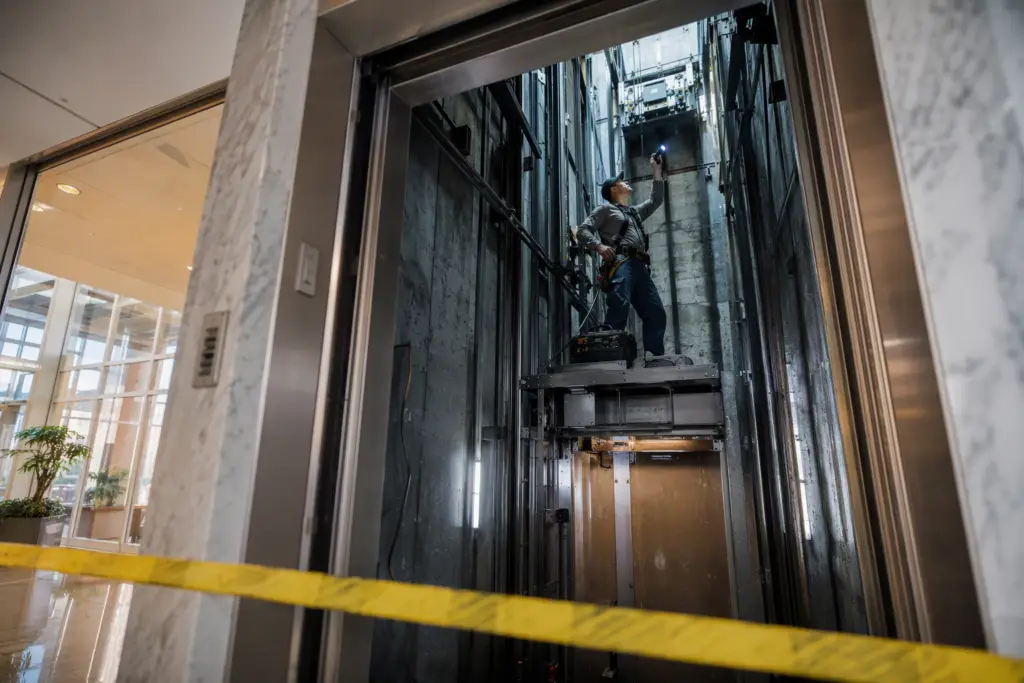
Liftech Elevator is an independent certified elevator service company serving office buildings, schools, and other facilities throughout California. As an independent provider, Liftech Elevator works across elevator brands and systems, offering facility directors unbiased assessments of what is required for ADA and CBC compliance — without the conflict of interest that can arise with manufacturer-affiliated service companies. Liftech Elevator’s team works with both privately owned office buildings and DSA-regulated school facilities to evaluate compliance gaps, develop remediation plans, and coordinate the permitting and inspection processes required under California law.
Compliance Timeline Comparison: Typical Project Phases
| Project Type | Assessment Phase | Design & Permitting Phase | Construction Phase | Inspection & Closeout |
|---|---|---|---|---|
| Barrier Removal (targeted fixes, existing building) | Weeks 1–3 | Weeks 3–6 (building permit) | Days to weeks depending on scope | Days (Cal/OSHA inspection) |
| Cab Modernization (office building alteration) | Weeks 1–4 | Weeks 4–10 (building permit + design) | Weeks 2–6 | Weeks 1–2 (inspection + certification) |
| School Elevator Modernization (DSA-regulated) | Weeks 1–4 | Months 2–5 (DSA plan review) | Weeks 4–12 | Months 1–2 (DSA closeout + Cal/OSHA) |
| New Elevator Installation (new construction) | Pre-design | Months 2–6 (building / DSA) | Months 3–9 | Months 1–3 (full inspection program) |
Note: Timelines are illustrative ranges based on project type complexity and typical California permitting processes. Actual durations depend on jurisdiction, project scope, and regulatory workload.
What Should Facility Directors Do Right Now If They Suspect Non-Compliance?
- Do not wait for a complaint or lawsuit to act — self-initiated compliance is treated more favorably under both ADA and California law than remediation ordered after a complaint.
- Locate the most recent Cal/OSHA elevator inspection certificate for each elevator in the building and review it for any open violations or conditions noted.
- Request a formal accessibility assessment from a qualified elevator service provider who can evaluate the elevator against current ADASAD and CBC standards.
- Consult with a California-licensed accessibility consultant or attorney if there is any uncertainty about path-of-travel obligations triggered by a pending renovation project.
- Contact Liftech Elevator to schedule a free elevator assessment and receive a written summary of compliance gaps and recommended remediation priorities.
Contact Liftech Elevator for a Free Elevator Assessment
Liftech Elevator provides independent, unbiased elevator accessibility assessments for office buildings and schools throughout California. Whether you are preparing for a renovation project, responding to an ADA complaint, or simply unsure of your current compliance status, the Liftech Elevator team can help you understand exactly what is required under both federal ADA standards and California CBC requirements.
Call Liftech Elevator today: 562-997-3639
Do not let compliance uncertainty become a legal or operational liability. A free assessment is the first step toward a compliant, safe, and fully accessible building for every occupant.
Need elevator service you can rely on? Liftech Elevator is ready to help.