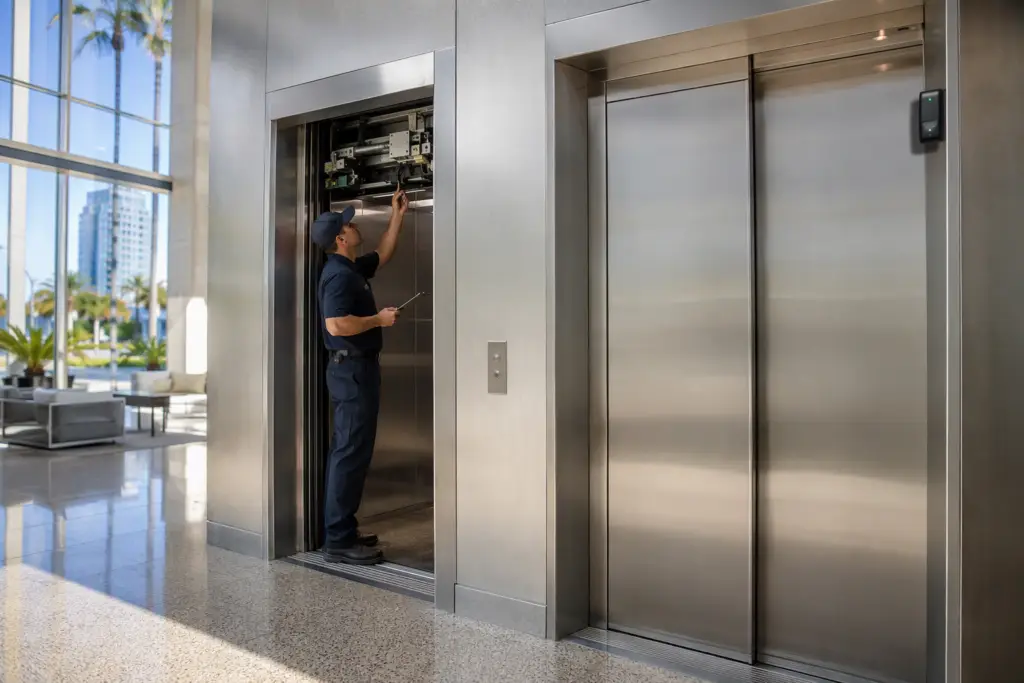
An elevator maintenance contract is a legally binding service agreement between a building owner and a licensed elevator company that defines inspection schedules, covered repairs, parts, emergency response, and compliance obligations — in California, a full maintenance contract with a Cal/OSHA-certified Certified Qualified Conveyance Company (CQCC) can extend a permit to operate from one year to two years and is the foundation of safe, code-compliant elevator ownership.

Elevator Maintenance Contracts in California: Complete FAQ Guide for Building Owners
Elevator maintenance contracts govern every scheduled visit, emergency call, parts replacement, and compliance task that keeps a conveyance safe and legally permitted to operate. For property owners in Signal Hill, Long Beach, Los Angeles, and Orange County, understanding exactly what a service agreement should contain — and what California law requires — is essential before signing anything. This guide answers the twenty most common questions building owners, facility managers, and property managers ask about elevator service agreements in California.
What Is an Elevator Maintenance Contract and Why Does California Law Make It Important?
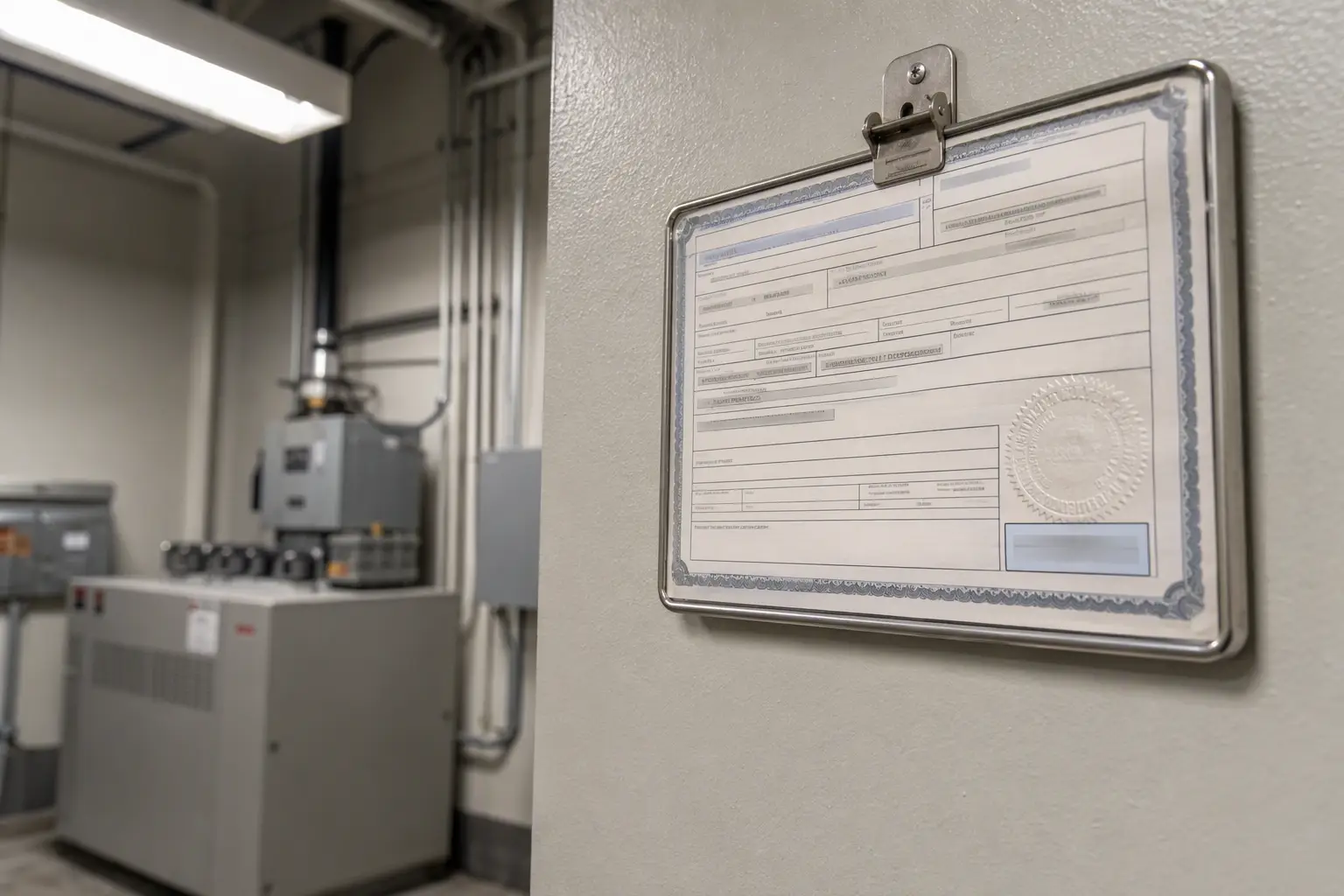
An elevator maintenance contract is a written agreement obligating a licensed elevator company to perform defined service tasks on a building’s conveyances in exchange for a recurring fee.
Under California Labor Code Sections 7300–7324.2 and the California Code of Regulations, Title 8, Elevator Safety Orders (Sections 3000–3146), every elevator operating in California must hold a valid permit to operate issued by Cal/OSHA. That permit is renewable annually following a satisfactory inspection. However, when a building owner enters a full maintenance contract with a company holding a Certified Qualified Conveyance Company (CQCC) certificate, Cal/OSHA may extend the permit to operate for up to two years rather than one — a direct regulatory incentive that makes the type and structure of the maintenance agreement financially and operationally significant.
Beyond the permit benefit, a well-structured contract defines who is responsible for scheduling the annual reinspection (under California law, that responsibility belongs to the elevator owner), which components are covered at no additional charge, and what documentation is provided after every service visit.
What Are the Different Types of Elevator Maintenance Contracts?
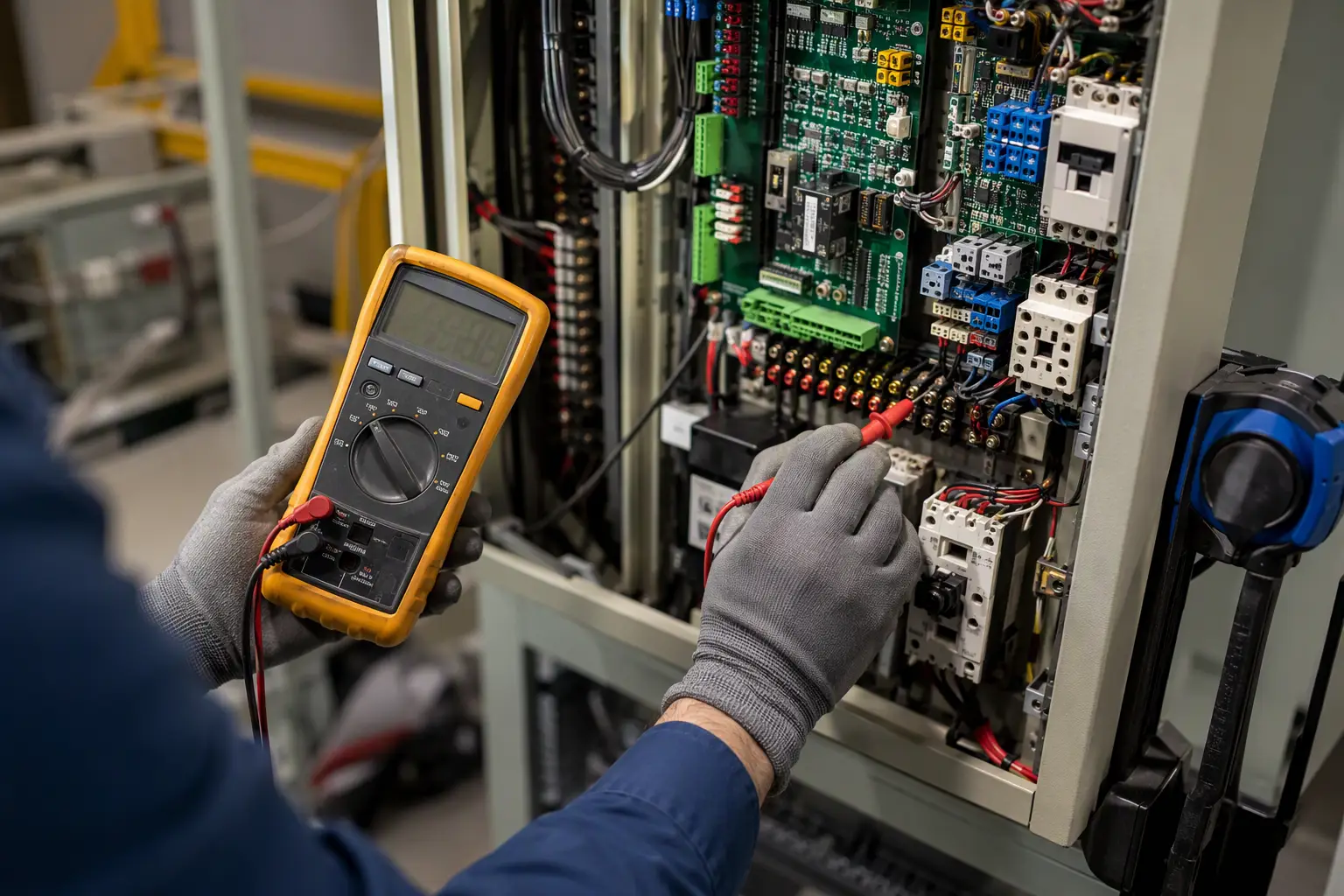
Elevator service agreements generally fall into four tiers, each offering a different scope of coverage and risk allocation between owner and contractor.
The four most common structures are:
- Oil and Grease (Lubrication-Only): The contractor visits on a scheduled basis to lubricate components, conduct a visual inspection, and make minor adjustments. Parts, repairs, and callbacks are billed separately. This is the lowest-cost option but places the most financial risk on the building owner.
- Examination and Adjustment: Covers lubrication, examination, cleaning, and minor adjustments. Major parts and repairs remain outside the contract scope.
- Comprehensive (Parts and Labor): Covers all routine maintenance plus parts and labor for most repairs, excluding items such as vandalism damage, cab interior work, or major modernizations. This tier is most likely to qualify a building for Cal/OSHA’s two-year permit extension.
- Full Maintenance: The broadest coverage, often including all parts, labor, callbacks, and some modernization components. This is the tier referenced in California’s regulatory provision allowing the two-year permit to operate when the contract is held with a CQCC-certified company.
Liftech Elevator offers service agreement structures across these tiers for properties throughout Long Beach, Signal Hill, Los Angeles, and Orange County, allowing building owners to match coverage level to building age, usage, and budget.
What Should Every Elevator Service Agreement Include in California?
A compliant, protective elevator service agreement must contain specific contractual and regulatory elements to be enforceable and to satisfy California’s oversight requirements.
At minimum, a California elevator maintenance contract should include:
- Contractor credentials: The company’s CQCC certificate number issued by Cal/OSHA and its C-11 Elevator Contractor license number from the California Contractors State License Board (CSLB).
- Scope of work: An explicit, itemized list of tasks performed at each visit — lubrication points, adjustment tasks, safety device tests, cleaning.
- Covered components: Clear identification of which parts are included versus excluded.
- Service frequency: The number of scheduled maintenance visits per year and approximate intervals.
- Inspection coordination: A written commitment describing how the contractor will support the owner in scheduling the required Cal/OSHA annual reinspection (noting that the legal responsibility remains with the owner).
- Callback provisions: Whether emergency and non-emergency callbacks are included or billed separately, and any limitations on callback coverage.
- Record-keeping: A provision requiring the contractor to maintain a service logbook in or near the machine room and to provide written reports after each visit.
- Code compliance basis: A reference to the applicable adopted standard — for California, the ASME A17.1/CSA B44 2004 edition under the Group IV Elevator Safety Orders — and a commitment to perform work in conformance with the ASME A17.1 Safety Code for Elevators and Escalators.
- ADA obligations: Acknowledgment of any ADA compliance items that fall within the maintenance scope.
- Term and termination: Contract duration, renewal terms, and conditions under which either party may terminate.
- Insurance and liability: Contractor’s certificate of workers’ compensation and general liability insurance (required for CQCC certification in California).
- Exclusions: Explicit list of what is not covered — this protects both parties from disputes.
What Are California’s Legal Requirements for Elevator Maintenance Providers?
In California, only a company holding a Certified Qualified Conveyance Company (CQCC) certificate from Cal/OSHA may maintain, repair, alter, or replace components on an elevator.
The regulatory structure is layered. The California Department of Industrial Relations, Division of Occupational Safety and Health (Cal/OSHA), Elevator Unit administers the CQCC certification program. To obtain CQCC status, a company must submit a current C-11 Elevator Contractor license issued by the California Contractors State License Board and proof of workers’ compensation and liability insurance. CQCC certificates expire every two years; renewal requires at least eight hours of continuing education per certification cycle.
At the individual level, every mechanic who works on an elevator in California without direct supervision must hold a Certified Competent Conveyance Mechanic (CCCM) certificate, also issued by Cal/OSHA. CCCM certificates carry the same two-year renewal cycle and eight-hour continuing education requirement. A building owner signing a maintenance agreement should request proof of both the company’s CQCC certification and confirmation that assigned mechanics hold current CCCM credentials.
How Often Are Elevators Inspected in California?
California law requires every conveyance to be inspected at least once per year, and a conveyance found safe receives a permit to operate for up to one year.
Under the California Code of Regulations, Title 8, Elevator Safety Orders, only two categories of personnel may conduct these inspections: State of California safety engineers employed by Cal/OSHA and Certified Competent Conveyance Inspectors (CCCI). Building owners cannot fulfill this requirement by having their maintenance contractor perform the annual inspection — these are distinct roles. The maintenance contractor supports the inspection by keeping equipment in safe condition and by ensuring all required service records are current and available; the owner is legally responsible for arranging the reinspection itself.
For elevators covered by a full maintenance contract with a CQCC-certified company, Cal/OSHA has the authority to issue a permit to operate for up to two years when the elevator is found to be in safe condition. This two-year interval is not automatic — it is at Cal/OSHA’s discretion based on equipment condition and the nature of the contract.
Properties in the City of Los Angeles should be aware that Los Angeles has its own elevator and conveyance inspection program administered by the Los Angeles Department of Building and Safety (LADBS), which may involve additional local requirements. Liftech Elevator’s service team is familiar with both Cal/OSHA requirements and the local program operating in Los Angeles.
What Is the Difference Between a Full Maintenance Contract and a Comprehensive Contract?
A full maintenance contract covers all parts, labor, and adjustments needed to keep an elevator in safe operating condition, while a comprehensive contract typically covers most parts and labor but may exclude certain major components or modernization work.
The distinction matters in California because Cal/OSHA’s provision for the two-year permit to operate specifically references a “full maintenance contract.” A comprehensive agreement that excludes significant components may not qualify for the extended permit interval. Before signing, owners should ask the contractor explicitly whether the proposed agreement qualifies as a full maintenance contract under California’s regulatory criteria and request that characterization in writing.
Who Is Responsible for Arranging the Annual Elevator Inspection in California?
Under California law, arranging the annual reinspection of a conveyance is the elevator owner’s responsibility, not the maintenance contractor’s.
This is a common source of compliance risk. A maintenance contractor may offer to coordinate inspection scheduling as a value-added service — and many do — but the legal obligation rests with the property owner or their designated agent. If the permit to operate lapses because an inspection was not arranged on time, the elevator must be taken out of service until a valid permit is issued. The permit to operate must be posted conspicuously inside the elevator car at all times. Building owners and facility managers should maintain their own calendars for permit expiration dates and not rely solely on contractor reminders.
What Happens If an Elevator Operates Without a Valid Permit in California?
Operating an elevator in California without a current permit to operate issued by Cal/OSHA is a violation of California Labor Code Sections 7300–7324.2 and can result in enforcement action, fines, and mandatory shutdown of the conveyance.
Cal/OSHA has the authority to order an elevator out of service if it poses a safety risk or if its permit has expired. Beyond regulatory penalties, operating an unpermitted elevator creates significant civil liability exposure for building owners, particularly if an incident occurs. The permit to operate — which must be posted in the car — is evidence of current compliance; its absence is immediately visible to inspectors, tenants, and their attorneys.
For any elevator installation, alteration, or new equipment, Cal/OSHA must inspect the conveyance and issue a permit to operate before it is placed in service. A permit from Cal/OSHA is also required before a conveyance is erected, installed, or materially altered.
What Should Building Owners Look for When Comparing Elevator Service Agreements?
Building owners should evaluate elevator service proposals on credential verification, scope clarity, exclusion transparency, record-keeping requirements, and contract flexibility — not on price alone.
| Evaluation Criterion | What to Look For | Red Flags |
|---|---|---|
| Contractor Credentials | Current CQCC certificate (Cal/OSHA) and C-11 license (CSLB) listed in contract | Credentials not listed; contractor cannot produce certificate numbers on request |
| Mechanic Qualifications | Written confirmation that all assigned mechanics hold current CCCM certificates | No mention of individual mechanic certification; vague language about “qualified technicians” |
| Scope of Work | Itemized list of tasks performed at each visit; no vague catch-all language | Scope described only in general terms (“routine maintenance as needed”) |
| Parts Coverage | Explicit list of covered and excluded components | Blanket exclusions for “electrical components,” “hydraulic systems,” or “wear items” without specificity |
| Inspection Support | Contractor commitment to support owner in scheduling Cal/OSHA reinspection | Contract silent on inspection coordination; no mention of permit renewal |
| Record-Keeping | Written service reports after each visit; machine room logbook maintenance | No documentation provision; verbal-only reporting |
| Code Reference | Explicit reference to ASME A17.1/CSA B44 and California Title 8 Elevator Safety Orders | No code reference; generic “industry standards” language only |
| Contract Term and Exit | Clear term length; reasonable termination-for-cause clause; no automatic multi-year rollover traps | Auto-renewing 5-year terms; punitive cancellation penalties |
| Insurance | Certificate of workers’ compensation and general liability insurance provided | Contractor declines to provide insurance certificates |
How Does an Elevator Maintenance Contract Affect ADA Compliance?
A maintenance contract does not create ADA compliance obligations, but it can be the practical mechanism through which existing ADA requirements are maintained and documented over time.
The Americans with Disabilities Act requires that elevators in covered buildings remain accessible and operational. When an elevator serving as an ADA-required accessible route is out of service, building owners may face obligations to provide alternative access. A well-structured maintenance contract should address ADA-relevant components — door timing, leveling accuracy, cab controls, and communication systems — as part of the routine service scope. Persistent door malfunctions or leveling problems that affect wheelchair users are not just service issues; they can constitute ADA violations. Liftech Elevator includes assessment of accessibility-related components as part of its service visits for properties throughout Los Angeles, Long Beach, Signal Hill, and Orange County.
What Code Standards Govern Elevator Maintenance Work in California?
California has adopted the ASME A17.1/CSA B44 2004 edition as its base standard for elevator installations under the Group IV Elevator Safety Orders, which became effective May 1, 2008 for installation contracts signed on or after that date.
The ASME A17.1 Safety Code for Elevators and Escalators sets the technical requirements for elevator design, installation, inspection, testing, and maintenance throughout the United States. California’s adoption of a specific edition means that the 2004 edition’s requirements govern maintenance and testing obligations for equipment installed under those orders. California has proposed a Group V update that would incorporate portions of ASME A17.1-2019; a public hearing was held on June 18, 2026, but no effective date has been posted as of the time of this writing.
Existing installations may be subject to ASME A17.3, which addresses safety requirements for existing installations. The interaction between the adopted California edition and ongoing compliance obligations for older equipment is a nuanced area; property owners are best served by working with a CQCC-certified company whose mechanics hold current CCCM credentials and regularly complete the required continuing education.
What Records Should a Maintenance Contractor Provide Under a Service Agreement?
A service agreement should require the contractor to produce written documentation after every visit, maintain a machine room logbook, and provide a record of any safety deficiencies identified and corrected.
Proper documentation serves multiple purposes: it demonstrates to Cal/OSHA inspectors that required maintenance has been performed, it establishes a maintenance history that can accelerate inspection approvals, and it protects building owners in the event of a liability claim. At minimum, post-visit documentation should include the date of service, the name and CCCM certificate number of the mechanic who performed the work, a description of tasks performed, any deficiencies noted, corrective actions taken, and any items deferred for follow-up. Building owners should retain these records for the life of the service agreement and for a reasonable period after termination.
What Are Common Exclusions in Elevator Maintenance Contracts?
Most elevator maintenance contracts, even comprehensive and full maintenance agreements, contain exclusions that building owners must understand before signing.
Common exclusions include: damage caused by vandalism, misuse, or flood; cab interior finishes and lighting fixtures; building structure and hoistway walls; pit waterproofing; modernization of major control systems that have reached end of useful life; remote monitoring hardware and software unless specifically included; and work required to bring a legacy installation into compliance with a newly adopted code edition. Some contracts also exclude work on proprietary components that require the original manufacturer’s involvement. Owners should request a written exclusions list and ask the contractor to explain the practical financial implications of each exclusion for their specific equipment.
How Should Building Owners Prepare for the Annual Cal/OSHA Elevator Inspection?
Preparation for the annual Cal/OSHA elevator inspection involves coordinating with the maintenance contractor, ensuring all documentation is current, and confirming that the equipment is in the condition required to pass.
The recommended preparation steps are:
- Contact the maintenance contractor at least sixty to ninety days before the current permit to operate expires to schedule a pre-inspection service visit.
- Request that the contractor conduct a complete examination of all safety devices, including buffers, safeties, governor, and door interlocks, and correct any deficiencies before the Cal/OSHA inspection date.
- Confirm that the machine room logbook is current and that all service visit records from the preceding permit period are available on-site.
- Verify that the current permit to operate is posted conspicuously inside the elevator car.
- Contact Cal/OSHA’s Elevator Unit or the applicable local program (for properties in Los Angeles, the LADBS program) to schedule the inspection itself — remember, this is the owner’s legal responsibility.
- Ensure that the elevator machine room is accessible and clear of obstructions on the inspection date.
- Have a representative available during the inspection who can answer questions and authorize any immediate corrective work the inspector may require.
Can a Building Owner Self-Perform Elevator Maintenance in California?
No — California law requires that maintenance, repair, alteration, or component replacement on a conveyance be performed only by a Certified Competent Conveyance Mechanic (CCCM) working for a Certified Qualified Conveyance Company (CQCC).
A building owner or facilities manager who is not a CCCM working for a CQCC-certified company cannot legally perform even basic maintenance tasks on an elevator in California. This is not merely a recommendation; it is a statutory requirement under California Labor Code Sections 7300–7324.2 and the Title 8 Elevator Safety Orders. The narrow exemptions in California law apply to conveyances under federal jurisdiction and conveyances in single-unit private homes that are not accessible to the public — not to commercial or multi-family residential buildings.
What Questions Should Building Owners Ask Before Signing an Elevator Service Agreement?
Before signing any elevator maintenance contract, owners should ask a targeted set of questions to verify credentials, clarify scope, and understand their ongoing obligations.
- What is your current CQCC certificate number, and can I verify it with Cal/OSHA?
- What is your C-11 license number with the CSLB?
- Are all mechanics who will service my equipment current CCCM certificate holders?
- Does this agreement qualify as a “full maintenance contract” under California’s criteria for the two-year permit to operate?
- What exactly is excluded from coverage under this contract?
- How will you document each service visit, and in what format will reports be provided?
- Will you notify me proactively when my permit to operate is approaching expiration?
- What is your process if a Cal/OSHA inspector identifies a deficiency during the annual inspection?
- Are callbacks for non-scheduled service calls included or billed separately?
- What are the contract term, renewal terms, and termination conditions?
How Do Elevator Maintenance Contracts Handle Emergency and Entrapment Calls?
A service agreement should explicitly define how entrapment situations and emergency calls are handled, including whether emergency response is included in the contract price or billed as an additional charge.
Elevator entrapments require prompt response to ensure the safety of trapped passengers. A building owner whose contract does not include emergency callback coverage may face additional per-call charges during an entrapment event — which is precisely the worst time to be negotiating billing terms. The service agreement should specify the mechanism by which entrapments and emergency calls are dispatched to on-call mechanics, what constitutes a covered emergency call versus a standard callback, and any limitations on emergency coverage (such as exclusions for nights, weekends, or holidays). Building owners should also ensure that the elevator’s emergency communication system is functional and compliant with applicable requirements, as this is a life-safety component subject to inspection.
What Is the Process for Modifying or Terminating an Elevator Maintenance Contract?
Modifying or terminating an elevator maintenance contract requires careful review of the agreement’s amendment, notice, and termination provisions to avoid automatic renewals and financial penalties.
Long-term elevator service contracts — particularly those with automatic multi-year renewal clauses — can bind a property owner to a vendor for extended periods even after the relationship is no longer serving the building’s needs. Owners should look for: a reasonable notice period for termination (commonly sixty to ninety days written notice); the right to terminate for cause without penalty if the contractor fails to perform; a clear amendment process requiring written signatures from both parties; and provisions addressing what happens to service records and machine room documentation upon contract termination. Building owners should retain copies of all service records regardless of where the originals are held, and should request a full set of records from any departing contractor before the relationship ends.
How Do Elevator Maintenance Contracts Interact With Building Insurance Requirements?
Many commercial property and general liability insurance policies require building owners to demonstrate that elevators are maintained under a formal service agreement with a licensed, insured contractor — and some policies condition coverage on compliance with applicable safety codes.
Insurance carriers may request proof of the maintenance contract, the contractor’s insurance certificates, and current Cal/OSHA permit to operate documentation as part of underwriting or following a claim. A lapsed permit to operate or a maintenance agreement with an uncertified contractor could provide grounds for a carrier to contest coverage. Building owners should share their elevator maintenance agreements with their insurance broker for review and should confirm that the contractor’s general liability and workers’ compensation insurance limits meet the levels their own policy requires of service vendors.
Why Should Building Owners in Southern California Choose Liftech Elevator for Elevator Maintenance?
Building owners seeking elevator maintenance in Signal Hill, Long Beach, Los Angeles, and Orange County benefit from working with a local, California-certified service provider who understands the full regulatory landscape — from Cal/OSHA permit requirements to LADBS program obligations in Los Angeles.
Liftech Elevator is a certified elevator service company operating across these markets. The company holds the required CQCC certification from Cal/OSHA and the C-11 Elevator Contractor license from the California Contractors State License Board, and its mechanics hold current CCCM credentials. Liftech Elevator’s service agreements are structured to comply with California’s regulatory requirements, including the provisions relevant to the two-year permit to operate, and the company’s service visits include the documentation protocols that support smooth Cal/OSHA reinspections.
For property managers, HOAs, commercial building owners, and facilities teams across Southern California, Liftech Elevator provides maintenance agreements tailored to the age, usage, and compliance obligations of each property’s equipment.
Get a Free Elevator Assessment from Liftech Elevator
Contact Liftech Elevator for a free elevator assessment — a review of your equipment condition, current permit status, existing service agreement coverage, and compliance standing under California’s elevator safety requirements. Whether your building is in Long Beach, Signal Hill, Los Angeles, or Orange County, Liftech Elevator’s team is ready to help you understand your obligations and ensure your conveyances are safely maintained and properly permitted.
Call Liftech Elevator today: 562-609-3478